
You are using an outdated browser and your browsing experience will not be optimal. Please update to the latest version of Microsoft Edge, Google Chrome or Mozilla Firefox. Install Microsoft Edge

December 6, 2018

Myanmar Releases Updated Regulations on Car Importation for 2019

Informed Counsel

On October 26, 2018, the Supervisory Committee for Motor Vehicle Import, a branch of the Ministry of Commerce, released Notification No. 1/2018 in regard to the importation of vehicles in Myanmar in 2019. Under the new legislation (which is largely similar to the 2018 notification that it replaces) only left-hand drive vehicles, or machines that cannot be classified as either right-hand or left-hand drive, will be permitted for importation. In addition, the updated law stresses the importance of importing new vehicles by classifying permitted vehicles based on their year of manufacture.
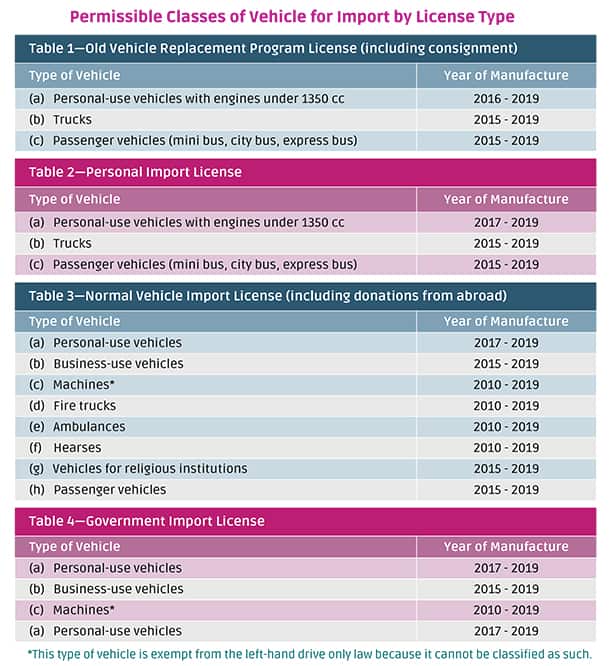
The Notification sets out the following exceptions for permissible vehicle import:

  1. Imports of ambulances and fire trucks that are being donated to the country are permitted only if the vehicle is manufactured in, or after, the year 2007.
  2. Excavators, bulldozers, wheel loaders, vibratory rollers, clamp loaders, motor graders, road-roller compactors, bridge cranes, gantry cranes, tower cranes, pilling machines, crawler drills/cranes, overhead-traveling cranes, mobile cranes, rough-terrain cranes, forklifts, boom lifts, and asphalt finishers that are not going to be driven on public roads, are permitted for importation if the vehicle was manufactured within the last 15 years.
  3. International non-governmental organizations are only allowed to buy from sale centers/showrooms as prescribed above in Table 1 and Table 2.  

The new regulations will come into effect in January 2019, and it is important for companies to take note of the revisions and prepare accordingly.    

Though often considered unpopular, the mandate to only allow the importation of left-hand drive cars is ultimately in the interest of public safety. As a country that drives on the right, left-hand drive cars are safer and more suitable for the people of Myanmar than right-hand drive cars, and their adoption is for the public benefit.

RELATED INSIGHTS​ 

December 4, 2025
Thailand has expanded the circumstances under which state agencies may bypass competitive bidding procedures to address urgent security challenges. On November 28, 2025, Thailand’s Ministry of Finance published the Ministerial Regulation Determining Cases of Procurement by Specific Method (No. 6) B.E. 2568 in the Royal Gazette, introducing a new pathway for procuring supplies and services needed to address cyber and military threats that may affect the stability of government agencies or the nation. For technology vendors, cybersecurity firms, and defense contractors, this regulatory change creates immediate opportunities to engage directly with government buyers facing urgent security challenges. New Fast-Track Category for Security Threats The regulation amends Thailand’s Public Procurement and Supplies Management Act B.E. 2560 (2017) to add a new category of procurement that qualifies for the “specific method”—a noncompetitive, direct selection process. Previously, agencies could use this expedited method only in limited circumstances, such as emergencies, cases with proprietary technology requirements, or national security operations. The new provision explicitly covers procurement of supplies related to preventing or resolving cyber or military threats that could impact the stability of a state agency or the country. This addition recognizes the urgent nature of modern security challenges, where competitive bidding timelines may leave agencies vulnerable during critical threat windows. State agencies dealing with active cyberattacks, preparing defensive measures against anticipated threats, or responding to military security concerns can now move directly to negotiate with qualified vendors rather than conducting lengthy public tender processes. Vendor Considerations Vendors offering cybersecurity solutions now have a regulatory avenue to work directly with government clients when stability concerns are present. These solutions include threat detection systems, anti-ransomware tools, incident response services, firewalls, and security consulting. Similarly, defense contractors providing military equipment or specialized security supplies can pursue direct engagement channels where traditional procurement methods would create
December 4, 2025
Thailand’s Department of Business Development (DBD), through its Office of Central Company and Partnership Registration, has released multiple draft orders for public consultation until December 12, 2025. These draft orders aim to strengthen the business registration process, with a focus on the requirements for establishing and amending the principal office address of a partnership or limited company, verification of authorized signatories, and measures to identify and prevent registrations involving persons linked to suspicious or high-risk activities. The draft orders’ proposed requirements are outlined below. Principal Office Verification The principal office address of a partnership or limited company, including house registration code, house number, full address details, and building name, must be fully aligned with the civil registry. The registrar will strictly verify this before accepting any registration or amendment. If the address used for registration is already registered for at least five other companies, the company must submit a consent letter from the person authorized to allow use of the principal office, along with supporting documents proving the right to use the address. Signatory Certification Compliance Duties Persons certifying directors’ signatures on registration forms are responsible for verifying their identities, maintaining up-to-date information, and complying with the requirements of the DBD’s Biz Regist digital registration system. Certain supporting documents proving the qualifications of certifying persons are also required, with some exceptions for specific professional roles. Identity and qualification verification must be renewed upon the completion of one year from the date of registration as a certifying person, or if the certification credentials expire before the one-year period ends, in accordance with the verification requirements. Verification of Suspicious Parties Any partner, shareholder, or director linked to a predicate offense will be required to meet with the registrar in person for further verification steps. For all parties related to a company
December 2, 2025
Investing in Mainland Southeast Asia is Tilleke & Gibbins’ essential guide for investors looking to do business in this vibrant region, whether it’s starting operations as a newly established entity or expanding into new territories or business models.
November 28, 2025
On November 26, 2025, the government of Vietnam issued Resolution No. 8/2025/NQ-CP to extend and expand the pilot program allowing Vietnamese citizens who meet certain conditions to gamble at three integrated casino resorts in Vietnam: Corona Resorts & Casino Phu Quoc (An Giang Province) – Effective immediately, and continuing an ongoing pilot program that started in 2019. The Grand Casino Ho Tram (Ho Chi Minh City) – New pilot program for five years starting November 26, 2025. Van Don Integrated Casino & Tourism Complex (Quang Ninh Province) – New pilot program for five years from the date the casino receives its license. The pilot program was originally established under Decree No. 03/2017/ND-CP on casino business, which also sets out the specific eligibility conditions for Vietnamese citizens. After the pilot period, these projects must stop allowing Vietnamese players until the government issues further decisions. This expansion of the pilot program comes after Vietnam’s Ministry of Finance (MOF) released a draft decree earlier this year proposing significant changes to the regulatory framework governing casino operations. These revisions, which focus on increasing fiscal contributions from local players and strengthening compliance obligations for casino operators nationwide, are detailed below. Proposed Increase in Casino Entry Fees for Vietnamese Players The draft decree increases the entry fees applicable to Vietnamese citizens permitted to play at casinos. Under the current regulations, Vietnamese players are required to pay an entry fee of VND 1 million (approx. USD 38) for 24 consecutive hours or VND 25 million (approx. USD 950) per month. The draft decree proposes increasing these fees to VND 2.5 million (approx. USD 95) for 24 consecutive hours and VND 50 million (approx. USD 1,900) per month, effectively doubling the existing amounts and marking the first major fee revision since the pilot program allowing Vietnamese players