
You are using an outdated browser and your browsing experience will not be optimal. Please update to the latest version of Microsoft Edge, Google Chrome or Mozilla Firefox. Install Microsoft Edge

May 25, 2018

Myanmar Opens Retail and Wholesale Business to 100% Foreign-Owned Companies

Informed Counsel

On May 9, 2018, Myanmar’s Ministry of Commerce (MoC) issued Directive 25/2018 (the Directive) permitting 100% foreign-owned companies, and joint venture companies established between Myanmar citizens and non-Myanmar citizens, to conduct retail or wholesale business in Myanmar, provided that they meet minimum initial investment requirements, register with the MoC, and comply with certain operational restrictions.

Initial Investment Capital

To qualify under the Directive, companies must meet certain minimum initial investment requirements. Foreign-owned companies, and joint ventures in which Myanmar citizens own less than 20% of the direct share equity, require more initial investment capital than companies with 20% or more direct share equity owned by Myanmar citizens, as detailed below.

Minimum Initial Investment for Retail and Wholesale Business in Myanmar
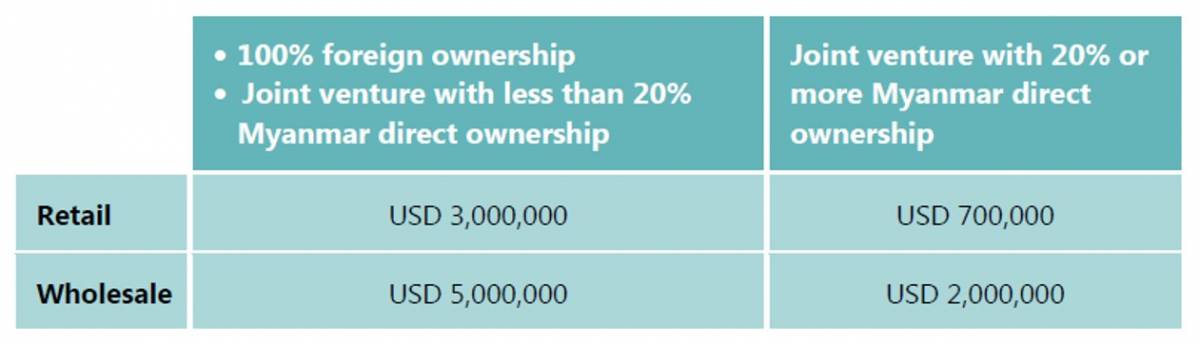
For the purposes of the Directive, initial investment capital does not include the cost of leasing land.

MoC Registration

Any company intending to operate a retail or wholesale business under the Directive must register with the MoC by supplying the following documents:

  • Certificate of company registration
  • Copy of the company’s Myanmar Investment Commission (MIC) endorsement, (or MIC permit if the company falls under the MIC permit requirement scheme)
  • Recommendation letter from the relevant City Development Committee or Township Development Committee of the region or state
  • Lists of group of goods to be sold retail or wholesale
  • Detailed descriptions of the business plan prescribing the amount of initial capital investment, the location, and the area to be occupied in square meters

Any existing company registered under the Directive that wishes to open a new branch or outlet must provide 90-days’ notice to the MoC.

In addition, the Directive expressly entitles Myanmar citizens to operate retail or wholesale businesses with any amount of initial investment capital. However, if these businesses are already in operation, and their initial investment capital was equivalent to USD 700,000 or more, they must register with the MoC within 150 days of the issuance of the Directive.

Operational Restrictions

Companies established under the Directive must not:

  • operate a retail or wholesale premises, including minimarkets and convenience stores, with a floor area of less than 929 square meters;
  • operate a business outside the times, days, and location prescribed by the development committee of the relevant region, state, city, or other local authorities;
  • distribute unsafe or substandard goods in breach of relevant laws; or
  • sell goods prohibited under the law.

In addition, companies have a duty to cooperate with the MoC to support their efficient supervision and enforcement of the law.

This represents a major relaxation of business operational requirements in the Myanmar retail sector, and opens the door for large-scale foreign investment in this burgeoning economy.

RELATED INSIGHTS​ 

March 31, 2026
On December 10, 2025, the National Assembly of Vietnam adopted Law on Vocational Education No. 124/2025/QH15, which took effect on January 1, 2026, replacing Law on Vocational Education No. 74/2014/QH13 of 2014. The new law broadens the categories of institutions eligible to deliver vocational training, introduces vocational upper secondary schools, and shifts governance structures for private institutions from ownership-representative boards of management to stakeholder-based school councils. These reforms aim to diversify training providers, align programs with labor market needs, and create a more flexible, open vocational education ecosystem, offering expanded opportunities for foreign and domestic investors, universities, and enterprises. Some highlights of the new Law on Vocational Education are presented below. Expansion of Vocational Training Levels and Programs In addition to elementary, intermediate, and college—the three levels of vocational training program set out under the 2014 Law on Vocational Education—the new law expands the structure by introducing two new levels: Vocational high school training programs are placed between elementary and intermediate levels, and are aimed at combining upper secondary education with vocational training, expanding options for learners after graduating from the lower secondary level. Other vocational training programs are not specified in detail under the new law, but aim to equip learners with the capability to perform and handle one or several simple tasks of an occupation. Expansion of Vocational Education Providers The new law reclassifies and extends vocational education providers by classifying them into two distinct categories: Vocational education institutions, which include colleges, intermediate schools, and vocational high schools. Establishments participating in vocational education activities, which include vocational education centers, vocational-continuing education centers, continuing education centers, other centers with vocational education functions, enterprises, cooperatives, and higher education institutions. Vocational education providers may provide one vocational training level only, or several/all levels, depending on the type of provider. The
March 31, 2026
Thailand’s Office of the Consumer Protection Board has opened a public hearing period on draft regulations governing the transfer of direct sales and direct marketing businesses. The draft Notification of the Direct Sales and Direct Marketing Committee: Criteria and Procedures for Business Transfer and Amendment of Registration for Direct Sales or Direct Marketing Businesses establishes a compliance-focused process with strict documentation requirements and timelines for transferring direct sales and direct marketing businesses. The proposed framework also defines the roles of transferors and transferees and establishes application procedures with the Office of the Consumer Protection Board. Applications may be submitted in person or electronically and will be examined to confirm they are complete, authentic, and compliant with legal requirements. This includes verification that: The transferee meets all required qualifications; No disqualifying factors apply; and The applicant is not subject to legal restrictions. The public hearing period is open until April 29, 2026. Direct sales and direct marketing business operators should prepare for these proposed requirements to ensure compliant implementation once the regulations are finalized.
March 27, 2026
Thailand’s National Broadcasting and Telecommunications Commission (NBTC) has publicly indicated that it is preparing a new regulatory framework for data center operators that may introduce foreign-ownership restrictions. In particular, the NBTC is considering reclassifying data center operations from a type 1 telecommunications business license to a type 3 license. If implemented, this change would subject data center operators to a significantly more stringent regulatory regime, especially in relation to foreign ownership and control. The NBTC has indicated that it intends to propose a draft framework to the NBTC board. This would be followed by a public hearing process, with a view to implementing the new rules within 2026. Under the Telecommunications Business Act B.E. 2544 (2001), as amended, telecommunications businesses operating under type 3 licenses are subject to foreign ownership restrictions, including a requirement that less than 50% of the total issued shares be held by foreign shareholders. In addition, type 3 licensees are subject to foreign dominance restrictions, which prohibit arrangements that allow foreigners to dominate the business. These foreign dominance restrictions are broad in scope and may capture various forms of direct and indirect control or influence. This includes circumstances in which a foreign national is able to influence or control the formulation of policy, management, or business operations, or the appointment of directors or senior executives. At this stage, the exact scope of the proposed rules remains unclear. Businesses with existing or planned data center operations in Thailand should therefore monitor upcoming NBTC developments in this regard and prepare for the expected public hearing process.
March 23, 2026
In March 2026, the Myanmar Investment Commission (MIC) introduced two regulatory updates affecting investors planning new investments or implementing MIC-approved projects. Minimum Investment Conditions for Tax Incentives MIC Notification No. 1/202 clarifies the minimum conditions for investments in promoted sectors to qualify for tax exemptions or relief under the Myanmar Investment Law. The notification establishes the following requirements: Investors must contribute at least 35% of the total investment amount in cash, as reflected in the relevant proposal or endorsement application. Where an investment involves a foreign loan, the investor must obtain approval from the Central Bank of Myanmar, together with a loan repayment schedule, and provide evidence that both the foreign loan proceeds and the capital contribution have been remitted in cash through an authorized dealer bank. Chinese Yuan Accepted for Investment Capital The MIC also issued Investment News Bulletin No. 1/2026, confirming that Chinese yuan (CNY) is now accepted as foreign investment capital for applications for MIC permits and endorsements, in addition to US dollars (USD). Investment funds contributed in CNY may be remitted through banks authorized to deal in foreign currency in CNY, following the same process currently applied to investments made in USD. These developments may affect how foreign investment capital is structured and remitted, as well as the availability of tax incentives for investments under the MIC framework.