
You are using an outdated browser and your browsing experience will not be optimal. Please update to the latest version of Microsoft Edge, Google Chrome or Mozilla Firefox. Install Microsoft Edge

May 25, 2018

Myanmar Opens Retail and Wholesale Business to 100% Foreign-Owned Companies

Informed Counsel

On May 9, 2018, Myanmar’s Ministry of Commerce (MoC) issued Directive 25/2018 (the Directive) permitting 100% foreign-owned companies, and joint venture companies established between Myanmar citizens and non-Myanmar citizens, to conduct retail or wholesale business in Myanmar, provided that they meet minimum initial investment requirements, register with the MoC, and comply with certain operational restrictions.

Initial Investment Capital

To qualify under the Directive, companies must meet certain minimum initial investment requirements. Foreign-owned companies, and joint ventures in which Myanmar citizens own less than 20% of the direct share equity, require more initial investment capital than companies with 20% or more direct share equity owned by Myanmar citizens, as detailed below.

Minimum Initial Investment for Retail and Wholesale Business in Myanmar
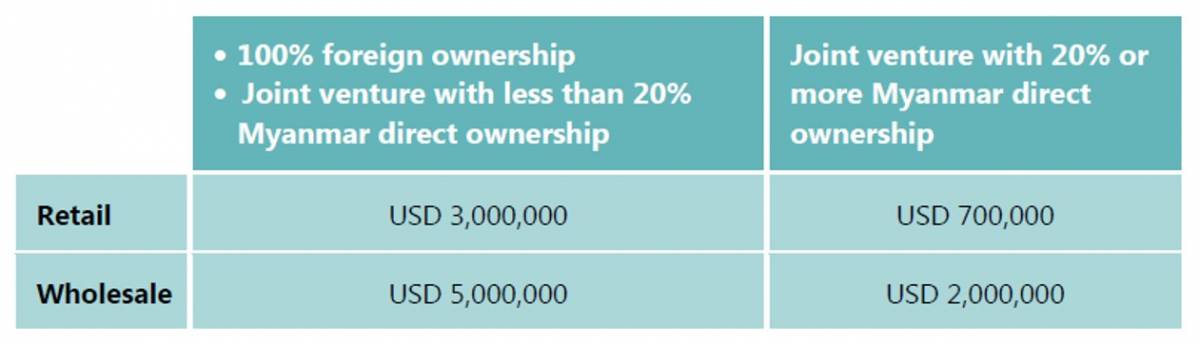
For the purposes of the Directive, initial investment capital does not include the cost of leasing land.

MoC Registration

Any company intending to operate a retail or wholesale business under the Directive must register with the MoC by supplying the following documents:

  • Certificate of company registration
  • Copy of the company’s Myanmar Investment Commission (MIC) endorsement, (or MIC permit if the company falls under the MIC permit requirement scheme)
  • Recommendation letter from the relevant City Development Committee or Township Development Committee of the region or state
  • Lists of group of goods to be sold retail or wholesale
  • Detailed descriptions of the business plan prescribing the amount of initial capital investment, the location, and the area to be occupied in square meters

Any existing company registered under the Directive that wishes to open a new branch or outlet must provide 90-days’ notice to the MoC.

In addition, the Directive expressly entitles Myanmar citizens to operate retail or wholesale businesses with any amount of initial investment capital. However, if these businesses are already in operation, and their initial investment capital was equivalent to USD 700,000 or more, they must register with the MoC within 150 days of the issuance of the Directive.

Operational Restrictions

Companies established under the Directive must not:

  • operate a retail or wholesale premises, including minimarkets and convenience stores, with a floor area of less than 929 square meters;
  • operate a business outside the times, days, and location prescribed by the development committee of the relevant region, state, city, or other local authorities;
  • distribute unsafe or substandard goods in breach of relevant laws; or
  • sell goods prohibited under the law.

In addition, companies have a duty to cooperate with the MoC to support their efficient supervision and enforcement of the law.

This represents a major relaxation of business operational requirements in the Myanmar retail sector, and opens the door for large-scale foreign investment in this burgeoning economy.

RELATED INSIGHTS​ 

August 11, 2026
Cambodia’s Ministry of Justice has launched a new platform on its official website to publish notices of forced sales issued by each municipal and provincial court of first instance. The platform’s stated purpose is to inform the public and facilitate greater participation in forced-sale auctions conducted in connection with court-ordered enforcement proceedings. How the Platform Works The platform publishes forced-sale notices from courts of first instance across Cambodia’s municipalities and provinces and includes a link where the public can view properties currently subject to forced sale. To participate in a forced-sale auction, individuals can download Khmer-language bidding application forms through links provided on the platform. The form typically requires the applicant’s name, sex, year of birth, identity card number and issue date, and address, together with details identifying the immovable property (including its ownership certificate number), the relevant enforcement case number and date, and the reference to the public auction or tender announcement issued by the court. Completed application forms must be submitted directly to the specific municipal or provincial court that issued the forced sale. For further inquiries about a particular forced sale, interested parties should likewise contact the relevant municipal or provincial court. Forced Sale of Immovable Property in Cambodia The publication of these notices relates to the forced sale procedure for immovable property under Cambodia’s Code of Civil Procedure (CPC). Unlike property seizure by a court, a forced sale is a compulsory execution proceeding—a subsequent enforcement step that arises only after an underlying dispute has been adjudicated and a debtor fails to pay the debt or outstanding amount due under a final and binding judgment or other enforceable title of execution. For the purposes of this procedure, the term “immovable property” under the CPC refers to land, registered buildings, jointly held shares of such property, registered
July 15, 2026
On July 8, 2026, Thailand enacted a new law significantly expanding the framework for government service delivery and licensing facilitation. The Facilitation of Licensing and Public Services Consideration Act B.E. 2569 (2026) (Facilitation Act 2026) replaces and expands the framework of governmental services under the Facilitation of Official Licensing Consideration Act B.E. 2558 (2015) (Facilitation Act 2015) and broadens its scope to cover public services, administrative processes, and public benefits. The Facilitation Act 2026 aims to modernize government services by promoting e-filing, reducing administrative burdens and repeated document requests, and improving predictability. For businesses, this should ease compliance and shorten approval timelines, subject to implementing regulations and agency readiness. Public Services Facilitation Scope The Facilitation Act 2015 applied mainly to permissions, registrations, and notifications required before conducting activities that require licenses, certificates, permits, approvals, or registrations. The Facilitation Act 2026 broadens this framework to include public services and other benefits, such as welfare, subsidies, and grants, provided to Thai citizens, expanding government agencies’ responsibilities beyond licensing facilitation into a wider administrative-service framework. It also introduces a broader definition of “government agency” to include central, regional, and local government bodies, state enterprises, public organizations, and other state entities. Licensing Changes The Facilitation Act 2026 introduces a “super license” (termed a “main license” under the act) that exempts the holder from obtaining multiple related or ancillary licenses issued by different government agencies. Obtaining a super license deems the licensee to have automatically obtained the related “sublicenses” required to conduct the relevant activities. The cabinet will designate eligible activities by royal decree. The act also introduces an expedited licensing option, allowing applicants to pay an additional fee to fast-track their applications in urgent cases. Expedited processing must not interfere with standard application timelines. The criteria, procedures, conditions, and fees for expedited licensing
July 10, 2026
Vietnam has taken a significant step in regulating its e-commerce sector with the issuance of a new decree guiding the country’s recently enacted Law on E-Commerce. Decree No. 248/2026/ND-CP, issued on June 30, 2026, and taking effect the following day, addresses mandatory platform policies, registration requirements for offshore platforms, additional obligations on platform operators, and market access conditions for foreign investors. Mandatory Policy Contents The decree sets out detailed guidance on the required contents of various platform policies, covering pricing, payment, display priority, livestream sales, delivery, returns, method of service provision, and service termination and refunds. Clarification of Obligations for Platform Operators The decree provides clarification of the obligations applicable to platform operators. Notably, intermediary e-commerce platform operators with online ordering functions must: Collect specific information to implement electronic identity verification of sellers; Cooperate with regulators by reporting online through the state e-commerce management system and by blocking, suspending, or removing content upon request of a competent authority; Maintain a mechanism to store contract data, including price, product or service information, and parties’ information, for at least three years from the date of contract conclusion; and If qualifying as a “large digital platform” under consumer protection law, maintain an online system for receiving and handling complaints and requests, and comply with enhanced content-removal requirements. Registration Requirements for Offshore Platforms Offshore e-commerce platforms, whether direct-sales, intermediary, social-network-based, or integrated, that conduct e-commerce activity in Vietnam must register with the Ministry of Industry and Trade if the platform: Allows Vietnamese-language selection; Uses a “.vn” domain; or Reaches 100,000 or more transactions with Vietnam-based buyers within a calendar year. Notably, the registration requirement now captures not only traditional intermediary platforms, but also direct-sales platforms. Foreign Investment Conditions Foreign investors holding a controlling interest in an intermediary e-commerce platform, a social media platform
June 23, 2026
Thailand’s Board of Investment (BOI) has significantly revised its post-approval compliance framework for projects that receive investment promotion incentives, replacing the previous semiannual reporting system for project progress with a new quarterly reporting regime. The initial report is due by July 30, 2026, covering the second-quarter reporting period of April to June 2026. The new requirements—implemented through BOI Announcement No. 8/2569 and Office of the BOI Notification No. Por. 8/2569, both of which became effective on March 30, 2026—apply both to newly promoted projects and to existing promoted projects that remain in the implementation stage. Background Under the previous reporting framework, BOI-promoted companies that had not yet commenced full operations were generally required to submit reports on project progress to the BOI twice a year (February and July) through the BOI’s e-Monitoring system. By adopting a quarterly reporting regime, the BOI seeks to strengthen monitoring and evaluation of investment progress and project implementation. Reporting Requirements Under the new regulations, BOI-promoted companies must submit project progress reports on a quarterly basis during the implementation phase of a promoted project. The reporting periods and submission deadlines are: Q1 (January–March): April 30 Q2 (April–June): July 30 Q3 (July–September): October 30 Q4 (October–December): January 30 of the following year The quarterly reporting obligation runs from the date the BOI promotion certificate is issued until the BOI grants approval for commencement of full operations. For newly promoted projects, no quarterly report is required for the quarter in which the BOI promotion certificate is issued—the first reporting obligation arises in the immediately following reporting period. All project progress reports must be submitted electronically through the BOI’s e-Monitoring system. The existing annual reporting requirement also remains in effect, requiring promoted companies to submit an annual operating results report through the e-Monitoring system by July 31 of