
You are using an outdated browser and your browsing experience will not be optimal. Please update to the latest version of Microsoft Edge, Google Chrome or Mozilla Firefox. Install Microsoft Edge

May 25, 2018

Myanmar Opens Retail and Wholesale Business to 100% Foreign-Owned Companies

Informed Counsel

On May 9, 2018, Myanmar’s Ministry of Commerce (MoC) issued Directive 25/2018 (the Directive) permitting 100% foreign-owned companies, and joint venture companies established between Myanmar citizens and non-Myanmar citizens, to conduct retail or wholesale business in Myanmar, provided that they meet minimum initial investment requirements, register with the MoC, and comply with certain operational restrictions.

Initial Investment Capital

To qualify under the Directive, companies must meet certain minimum initial investment requirements. Foreign-owned companies, and joint ventures in which Myanmar citizens own less than 20% of the direct share equity, require more initial investment capital than companies with 20% or more direct share equity owned by Myanmar citizens, as detailed below.

Minimum Initial Investment for Retail and Wholesale Business in Myanmar
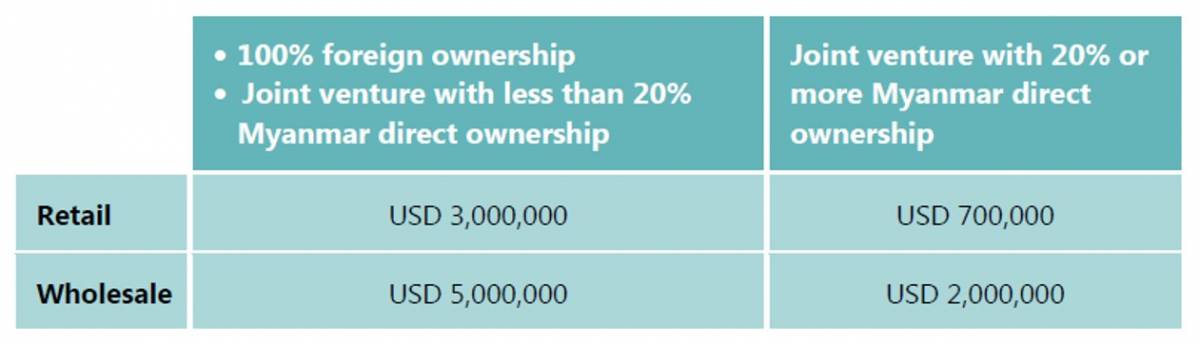
For the purposes of the Directive, initial investment capital does not include the cost of leasing land.

MoC Registration

Any company intending to operate a retail or wholesale business under the Directive must register with the MoC by supplying the following documents:

  • Certificate of company registration
  • Copy of the company’s Myanmar Investment Commission (MIC) endorsement, (or MIC permit if the company falls under the MIC permit requirement scheme)
  • Recommendation letter from the relevant City Development Committee or Township Development Committee of the region or state
  • Lists of group of goods to be sold retail or wholesale
  • Detailed descriptions of the business plan prescribing the amount of initial capital investment, the location, and the area to be occupied in square meters

Any existing company registered under the Directive that wishes to open a new branch or outlet must provide 90-days’ notice to the MoC.

In addition, the Directive expressly entitles Myanmar citizens to operate retail or wholesale businesses with any amount of initial investment capital. However, if these businesses are already in operation, and their initial investment capital was equivalent to USD 700,000 or more, they must register with the MoC within 150 days of the issuance of the Directive.

Operational Restrictions

Companies established under the Directive must not:

  • operate a retail or wholesale premises, including minimarkets and convenience stores, with a floor area of less than 929 square meters;
  • operate a business outside the times, days, and location prescribed by the development committee of the relevant region, state, city, or other local authorities;
  • distribute unsafe or substandard goods in breach of relevant laws; or
  • sell goods prohibited under the law.

In addition, companies have a duty to cooperate with the MoC to support their efficient supervision and enforcement of the law.

This represents a major relaxation of business operational requirements in the Myanmar retail sector, and opens the door for large-scale foreign investment in this burgeoning economy.

RELATED INSIGHTS​ 

September 28, 2026
Thailand has expanded the mandatory use of the Electronic Government Procurement (e-GP) system to cover submissions of procurement appeals to all government agencies subject to the Public Procurement and Supplies Administrative Act B.E. 2560 (2017) (Government Procurement Act). The expansion, which was set out in an official circular dated September 16, 2026, from the Public Procurement and Supplies Administrative Ruling Committee, takes effect on October 1, 2026. Notable Changes Under the expanded framework, bidders challenging an e-bidding or selective-method procurement result must file their appeal exclusively through e-GP within seven working days of the result being announced by the Comptroller General’s Department. While the system accepts filings around the clock during that window, submissions on the final day must be fully completed by 16:30 according to the e-GP system clock—merely starting a draft or uploading materials before the cutoff does not count as a confirmed submission. Government agencies that disagree with an appeal, in whole or in part, will also report their findings and supporting documents to the Appeals Committee through e-GP using the prescribed Appeal Opinion Report, also within seven working days of receipt. Withdrawals of appeals must likewise follow prescribed e-GP steps that vary depending on whether the matter is still under agency review, has been forwarded to the Appeals Committee, or has already been resolved. Excluded Categories Certain categories of procurement are not subject to the new guidelines on filing appeals electronically. These include: Procurement of supplies for confidential government use. Procurement conducted by government agencies operating overseas where the bidder is a foreign legal entity with no legal representative in Thailand, or where the bidder is a non-Thai national. Consulting service procurement under chapter 7 of the Government Procurement Act Design or construction supervision procurement under chapter 8 of the Government Procurement These exclusions apply
September 15, 2026
The Myanmar Investment Commission (MIC) has issued a notification that gives investors with projects in Myanmar clearer guidance for securing approval and for changing, expanding, or exiting an approved project. Issued on August 19, 2026, MIC Notification No. 5/2026 replaces MIC Notification No. 26/2021 and sets procedures for state or regional investment committees to review, approve, and supervise investment projects, including project amendments, investment increases, land-use rights applications, compliance inspections, and suspension or termination of approved businesses. Endorsement Application Timeline and Deemed Acceptance In Myanmar, prospective investors seeking approval under the Myanmar Investment Law generally do so through an MIC permit or an MIC endorsement, depending on the nature of the investment. While certain large-scale investment projects require an MIC permit, projects that are not required to obtain an MIC permit may instead apply for an MIC endorsement. Investors seeking MIC endorsement for their planned projects typically submit their applications to the relevant state or regional investment committee. These committees are established under the Myanmar Investment Law and are authorized to approve investments of less than USD 5 million, subject to the project’s nature and location. MIC Notification No. 5/2026 specifies that upon receiving an endorsement application, the relevant investment committee office will check it for completeness and determine whether it can be considered at the state or regional level or must be referred to the MIC; if it must be forwarded to the MIC, this will be done within 10 working days. If an application is within its purview, the committee may reject the endorsement application within 15 working days of receipt; otherwise, the application is deemed accepted. If approved, the endorsement certificate will be issued within 10 working days of the approval decision, subject to applicable procedures. Endorsement Certificate Amendment The notification clarifies which amendments a state
September 9, 2026
Certain securities, derivatives, and treasury activities in Thailand were opened to foreign investors when Thailand’s Ministry of Commerce published two new ministerial regulations in the Government Gazette on August 28, 2026. The regulations significantly broaden the service activities that foreign-owned businesses may conduct without a license or certificate under the Foreign Business Act B.E. 2542, as amended (FBA). Securities and Derivatives Business Exemptions Prior to the issuance of these ministerial regulations, the exemptions covered (1) securities brokerage and derivatives brokerage with their only underlying assets being agricultural commodities, financial instruments, and securities; and (2) dealers, advisers, and fund managers conducting derivatives business under Thailand’s derivatives laws. The ministerial regulations provide broader exemptions. In addition to derivatives under the laws on derivatives as before, the following two major categories are provided: Derivatives whose underlying assets or variables fall outside the scope of Thailand’s laws on derivatives. This addresses a gap in the previous framework, which did not comprehensively exempt derivatives tied to nonregulated underlying assets or variables, such as certain commodities. Foreign brokers, advisors, and fund managers can now facilitate a broader range of hedging and risk management instruments without triggering FBA licensing requirements. Derivatives traded outside a derivatives exchange, or over the counter (OTC), whose payments are calculated by reference to foreign exchange rates or interest rates. This removes an FBA licensing barrier for foreign providers of widely used OTC hedging products, broadening the solutions available to importers and exporters managing currency exposure and to borrowers seeking greater certainty over financing costs. The ministerial regulations also exempt brokers and agents handling transactions involving either of these two derivatives categories. For securities businesses, the ministerial regulations add exemptions for margin loans used to purchase securities and for securities repurchase transactions. These additions clarify whether such activities qualify as exempt brokerage
September 4, 2026
Foreign business restrictions on telecommunications, treasury center businesses, and intragroup support services were eased when Thailand published the Ministerial Regulation Prescribing Service Businesses Not Requiring Permission for Foreign Business Operations (No. 5) B.E. 2569 (2026) in the Government Gazette on August 28, 2026. The ministerial regulation expands the categories of service businesses that foreign investors may operate without a foreign business license (FBL) under the Foreign Business Act B.E. 2542 (1999) (FBA). Of particular relevance to the telecommunications, fintech, and technology sectors, the ministerial regulation exempts: Type 1 telecommunications licensees, which do not have their own networks; Treasury center businesses operated in accordance with Thailand’s exchange control regulations; and Certain intragroup administrative, human resources, and information technology management services. Telecommunications Services Foreign-owned businesses providing telecommunications services under a type 1 telecommunications license may now operate without obtaining an FBL. This may streamline market entry for qualifying telecommunications and digital infrastructure businesses. The exemption applies only to the FBA licensing requirement. Operators must continue to comply with applicable requirements under the Telecommunications Business Act and the regulations of the National Broadcasting and Telecommunications Commission, and the change does not affect foreign ownership restrictions applicable to type 2 or type 3 telecommunications businesses. Treasury Center Businesses The ministerial regulation also exempts qualifying treasury center businesses from the FBL requirement. This may facilitate centralized treasury functions in Thailand, including liquidity management, foreign exchange management, and intragroup funding arrangements. Treasury center operations remain subject to applicable requirements of the Bank of Thailand and other competent authorities. Intragroup Administrative, HR, and IT Services Certain administrative, human resources, and information technology management services provided between affiliated entities are also exempt, provided the relevant entities satisfy prescribed ownership or management criteria. The exemption is available where the service provider and recipient are related through specified ownership