
You are using an outdated browser and your browsing experience will not be optimal. Please update to the latest version of Microsoft Edge, Google Chrome or Mozilla Firefox. Install Microsoft Edge

November 5, 2018

Myanmar-Language Labeling Required on Wide Range of Products

Myanmar’s Central Committee for Consumer Protection issued Notification 1/2018 on October 26, 2018, which requires labels containing certain information in Myanmar language, jointly or combined with another language, to be affixed to certain products sold in the country. The notification is intended to ensure the safety of consumers.

The notification states that Myanmar-language labels must contain the following information:

  • Directions for use;
  • Storage instructions;
  • Allergy alerts and/or warnings; and
  • Side effects (if any).

The Myanmar-language label must be affixed to consumer units, jointly or combined with labelling in another language, but the legislation does not cover other packaging, such as display boxes.

The list of priority products that require Myanmar-language labelling, jointly or combined with labelling in another language, is as follows: 
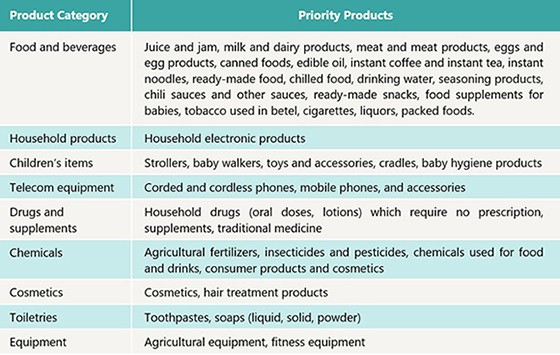
The committee may announce other products to be included in the list in the future.

Companies will have a six-month grace period from the notification date (October 26, 2018) to comply with the new regulation. Any violations after the grace period will leave companies vulnerable to the following sanctions under Section 19 of the Myanmar Consumer Protection Law 2014:

  • warning;
  • severe warning;
  • order to remedy the violation or compensate;
  • temporary prohibition of the sale and distribution of goods in violation;
  • product recall;
  • destruction of goods; and/or,
  • temporary or permanent revocation of business licenses or permits.

RELATED INSIGHTS​ 

July 10, 2023
One of the more positive outcomes of the COVID-19 pandemic is that telemedicine has become remarkably important as an interactive system between patients and healthcare professionals. Thailand, which ranks near the top as a world medical hub, is a highly favored destination in Asia for expat workers. Currently, the Thai market has both Thai-based and foreign-based platforms with information about healthcare providers and telemedicine readily available. “Doctor Locator,” “Weed Map,” and “Find a Teeth Aligner Dentist” are examples of online platforms connecting patients with medical and telemedicine services. These digital platforms provide information about the location of specialized clinics, cannabis dispensaries, pharmacy stores, and orthodontic practitioners in Thailand. These platforms act as intermediaries between medical care businesses and consumers. As actual medical services are not offered or provided, these digital platforms do not have to be regulated under the Medical Facility Act of Thailand. However, healthcare digital platform services that act as an intermediary or conduit managing information used to connect medical clinics or cannabis dispensaries with patients or customers via a computer network are now regulated under the soon-to-be-implemented Royal Decree on Digital Platforms, regardless of whether payment is actually made via the platform. The regulatory authority for this is the Electronic Transactions Development Agency (ETDA). Under this royal decree, digital platform providers that intend to operate a digital platform service must notify the ETDA prior to initiating operations. The extent of the details to be included in the notification to the ETDA will be more comprehensive if the digital platform: has annual revenue (before expenses) for digital platform services within Thailand exceeding THB 1.8 million (approx. USD 51,200) for an individual operator or THB 50 million (approx. USD 1.42 million) for a corporate or entity operator; or has more than 5,000 users (on average) per month. Apart
July 10, 2023
On June 30, 2023, the Ministry of Health of Vietnam issued Circular No. 14/2023/TT-BYT stipulating the process and procedure for building bidding package prices for procurement of goods and services in the field of medical devices at public health facilities (“Circular 14”). Circular 14 took effect on July 1, 2023, and will be valid through the end of 2023. Circular 14 applies to the procurement of medical devices/equipment and their accessories, spare parts, and supplies, as well as related services of repair, maintenance, inspection, and calibration. Under Circular 14, there are three methods of determining the price of bidding packages: Collecting quotations provided by suppliers of goods and services in the field of medical devices. Surveying the winning bid prices of similar goods and services on the national bidding network system (https://muasamcong.gov.vn). Using the results of price appraisal of a competent state agency that conducts price appraisal, or a specialized price appraisal enterprise. Method (i) must be used first; the two remaining methods can be applied only after method (i) has been unsuccessful. If the investor/procuring entity uses two or more methods to determine the price of bidding packages, it can select the highest price that is suitable to its financial capacity and professional requirements. Circular 14 further sets out the specific step-by-step process to build prices for procuring products and services in the field of medical devices/equipment. Transitional Provision For bidding packages that have already approved a contractor selection plan before July 1, 2023, the approved contractor selection plan will be followed. For bidding packages for which a contractor selection plan has been submitted by the investor/procuring entity but the plan has not yet been approved, the competent person can decide on the approval of the submitted plan or can request the investor/procuring entity to rebuild the bidding
July 4, 2023
Practitioners from Tilleke & Gibbins’ Vietnam offices contributed content for the latest edition of the Practical Law Life Sciences Global Guide. The guide provides a comparative overview, in Q&A format, of laws and regulations on pharmaceuticals, medical devices, and other life sciences products in dozens of jurisdictions around the world. The Life Sciences Global Guide is divided into two sections: Regulation (see more details here) and Commercialization, which covers the following topics: Overview of the life sciences sector Pricing, government funding, and reimbursement: National health care system, price regulation and reimbursement Distribution and sale Cross-border trade and parallel imports Advertising to the public and engagement with patient organizations Advertising to healthcare professionals and organizations: Gifts and incentives and transparency and disclosure Patents: Conditions for patentability, registration, length of protection, infringement, international treaties Trademarks: Requirements, registration Competition law issues: Authorities and legislation, commercial contracts and competition law, licensing approvals and formalities Product liability: Regulators, medicinal product liability law, liable partners, defenses, product liability claims, remedies Practical Law, produced by Thomson Reuters, is the world’s leading legal know-how resource for business lawyers, publishing a huge range of guides covering hundreds of jurisdictions and practice areas. The full “Life Sciences Commercialization in Vietnam” section can be found on the Practical Law website.
July 4, 2023
Practitioners from Tilleke & Gibbins’ Vietnam offices contributed content for the latest edition of the Practical Law Life Sciences Global Guide. The guide provides a comparative overview, in Q&A format, of laws and regulations on pharmaceuticals, medical devices, and other life sciences products in dozens of jurisdictions around the world. The Life Sciences Global Guide is divided into two sections: Commercialization (see more details here) and Regulation, which covers the following topics: Pharmaceuticals: Laws and regulatory authorities Clinical trials: Legal, regulatory, and procedural requirements Manufacturing and distribution Marketing: Authorization for marketing medicinal products, monitoring compliance and penalties, pharmacovigilance and other commitments, foreign marketing authorizations Data privacy Packaging, labeling, and tracking Biological medicines Medical devices: Legislation and regulatory authorities, definition and classification Healthcare IT Combination products and borderlines Natural health products Recent developments and reform proposals Practical Law, produced by Thomson Reuters, is the world’s leading legal know-how resource for business lawyers, publishing a huge range of guides covering hundreds of jurisdictions and practice areas. The full “Life Sciences Regulation in Vietnam” section can be found on the Practical Law website.