
You are using an outdated browser and your browsing experience will not be optimal. Please update to the latest version of Microsoft Edge, Google Chrome or Mozilla Firefox. Install Microsoft Edge

November 5, 2018

Myanmar-Language Labeling Required on Wide Range of Products

Myanmar’s Central Committee for Consumer Protection issued Notification 1/2018 on October 26, 2018, which requires labels containing certain information in Myanmar language, jointly or combined with another language, to be affixed to certain products sold in the country. The notification is intended to ensure the safety of consumers.

The notification states that Myanmar-language labels must contain the following information:

  • Directions for use;
  • Storage instructions;
  • Allergy alerts and/or warnings; and
  • Side effects (if any).

The Myanmar-language label must be affixed to consumer units, jointly or combined with labelling in another language, but the legislation does not cover other packaging, such as display boxes.

The list of priority products that require Myanmar-language labelling, jointly or combined with labelling in another language, is as follows: 
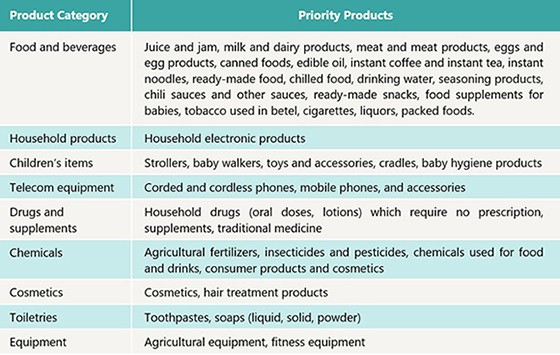
The committee may announce other products to be included in the list in the future.

Companies will have a six-month grace period from the notification date (October 26, 2018) to comply with the new regulation. Any violations after the grace period will leave companies vulnerable to the following sanctions under Section 19 of the Myanmar Consumer Protection Law 2014:

  • warning;
  • severe warning;
  • order to remedy the violation or compensate;
  • temporary prohibition of the sale and distribution of goods in violation;
  • product recall;
  • destruction of goods; and/or,
  • temporary or permanent revocation of business licenses or permits.

RELATED INSIGHTS​ 

December 22, 2014
In association with Lex Mundi, Practical Law Company has published the latest edition in its series of Q&A-style guides to doing business in jurisdictions around the world. The Myanmar chapter, written by Tilleke & Gibbins attorneys, gives an overview of key recent developments affecting doing business in Myanmar as well as an introduction to the legal system; foreign investment, including restrictions, currency regulations and incentives; and business vehicles and their relevant restrictions and liabilities.
December 22, 2014
Practical Law Company, in association with Lex Mundi, has published the latest edition of its Q&A guides to doing business worldwide. The Thailand chapter, authored by Tilleke & Gibbins attorneys, presents an overview of the country’s legal system and the key laws applicable to foreign companies doing business in the Kingdom. In particular, the chapter examines the following main subjects:
August 29, 2014
In response to consumers paying more attention to their dietary nutritional values, the food industry has taken steps to alter its approach to food product labeling. Labels that stipulate nutrient levels in food products (e.g., claiming low fat, high vitamin C, etc.) are now a common sight on food packaging. The Thai Food and Drug Administration (FDA) has, however, set certain criteria that must be met in order to make such nutritional claims and statements.
August 28, 2014
In Thailand, Good Manufacturing Practices (GMP) were first implemented in 1979 for local pharmaceutical manufacturers under the Drug Act 1967 (B.E. 2510). In 1984, the Thai Food and Drug Administration (FDA) campaigned seriously for the pharmaceutical industry, and ultimately managed to update pharmaceutical standards, with the first Guidelines to Good Manufacturing Practices being issued in 1987. Also, as a way to standardize pharmaceutical factories, the Thai FDA began to officially grant GMP Certificates in 1989.