
You are using an outdated browser and your browsing experience will not be optimal. Please update to the latest version of Microsoft Edge, Google Chrome or Mozilla Firefox. Install Microsoft Edge

November 5, 2018

Myanmar-Language Labeling Required on Wide Range of Products

Myanmar’s Central Committee for Consumer Protection issued Notification 1/2018 on October 26, 2018, which requires labels containing certain information in Myanmar language, jointly or combined with another language, to be affixed to certain products sold in the country. The notification is intended to ensure the safety of consumers.

The notification states that Myanmar-language labels must contain the following information:

  • Directions for use;
  • Storage instructions;
  • Allergy alerts and/or warnings; and
  • Side effects (if any).

The Myanmar-language label must be affixed to consumer units, jointly or combined with labelling in another language, but the legislation does not cover other packaging, such as display boxes.

The list of priority products that require Myanmar-language labelling, jointly or combined with labelling in another language, is as follows: 
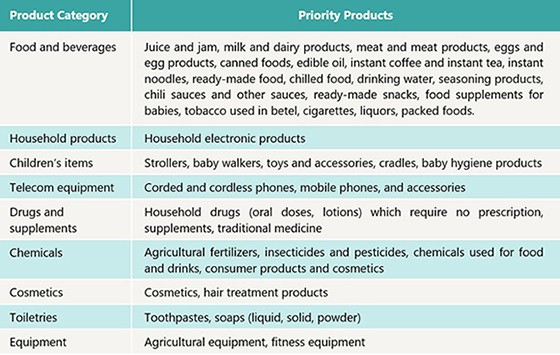
The committee may announce other products to be included in the list in the future.

Companies will have a six-month grace period from the notification date (October 26, 2018) to comply with the new regulation. Any violations after the grace period will leave companies vulnerable to the following sanctions under Section 19 of the Myanmar Consumer Protection Law 2014:

  • warning;
  • severe warning;
  • order to remedy the violation or compensate;
  • temporary prohibition of the sale and distribution of goods in violation;
  • product recall;
  • destruction of goods; and/or,
  • temporary or permanent revocation of business licenses or permits.

RELATED INSIGHTS​ 

July 20, 2018
Tilleke & Gibbins has contributed to the 2018 edition of the Distribution and Marketing of Drugs Global Guide, a Practical Law Company publication covering issues related to the distribution and marketing of drugs across 28 different jurisdictions.Providing their expertise in the guide’s Thailand chapter were Alan Adcock, partner and deputy director, Siraprapha Rungpry, consultant, and Dr. Atthachai Homhuan, regulatory affairs manager, from the Tilleke & Gibbins’ intellectual property group in Thailand. The chapter covers the following topics:
June 28, 2018
On June 19, 2018, Vietnam’s prime minister issued Directive No. 17/CT-TTg on strengthening the fight against smuggling, commercial fraud, and the production and trade of fake goods and low-quality goods for pharmaceuticals, cosmetics, and functional foods (Directive 17). Directive 17 states that, while tens of thousands of cases have been discovered and handled, the situation still needs improvement, as infringers are using more complex methods and are located not only in urban areas, but also in many remote regions.
May 25, 2018
The Medical Facility Act B.E. 2541 (1998) (also known as the Sanatorium Act) was recently amended by the Medical Facility Act (No. 4) B.E. 2559 (2016) which introduced a number of changes to Thailand’s regulation of private medical facilities, e.g. private clinics and hospitals, including those performing plastic surgery. Some of the most notable changes lie in the amended Section 38, which concerns advertisements. Previously, an advertisement for a medical facility was regulated post-publication and did not require any prior approval.
May 25, 2018
Food regulations issued by the Indonesia National Agency of Drug and Food Control (NADFC) are known to be dynamic and prone to change, and the regulations concerning food registration were amended again in late 2017 through the issuance of the Head of NADFC Regulation No. 27 of 2017, which came into force on January 8, 2018.Clarification and Codification of Current Practice