
You are using an outdated browser and your browsing experience will not be optimal. Please update to the latest version of Microsoft Edge, Google Chrome or Mozilla Firefox. Install Microsoft Edge

March 2, 2021

Methods of Stamp Duty Payment in Thailand

Informed Counsel

Like many countries, Thailand requires stamp duty to be paid on the execution of certain legal instruments. A liable person who fails to pay stamp duty on a required instrument can be subject to a maximum surcharge of six times the applicable stamp duty, and an instrument on which stamp duty has not been paid will not be admissible as evidence in civil cases (that is, it will have limited legal weight and enforceability).

Before July 2019, there were three methods for paying stamp duty:

  1. Affixing adhesive stamps on the instrument (and canceling it by the liable person in order to make sure that the adhesive stamp duty cannot be reused);
  2. Having a stamp impressed on the paper instrument; or
  3. Filing a prescribed form and paying the duty by cash or cashiers cheque at an area revenue office.

In addition to paying the correct amount of stamp duty, the law also requires that stamp duty on certain instruments be paid using a specific prescribed method from the list above. Failure to use the prescribed method would be considered as that the stamp duty not having been paid.

For example, a hire-of-work instrument is subject to stamp duty, but if the remuneration stated within the agreement is at least THB 1,000,000 (approximately USD 33,500), the stamp duty must be paid by filing a prescribed form and paying by cash or cashier’s cheque at an area revenue office. Affixing adhesive stamp duty is not allowed in that circumstance.

E-Stamp Duty

In June 2019, the Revenue Department introduced a fourth method of paying stamp duty, allowing online payments in specific circumstances (e-Stamp Duty). After the launch of the e-Stamp Duty system, the Revenue Department issued a notification (Notification of the Director-General of Revenue concerning Stamp Duty (No. 58)) requiring stamp duty on five instruments that are executed in electronic format (e-Instruments), to be paid via the e-Stamp Duty system.

The five e-Instruments are:

  • hire of work service instruments;
  • loan instruments or bank overdraft instruments;
  • powers of attorney (POA);
  • proxy letters for voting at company meetings; and
  • guarantee instruments.

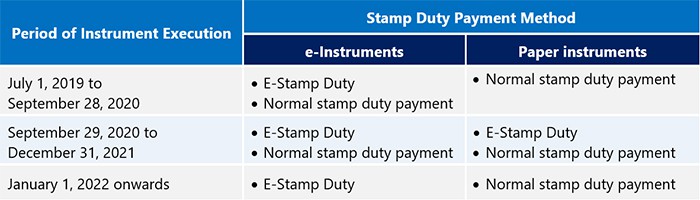
To allow taxpayers to become acquainted with the e-Stamp Duty system, the Revenue Department issued another notification (Notification of the Director-General of Revenue concerning Stamp Duty (No. 59)) which temporarily allowed taxpayers to omit the use of the e-Stamp Duty system by paying stamp duty on these e-Instruments at an area revenue office instead. Originally due to end on December 31, 2020, the measure was extended to December 31, 2021, under Notification of the Director-General of Revenue concerning Stamp Duty (No. 61), and now applies to e-Instruments executed between July 1, 2019 and December 31, 2021.

The Revenue Department also issued a notification allowing taxpayers to use the e-Stamp Duty system to pay stamp duty on the same five instruments executed in the traditional paper format; provided that the instruments are executed during September 29, 2020 to December 31, 2021. Again, this was originally due to end on December 31, 2020 (Notification of the Director-General of Revenue Re: Stamp Duty (No. 60)), but has been extended to December 31, 2020 (Notification of the Director-General of Revenue Re: Stamp Duty (No. 62)).

The table below summarizes the methods of stamp duty payment for the five instrument categories mentioned above.
Practicalities of the e-Stamp Duty System

The e-Stamp Duty system allows taxpayers to pay stamp duty online by filing the prescribed form (Form Or.Sor.9) through the website of the Revenue Department (www.rd.go.th) or the Revenue Department’s Application Programming Interface.

The e-Stamp Duty system allows taxpayers to file Form Or.Sor.9 and pay stamp duty before or within 15 days from the date of instrument execution. As of the date of this article, taxpayers can file a request to pay e-Stamp Duty no earlier than 30 days before the date on which an instrument is executed. If a taxpayer opts to pay e-Stamp Duty after executing an instrument, and the last date of paying stamp duty is due on public holiday, then the due date is extended to the next working day.

For example, if an instrument is due to be executed on March 31, 2021, the liable person can file Form Or.Sor.9 and pay e-Stamp Duty as early as March 2, 2021, or as late as April 16, 2021, (extended from April 15, 2021 which is a public holiday).

Taxpayers should note that the e-Stamp Duty system does not currently support late payment. Therefore, late filing and paying stamp duty will have to be done at an area revenue office.

After a taxpayer submits Form Or.Sor.9, they will receive a QR code and a pay-in-slip which can be used to make the e-Stamp Duty payment to the designated bank account of the Revenue Department.

Once the e-Stamp Duty is duly paid, the Revenue Department will generate a unique receipt code for the taxpayer to use as evidence of payment. This evidence of e-Stamp Duty payment can be downloaded from www.rd.go.th, or from the API (depending on where the taxpayer submitted Form Or.Sor.9).

Taxpayers should maintain the downloaded unique code and receipt for reference in the future. For instruments executed in paper format, taxpayers can maintain the downloaded unique code for reference in the future or print out the unique code and receipt and attach them to the instrument (instead of the usual official endorsement for paying stamp duty in cash at an area revenue office).

RELATED INSIGHTS​ 

July 7, 2025
On June 20, 2025, Cambodia’s Ministry of Economy and Finance issued Instruction No. 19116 to clarify when board members and company directors must receive salaries and pay payroll taxes. Board members and company directors who are not considered employees are subject to a withholding tax. This category consists of people who complete services for a nonresident individual and people who perform independent work for a company in Cambodia. Board members and company directors who are considered employees, including those appointed by a foreign head office to temporarily manage a company in Cambodia, must pay payroll taxes on any salary they receive, regardless of whether they are paid by a local or foreign branch of the company. The above obligations apply regardless of whether the person has a work permit. Board members and company directors are exempt from paying payroll tax if they: Are not present and not performing a regular management role at the company despite being registered on the company’s statutes or patent tax card; Participate only in board meetings and occasional shareholder meetings; and Do not receive a salary from a company in Cambodia. Overall, this instruction provides an important clarification regarding the tax obligations of board members and company directors. Companies should pay attention to the classification of their board members and directors and be mindful of the exemption.   This article was written with the assistance of Tilleke & Gibbins interns Amelia Gemma Erickson and Amrin Keat.
July 2, 2025
On June 17, 2025, Cambodia’s Ministry of Economy and Finance issued Instruction No. 18574 on Tax Obligations for Share Premiums to clarify that enterprises are not required to pay any income tax on share premiums that meet the conditions set out in the instruction. As outlined in the relevant provisions of the Law on Taxation (Royal Kram No. NS/RKM/0523/004) and Prakas No. 578 MEF.PrK.GDT on Tax on Income, taxable income is the difference between an asset’s value at the beginning and end of a period. This calculation deducts capital contributions, which are not taxable. A share premium is the amount of money that a company receives in excess of the par value of a share when the company issues new shares to a shareholder through a share subscription. In other words, share premiums are capital contributions made by shareholders into the equity of the company and, as a result, are not taxable. However, the government may nevertheless view share premiums as taxable if the company fails to meet certain legal conditions. Cambodian law requires share subscriptions to be properly recorded in the company’s accounting books and supported by documentary evidence. The recent instruction states that if an enterprise does not have proper documentation, any increase in equity, such as a capital increase through share premiums, will be treated as taxable income in accordance with the law. The instruction provides the following example: Enterprise A issues 200,000 new shares to an investor. The shares were registered with a par value of KHR 4,000 per share and were sold for a sale price of KHR 10,000 per share. The share premium of KHR 1.2 billion, which is calculated by subtracting the total par value (KHR 800 million) from the total value of the new capital (KHR 2 billion), is a capital
June 11, 2025
Thailand’s tax dispute resolution framework has undergone a significant transformation with the enactment of the Act Establishing the Tax Court and the Procedure for Tax Cases (No. 3) B.E. 2568. Published in the Government Gazette on May 27, 2025, the amended act will come into force on November 24, 2025, which is 180 days after its publication. The amended act marks a pivotal shift in the jurisdiction and procedures of the Tax Court, most notably by empowering it to adjudicate certain criminal tax cases for the first time. Background and Rationale The Tax Court was originally established in 1985 as a specialized forum to handle complex tax disputes, including those related to revenue, customs, and excise taxes. The creation of the Tax Court recognized the need for judicial expertise in tax law, given its technical and specialized nature. The latest amendment is designed to address procedural inefficiencies, modernize court processes, and align Thailand’s tax litigation system with international standards. The reform demonstrates Thailand’s commitment to enhancing the efficiency, transparency, and fairness of its tax dispute resolution mechanisms. Key Amendments and Provisions Six of the key changes in the amendment are highlighted below. Expansion of jurisdiction to criminal tax cases. The most significant change is the extension of the Tax Court’s jurisdiction to include criminal offenses under the Revenue Code, customs law, excise tax law, and other tax-related laws that may be specified by royal decree. New sections in the act explicitly grant the Tax Court authority to hear and decide criminal tax cases, so individuals and entities accused of criminal tax evasion or other tax-related crimes will now have their cases heard by judges with specialized tax expertise. The law also clarifies the Tax Court’s jurisdiction when a single act constitutes multiple offenses (some tax-related, some not) or when
June 3, 2025
On March 12, 2025, Cambodia’s Ministry of Economy and Finance issued Prakas No. 192 on Tax Rules and Procedures for Trust to determine the tax rules and procedures for trust operations. With the exception of trusts whose legal form is a company or enterprise, all trustors, trustees, and beneficiaries engaged in trust operations in Cambodia are subject to this new regulation. Taxpayer Registration A trustee company must register as a medium or large taxpayer. An independent individual trustee must register as a small, medium, or large taxpayer depending on the amount of turnover or the value of the fixed assets of the business, as stipulated in the Prakas on the Clarification of Taxpayers under the Self-Assessment Regime. Independent individual trustees must register as taxpayers within 15 working days from the commencement of economic activity or from the receipt of a license or authorization from the Trust Regulator. Accounting Records Accounting records should follow the rules stipulated in Article 6 of the Law on Taxation., which requires small taxpayers to use simplified accounting, while medium and large taxpayers must adhere to the Cambodian International Financial Reporting Standards (CIFRS).The trustee must maintain separate accounting records between its own operations and the trust. If the trustee manages more than one trust, the trustee must prepare separate records for each trust. For all the records, the trustee must clearly identify the ownership of all assets, liabilities, expenses, and other transactions. Taxation of Trustee’s Income Trust property or funds that are transferred to a trustee for management are not considered income or property of the trustee. However, any allowances or commissions that the trustee receives from managing the trust are taxed as income. The trustee must follow the general rules on expenses outlined under Cambodian tax law to record all income and expenses related