
You are using an outdated browser and your browsing experience will not be optimal. Please update to the latest version of Microsoft Edge, Google Chrome or Mozilla Firefox. Install Microsoft Edge

March 13, 2025

Funding Cuts and Mass Layoffs Due to Financial Stress in Cambodia

The recent freeze on US foreign aid has led to the suspension of billions of dollars in foreign assistance as well as widespread layoffs at contracting organizations around the world. Under this situation, USAID-funded offices in all jurisdictions, including Cambodia, may face the challenge of determining whether they need to lay off their employees.

Employers in Cambodia may take different steps in response to this and other instances of sudden financial stress in order to manage their workforce in accordance with Cambodian laws and regulations.

Suspension

Cambodia’s Labor Law allows employers to suspend employment contracts due to a major economic or material issue or any unexpected difficulty that results in the suspension of operations. To impose this employment contract suspension, the employer must initially submit a suspension request to the Ministry of Labor and Vocational Training (MLVT), detailing the reasons for the requested suspension.

If the reasons are deemed valid and the request is approved, the suspension period cannot exceed two months. During the suspension period, the employer must continue providing accommodation for employees if this benefit is already being provided. In some circumstances, the suspension period can be extended if necessary (as happened during the COVID-19 pandemic).

However, financial difficulties alone may not be a valid reason for extension. The decision is at the discretion of the MLVT labor inspectors on a case-by-case basis. Therefore, given the uncertain timeline of financial difficulties that may significantly impact the employer’s budget, suspending employment contracts might be ineffective.

Mass Layoffs

Under Cambodia’s Labor Law, mass layoffs due to a significant reduction in an establishment’s operation or an internal reorganization foreseen by the employer are permissible.

The layoff order must be based on professional qualifications, seniority period, and family burdens of the employees. The first employees to be laid off must be those with the least professional ability, followed by those with the least seniority. For seniority calculations, married employees must be given an additional year, as well as an additional year for each dependent child.

In addition, employers must inform the employees’ representatives in writing to solicit their suggestions, primarily on measures for announcing employee reductions in advance and minimizing the effects on affected workers.

The mass layoffs procedure is subject to the MLVT’s review and approval. Upon receipt of the request, an MLVT labor inspector may conduct a hearing to examine the impact of the proposed layoffs and measures to be taken to minimize their effects.

Termination

If an employment contract is not terminated by mutual agreement, due to serious misconduct by either party, or force majeure as defined under the Labor Law, the termination must have a valid reason.

Under the Labor Law, “valid reason” may refer to an employee’s aptitude or behavior, based on the requirements of the operation of the establishment. However, if employers face financial difficulties, they may consider declaring bankruptcy.

Declaring bankruptcy can be considered a valid reason and exempts employers from paying damages, as it does not impact an employee’s dignity or cause the public to question their behavior, abilities, or performance. However, declaring bankruptcy has legal implications, as it is governed by the Law on Insolvency and requires court proceedings.

The process involves filing an insolvency complaint with the court, which will review the complaint to determine if the employer is indeed insolvent. In addition, the employer must notify employees about the insolvency proceedings, their rights, and any potential layoffs. Employees can file claims for unpaid wages and other compensation, which are prioritized over other unsecured debts under both the Law on Insolvency and the Labor Law. Employers’ assets can be sold to pay off creditors, with employees being among the first to receive payment.

Damages and Statutory Payments

According to the Notification on Compensation for Terminating an Employment Contract, dated March 21, 2024, employers that terminate an employment contract without a valid reason must pay damages to the employees as follows:

  • For employees under a fixed-duration contract, the damages must be at least equal to the wages the employee would have received if they had completed the original term of the contract.
  • For employees under an unspecified-duration contract, the damages are equal to the seniority payment received during the employment contract.

These damages are in addition to required statutory payments that employees must receive after their contract is terminated, detailed in the table below.
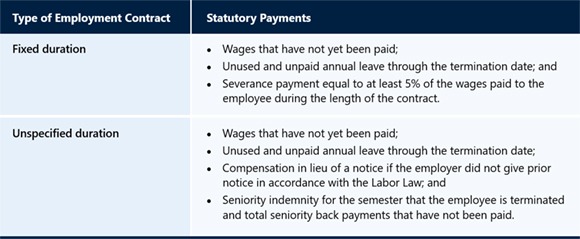
The requirements regarding statutory payments and other compensation dues to employees upon termination of employment were significantly clarified by a notification in March 2024.

Compliance

Organizations forced to consider mass layoffs should consult with legal counsel to ensure compliance with the March 2024 notification and other relevant labor regulations before proceeding with any workforce reduction measures. Proactive communication with both the MLVT and employee representatives will be crucial throughout this process. Furthermore, employers should consider developing contingency plans that account for various timelines of financial recovery, as each approach—whether suspension, mass layoffs, or termination—carries distinct legal obligations and financial implications that extend beyond the immediate crisis period. Organizations that approach these difficult decisions with careful planning and legal diligence will be better positioned to maintain operational stability while fulfilling their obligations to employees during this period of economic uncertainty.


RELATED INSIGHTS​ 

March 18, 2024
Lawyers from Tilleke & Gibbins’ labor and employment team have contributed a new Vietnam chapter to Thomson Reuters Practical Law’s Employment and Employee Benefits Global Guide. The guide provides a high-level comparative overview of employment laws and regulations across various jurisdictions around the world. Tilleke & Gibbins also contributed the Myanmar chapter of the guide. The Vietnam chapter covers a wide range of typical employment matters, such as limitations on working hours, paid leave requirements, minimum wage, and health and safety obligations. In addition, the guide provides insight on a number of topics of special interest to foreign investors doing business in Vietnam, including the following: Mandatory contents of a labor contract; Visas and permits required for expatriate employees; Employers’ obligations for protecting employees’ privacy and personal data; Procedural requirements for the dismissal of an employee; Employer and parent company liability. To view the latest version of Employment and Employee Benefits, please visit the Practical Law website and enroll in the free Practical Law trial to gain full access.
February 28, 2024
The Myanmar Investment Commission (MIC) has announced the opening of the trial period for MIC-permitted or MIC-endorsed companies to reenter investment data for using the Myanmar Investment Online (MyInO) system. The trial period is open until June 30, 2024. The MyInO system allows for the submission and recordal of applications for investment under the Myanmar Investment Law. With the implementation of phase 2 from September 1, 2023, applications for the appointment or resignation of foreign experts and employees within MIC-permitted or MIC-endorsed companies can now be submitted manually or through the Investment Monitoring System available on MyInO. To initiate the application process in MyInO, applicants are required to create an account on the platform. Subsequently, companies holding an MIC permit or endorsement must reenter all investment-related data since the obtaining of the relevant permits/endorsements, in compliance with the announcement. Following this data update, applications can be filed through MyInO. After this trial period, the submission of applications for appointments will be available online. The benefit of using MyInO to submit a foreign expert or employee appointment or resignation application is that the application can be submitted within 30 days of the foreign expert’s arrival in Myanmar. In contrast, hard copy applications must be submitted within seven working days of arrival. According to the Myanmar Investment Law, a foreign expert is one who qualifies as a senior manager, technical or operational expert, or advisor in permitted or endorsed companies within Myanmar. For assistance with completing the investment data reentry process or filing applications for appointment or resignation of foreign experts or employees, or for further details on any aspect of the Investment Monitoring System under MyInO, please contact Tilleke & Gibbins at [email protected].
February 9, 2024
Tilleke & Gibbins employment specialists in Myanmar have contributed an updated Employment and Employee Benefits in Myanmar overview for Thomson Reuters Practical Law, an online publication that provides an overview of employment and employee benefits in jurisdictions worldwide. The Myanmar overview was written by members of Tilleke & Gibbins’ Yangon office, including Yuwadee Thean-ngarm, director; Nwe Oo, senior associate; and Kyaw Min Tun, associate. The chapter covers a wide range of key employment topics, including employment status, background checks, regulation of the employment relationship, minimum wage, working hours and holidays, illness and injury of employees, discrimination and harassment, termination of employment, resolution of employer-employee disputes, redundancy/layoffs, employee representation and consultation, business transfer and insolvency, employee relocation, health and safety obligations, taxation of employment income, intellectual property issues, and more. Practical Law, one of the many legal reference resources from Thomson Reuters, publishes a wide range of guides for hundreds of jurisdictions and practice areas. The Employment and Employee Benefits Global Guide covers 44 jurisdictions around the world, with Tilleke & Gibbins also providing the Vietnam chapter of the guide. To view the latest version of the Employment and Employee Benefits in Myanmar overview, please visit the Practical Law website and enroll in the free Practical Law trial to gain full access.
January 12, 2024
On December 28, 2023, Cambodia’s Ministry of Labor and Vocational Training (MLVT) issued Notification No. 110/23 on the issuance of work permits for foreign employees, in accordance with the country’s Labor Law and Prakas 195 dated August 20, 2014, on work permits and employment cards for foreign employees. This is a more comprehensive notification than existed previously, as it specifically clarifies the parties that are required to apply for work permits and employment cards. Notification No. 110/23 specifies that the following types of foreign individuals must hold a valid foreign work permit and/or employment card in order to work in Cambodia: A foreign employer whose name is stated in an enterprise’s patent tax certificate must hold a foreign work permit. A foreign employee whose name is stated in an enterprise’s patent tax certificate must hold a foreign work permit and an employment card. Self-employed individuals must hold a foreign work permit and an employment card. Applications for work permits and employment cards can be submitted through the MLVT’s online portal, accompanied by the following required documents: Valid passport; Latest patent tax certificate; Physical examination form; and Photo (4×6 cm) However, foreign shareholders and members of the board of directors as defined in the company’s articles of incorporation who do not have a Cambodian resident visa are not required to obtain a work permit or employment card. For more information on regulations and requirements for foreign employees in Cambodia, please contact Tilleke & Gibbins at [email protected].