
You are using an outdated browser and your browsing experience will not be optimal. Please update to the latest version of Microsoft Edge, Google Chrome or Mozilla Firefox. Install Microsoft Edge

March 13, 2025

Funding Cuts and Mass Layoffs Due to Financial Stress in Cambodia

The recent freeze on US foreign aid has led to the suspension of billions of dollars in foreign assistance as well as widespread layoffs at contracting organizations around the world. Under this situation, USAID-funded offices in all jurisdictions, including Cambodia, may face the challenge of determining whether they need to lay off their employees.

Employers in Cambodia may take different steps in response to this and other instances of sudden financial stress in order to manage their workforce in accordance with Cambodian laws and regulations.

Suspension

Cambodia’s Labor Law allows employers to suspend employment contracts due to a major economic or material issue or any unexpected difficulty that results in the suspension of operations. To impose this employment contract suspension, the employer must initially submit a suspension request to the Ministry of Labor and Vocational Training (MLVT), detailing the reasons for the requested suspension.

If the reasons are deemed valid and the request is approved, the suspension period cannot exceed two months. During the suspension period, the employer must continue providing accommodation for employees if this benefit is already being provided. In some circumstances, the suspension period can be extended if necessary (as happened during the COVID-19 pandemic).

However, financial difficulties alone may not be a valid reason for extension. The decision is at the discretion of the MLVT labor inspectors on a case-by-case basis. Therefore, given the uncertain timeline of financial difficulties that may significantly impact the employer’s budget, suspending employment contracts might be ineffective.

Mass Layoffs

Under Cambodia’s Labor Law, mass layoffs due to a significant reduction in an establishment’s operation or an internal reorganization foreseen by the employer are permissible.

The layoff order must be based on professional qualifications, seniority period, and family burdens of the employees. The first employees to be laid off must be those with the least professional ability, followed by those with the least seniority. For seniority calculations, married employees must be given an additional year, as well as an additional year for each dependent child.

In addition, employers must inform the employees’ representatives in writing to solicit their suggestions, primarily on measures for announcing employee reductions in advance and minimizing the effects on affected workers.

The mass layoffs procedure is subject to the MLVT’s review and approval. Upon receipt of the request, an MLVT labor inspector may conduct a hearing to examine the impact of the proposed layoffs and measures to be taken to minimize their effects.

Termination

If an employment contract is not terminated by mutual agreement, due to serious misconduct by either party, or force majeure as defined under the Labor Law, the termination must have a valid reason.

Under the Labor Law, “valid reason” may refer to an employee’s aptitude or behavior, based on the requirements of the operation of the establishment. However, if employers face financial difficulties, they may consider declaring bankruptcy.

Declaring bankruptcy can be considered a valid reason and exempts employers from paying damages, as it does not impact an employee’s dignity or cause the public to question their behavior, abilities, or performance. However, declaring bankruptcy has legal implications, as it is governed by the Law on Insolvency and requires court proceedings.

The process involves filing an insolvency complaint with the court, which will review the complaint to determine if the employer is indeed insolvent. In addition, the employer must notify employees about the insolvency proceedings, their rights, and any potential layoffs. Employees can file claims for unpaid wages and other compensation, which are prioritized over other unsecured debts under both the Law on Insolvency and the Labor Law. Employers’ assets can be sold to pay off creditors, with employees being among the first to receive payment.

Damages and Statutory Payments

According to the Notification on Compensation for Terminating an Employment Contract, dated March 21, 2024, employers that terminate an employment contract without a valid reason must pay damages to the employees as follows:

  • For employees under a fixed-duration contract, the damages must be at least equal to the wages the employee would have received if they had completed the original term of the contract.
  • For employees under an unspecified-duration contract, the damages are equal to the seniority payment received during the employment contract.

These damages are in addition to required statutory payments that employees must receive after their contract is terminated, detailed in the table below.
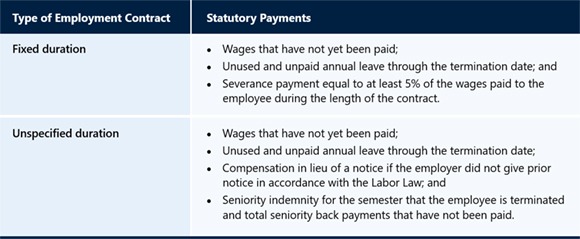
The requirements regarding statutory payments and other compensation dues to employees upon termination of employment were significantly clarified by a notification in March 2024.

Compliance

Organizations forced to consider mass layoffs should consult with legal counsel to ensure compliance with the March 2024 notification and other relevant labor regulations before proceeding with any workforce reduction measures. Proactive communication with both the MLVT and employee representatives will be crucial throughout this process. Furthermore, employers should consider developing contingency plans that account for various timelines of financial recovery, as each approach—whether suspension, mass layoffs, or termination—carries distinct legal obligations and financial implications that extend beyond the immediate crisis period. Organizations that approach these difficult decisions with careful planning and legal diligence will be better positioned to maintain operational stability while fulfilling their obligations to employees during this period of economic uncertainty.


RELATED INSIGHTS​ 

October 1, 2024
Three of Tilleke & Gibbins’ labor and employment specialists in Vietnam have contributed the Vietnam chapter to the newly issued Labor and Employment Disputes 2024, a comprehensive guide from Lexology Panoramic to labor and employment dispute resolution in various jurisdictions around the world. The Vietnam chapter covers the following topics: Pre-action considerations: Key requirements, third-party funding, contingency fee arrangements Issuing a claim: Forum, territorial jurisdiction, standing, commencing claims, fees, service Defendants and legal personality: Types of claims, time limits, counterclaims Case management: Procedure, rules, amendments to claims, adding parties to proceedings, consolidating proceedings Class and collective actions: Special considerations Evidence: Witnesses, tactical considerations Interim relief: Availability, requirements Trial: Hearings conduct and typical time frames, confidentiality and public access, media reporting Elements of successful claims and burden of proof Alternative dispute resolution: Available types, requirements and expectations Enforcement: Collective employment and labor rights, enforcement of collective rights, standing Remedies and enforcement: Available remedies, assessing compensation, enforcement mechanisms Appeals: Appeal procedure and time frames, other means of challenge Update and trends: Recent cases and developments, technology developments, other issues The Vietnam chapter was authored by Truc Thi Thanh, Linh Ngoc Nguyen, and Kien Trung Trinh. Tilleke & Gibbins also contributed the Cambodia and Thailand chapters to Labor and Employment Disputes 2024.
October 1, 2024
Four of Tilleke & Gibbins’ labor and employment specialists in Bangkok have contributed the Thailand chapter to the newly issued Labor and Employment Disputes 2024, a comprehensive guide from Lexology Panoramic to labor and employment dispute resolution in various jurisdictions around the world. The Thailand chapter covers the following topics: Pre-action considerations: Key requirements, third-party funding, contingency fee arrangements Issuing a claim: Forum, territorial jurisdiction, standing, commencing claims, fees, service Defendants and legal personality: Types of claims, time limits, counterclaims Case management: Procedure, rules, amendments to claims, adding parties to proceedings, consolidating proceedings Class and collective actions: Special considerations Evidence: Witnesses, tactical considerations Interim relief: Availability, requirements Trial: Hearings conduct and typical time frames, confidentiality and public access, media reporting Elements of successful claims and burden of proof Alternative dispute resolution: Available types, requirements and expectations Enforcement: Collective employment and labor rights, enforcement of collective rights, standing Remedies and enforcement: Available remedies, assessing compensation, enforcement mechanisms Appeals: Appeal procedure and time frames, other means of challenge Update and trends: Recent cases and developments, technology developments, other issues The Thailand chapter was authored by Eric M. Meyer, Chusert Supasitthumrong, Pathanin Sornchangwat, and Chayathorn Kruatao, all in the Thailand dispute resolution and litigation team. Tilleke & Gibbins also contributed the Cambodia and Vietnam chapters to Labor and Employment Disputes 2024. The full Thailand chapter is available below as a PDF.
August 14, 2024
Myanmar has once again made significant amendments to its minimum-wage framework by introducing additional allowances for both public- and private-sector workers. On August 9, 2024, the National Committee for Setting the Minimum Wage issued Notification No. 1/2024, which entitles private-sector workers to a new additional daily allowance of MMK 1,000 (approximately USD 0.48). This increase is on top of the MMK 1,000 additional daily allowance introduced last year. As a result, workers at private-sector employers with more than 10 employees are now entitled to the base minimum wage of MMK 4,800 plus additional allowances of MMK 2,000, for a total of MMK 6,800 (approximately USD 3.20) per day for an eight-hour workday, effective August 1, 2024. A similar additional allowance had been announced for workers in government departments and organizations on July 26, 2024. Background The MMK 4,800 (approximately USD 2.29) minimum wage for an eight-hour workday (equivalent to MMK 600 per hour) was established in May 2018 for all workers, irrespective of location or job type. In September 2023, the Ministry of Planning and Finance announced an additional daily benefit of MMK 1,000 for workers in government departments and organizations, and on October 9, 2023, the National Committee for Setting the Minimum Wage extended this benefit to workers at private-sector employers with more than 10 employees, bringing the effective minimum daily wage to MMK 5,800 (approximately USD 2.77). These changes took effect on October 1, 2023. Applicability of Additional Allowances for Private-Sector Workers The latest announcement also entitles employees to the base minimum wage and additional allowances for days used from their entitlement to leave and holidays, in accordance with the 1951 Leave and Holidays Act. However, the daily allowances—totaling MMK 2,000—are not to be included when calculating overtime payments. Instead, overtime payments must be calculated based on
August 12, 2024
With the growing prominence of ESG (Environmental, Social, and Governance) factors, businesses in Vietnam are increasingly recognizing their importance in driving global demand, societal impact, and economic value. A comprehensive acknowledgment of ESG-related legal requirements is critical for investors and companies operating in Vietnam to meet stakeholder expectations and ensure compliance. Our guide provides a basic overview of the rapidly evolving ESG landscape in Vietnam, covering a range of key issues for companies doing business in the country: What is ESG, and what does the ESG legal framework look like in Vietnam? Who needs to follow ESG regulations in Vietnam? What are the benefits of ESG compliance? How can enterprises enhance ESG best practices in Vietnam? Please click on the link below to view the full article.