You are using an outdated browser and your browsing experience will not be optimal. Please update to the latest version of Microsoft Edge, Google Chrome or Mozilla Firefox. Install Microsoft Edge

September 7, 2021

Legal Options in Thailand When a Debtor Can’t (or Won’t) Pay Up

COVID-19 and the resulting lockdown measures to limit outbreaks in Thailand have caused significant financial difficulties for many business operators, large and small. Whether a business is a creditor or debtor, there is a high likelihood they have faced or will face a default caused by the pandemic. This article identifies three legal options available when a party defaults—civil cases, bankruptcy actions, and business rehabilitation actions—and compares key elements associated with each option. For context, those three options are defined as follows:

  • Civil case. A legal proceeding in which a creditor files a civil lawsuit (or arbitration claim) against a debtor for debt collection. If a debtor fails to settle a debt in accordance with a judgment, the creditor can ask the court to enforce the judgment by seizure and sale of the debtor’s assets through public auction.
  • Bankruptcy action. A legal proceeding under the Bankruptcy Act in which a government authority can collect a debtor’s assets, sell the assets by public auction, and distribute the net proceeds among creditors. In bankruptcy proceedings, the creditors will receive repayment in proportion to the size of the outstanding debts.
  • Business rehabilitation action. A legal proceeding under the Bankruptcy Act aimed at helping a debtor recover from insolvency and continue its business. Debtors are given debt relief and a “new start” through business rehabilitation, while creditors are able to collect a higher percentage of outstanding debt under rehabilitation than they would under a bankruptcy action.

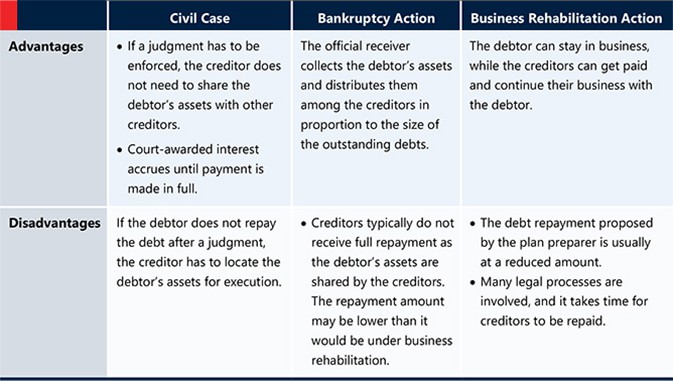
In short, a civil case is a claim in court for repayment of a specific debt, a bankruptcy action results in distribution of the debtor’s assets among the creditors, and a business rehabilitation action aims to enable the debtor to stay in business while repaying their debts to some degree.

A civil case may be appropriate when the debtor defaults on debt repayment and is indebted to only the creditor bringing the action. A bankruptcy action should be considered when the debtor’s liabilities are greater than its assets, and its business cannot continue. Business rehabilitation may be a good option when there is still a reasonable chance of reforming and rebuilding the debtor’s business. The three options also differ in a number of other ways, as laid out below.


Legal Particulars
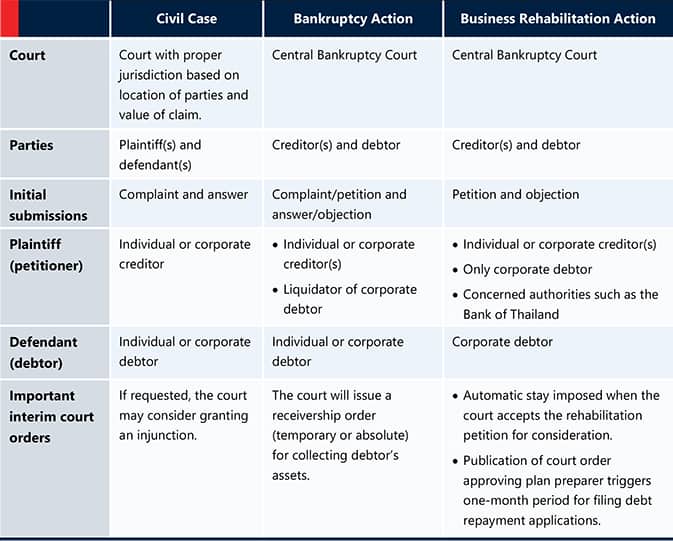
 

Requirements for Initiating Action
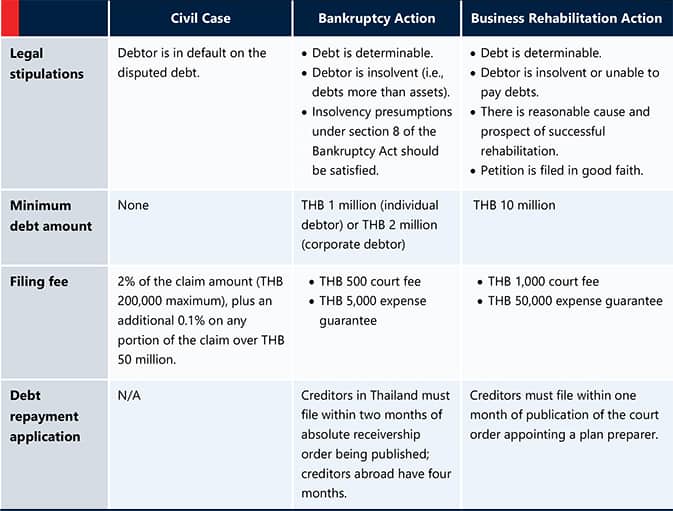
 

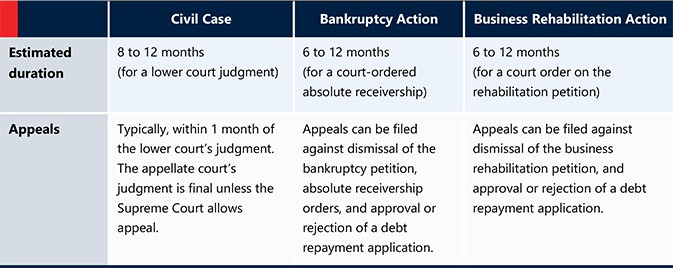
Proceedings
 

Advantages and Disadvantages
 

Conclusion

An essential step in pursuing any of these actions is retaining experienced local counsel who can offer tailored advice. Creditors should consider which of these three legal actions in Thailand best suits their needs and circumstances, and chart their course with the help of their legal advisor in Thailand. As noted above, a civil case might be the right option for a single creditor pursuing repayment, while bankruptcy actions and business rehabilitation are more far-reaching options that may be appropriate when there are serious underlying financial or structural issues affecting the debtor. With the aid of a specialist in debt recovery, bankruptcy, and business rehabilitation in Thailand, the creditor can consider the specific circumstances, lay out and execute a winning strategy, and resolve their debt recovery problems efficiently and cost-effectively.


RELATED INSIGHTS​ 

September 25, 2025
In the Thailand contribution to Labor and Employment Disputes 2026, four members of Tilleke & Gibbins’ Bangkok labor and employment team outline key aspects of dispute resolution in Thailand. Their analysis, part of Lexology Panoramic’s comparative guide covering jurisdictions worldwide, addresses the following areas: Pre-action considerations: key requirements, third-party funding, contingency fee arrangements Issuing a claim: forum, territorial jurisdiction, standing, commencing claims, fees, service, defendants and legal personality, types of claims, time limits, counterclaims Case management: procedure, rules, amendments to claims, adding parties, consolidating proceedings, class and collective actions, evidence, witnesses, tactical considerations Interim relief: availability, requirements Trial: hearings conduct and time frames, confidentiality and public access, media reporting, elements of successful claims and burden of proof Alternative dispute resolution: available types, requirements and expectations, enforcement Collective employment and labor rights: enforcement and standing Remedies and enforcement: available remedies, assessing compensation, enforcement mechanisms Appeals: procedure, time frames, other means of challenge Updates and trends: recent cases and developments, technology developments, other issues The complete Thailand chapter can be downloaded below. Tilleke & Gibbins also contributed the Cambodia and Vietnam chapters to Labor and Employment Disputes 2026. Readers can also gain 30 days of complementary access to the full Labor and Employment Disputes 2026 guide and the rest of Lexology Panoramic’s varied offerings through this link.
September 25, 2025
Four of Tilleke & Gibbins’ labor and employment specialists in Phnom Penh have authored the Cambodia chapter of Labor and Employment Disputes 2026, the latest edition of Lexology Panoramic’s global guide to handling labor and employment disputes. The chapter provides practical insights on a wide range of dispute resolution issues, including: Pre-action considerations: key requirements, third-party funding, contingency fee arrangements Issuing a claim: forum, territorial jurisdiction, standing, commencing claims, fees, service, defendants and legal personality, types of claims, time limits, counterclaims Case management: procedure, rules, amendments to claims, adding parties, consolidating proceedings, class and collective actions, evidence, witnesses, tactical considerations Interim relief: availability, requirements Trial: hearings conduct and time frames, confidentiality and public access, media reporting, elements of successful claims and burden of proof Alternative dispute resolution: available types, requirements and expectations, enforcement Collective employment and labor rights: enforcement and standing Remedies and enforcement: available remedies, assessing compensation, enforcement mechanisms Appeals: procedure, time frames, other means of challenge Updates and trends: recent cases and developments, technology developments, other issues The full Cambodia chapter is available for download below. Tilleke & Gibbins also contributed the Thailand and Vietnam chapters to Labor and Employment Disputes 2026. Readers can also gain 30 days of complementary access to the full Labor and Employment Disputes 2026 guide and the rest of Lexology Panoramic’s varied offerings through this link.
September 19, 2025
Over the past two years—particularly since Thailand announced incentives for EVs, including tax exemptions and reductions—there has been a clear trend of manufacturers relocating their facilities to Thailand. This shift is reshaping the country’s industrial landscape and creating significant opportunities in the real estate sector for companies looking to establish or expand EV manufacturing operations in Southeast Asia. Incentive-Driven Market Transformation The government’s tax exemptions and reductions have proven effective in attracting foreign investment, with Chinese manufacturers currently dominating the market. Most EV parts and car manufacturers operating in Thailand are from China, reflecting the prominence of Chinese EV brands that have already established a presence in the country. The sector encompasses manufacturers of electrical equipment as well as companies seeking to establish facilities for producing electric vehicle components, parts, and accessories. The surge in activity is evident across Thailand’s EV manufacturing sector, with legal practices handling these transactions experiencing unprecedented demand. Industrial Real Estate Framework and Market Dynamics Thailand’s industrial real estate framework provides compelling advantages for foreign manufacturers, who typically face restrictions on foreign land ownership under the Land Code. However, foreign investors can benefit from exemptions to these restrictions if the land is located within industrial real estate zones designated by the Industrial Estate Authority of Thailand (IEAT) or they obtain investment promotion from the Board of Investment (BOI) if the land is located outside an industrial estate area governed by the IEAT. Both the IEAT and BOI provide special tax and nontax incentives, including foreign land ownership, with even greater incentives available for land situated within the country’s Eastern Economic Corridor (EEC). This regulatory advantage has sparked a parallel trend in land development. Industrial real estate developers in the EEC are actively consolidating land into large plots to develop new industrial estate projects, recognizing that
September 17, 2025
M&A specialists at Tilleke & Gibbins have contributed the Vietnam chapter to Private M&A 2025, a newly released guide from Lexology Panoramic. The publication provides practical insights into private mergers and acquisitions frameworks in jurisdictions worldwide. The Vietnam chapter addresses key aspects of private M&A transactions, including: Structure and process, legal regulation, and required consents Advisers, negotiation, and documentation Due diligence and disclosure obligations Pricing, consideration, and financing Conditions, preclosing covenants, and termination rights Representations, warranties, indemnities, and postclosing covenants Taxation of transfers Employees, pensions, and benefits Recent legal, regulatory, and market practice developments The chapter highlights how Vietnam’s legal framework governs private acquisitions and disposals, outlines typical transaction processes and structures, and provides guidance on common regulatory and practical considerations. It also notes recent trends, including increased scrutiny of merger control filings by the Vietnam Competition Commission and regulatory changes affecting M&A approvals. The full Vietnam chapter is available as a PDF through the button below. Readers can also gain 30 days of complimentary access to Private M&A 2025 and Lexology Panoramic’s full library of resources through this link.