You are using an outdated browser and your browsing experience will not be optimal. Please update to the latest version of Microsoft Edge, Google Chrome or Mozilla Firefox. Install Microsoft Edge

September 7, 2021

Legal Options in Thailand When a Debtor Can’t (or Won’t) Pay Up

COVID-19 and the resulting lockdown measures to limit outbreaks in Thailand have caused significant financial difficulties for many business operators, large and small. Whether a business is a creditor or debtor, there is a high likelihood they have faced or will face a default caused by the pandemic. This article identifies three legal options available when a party defaults—civil cases, bankruptcy actions, and business rehabilitation actions—and compares key elements associated with each option. For context, those three options are defined as follows:

  • Civil case. A legal proceeding in which a creditor files a civil lawsuit (or arbitration claim) against a debtor for debt collection. If a debtor fails to settle a debt in accordance with a judgment, the creditor can ask the court to enforce the judgment by seizure and sale of the debtor’s assets through public auction.
  • Bankruptcy action. A legal proceeding under the Bankruptcy Act in which a government authority can collect a debtor’s assets, sell the assets by public auction, and distribute the net proceeds among creditors. In bankruptcy proceedings, the creditors will receive repayment in proportion to the size of the outstanding debts.
  • Business rehabilitation action. A legal proceeding under the Bankruptcy Act aimed at helping a debtor recover from insolvency and continue its business. Debtors are given debt relief and a “new start” through business rehabilitation, while creditors are able to collect a higher percentage of outstanding debt under rehabilitation than they would under a bankruptcy action.

In short, a civil case is a claim in court for repayment of a specific debt, a bankruptcy action results in distribution of the debtor’s assets among the creditors, and a business rehabilitation action aims to enable the debtor to stay in business while repaying their debts to some degree.

A civil case may be appropriate when the debtor defaults on debt repayment and is indebted to only the creditor bringing the action. A bankruptcy action should be considered when the debtor’s liabilities are greater than its assets, and its business cannot continue. Business rehabilitation may be a good option when there is still a reasonable chance of reforming and rebuilding the debtor’s business. The three options also differ in a number of other ways, as laid out below.


Legal Particulars
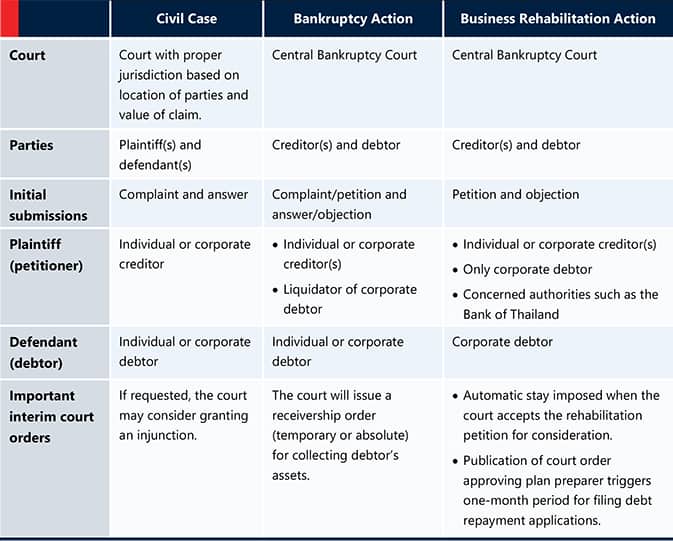
 

Requirements for Initiating Action
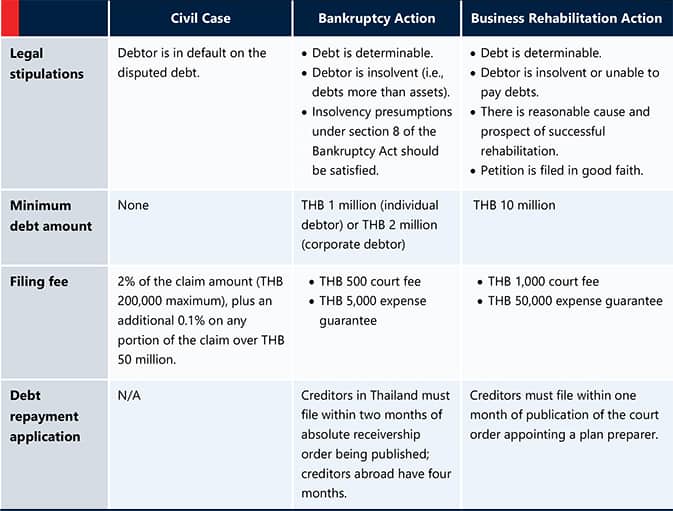
 

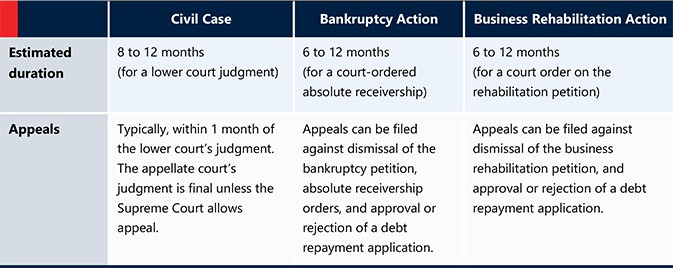
Proceedings
 

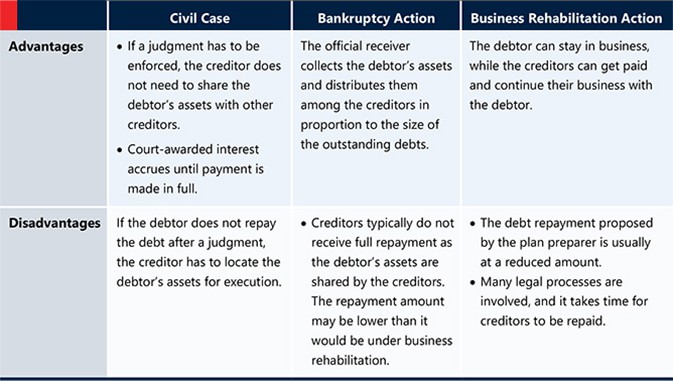
Advantages and Disadvantages
 

Conclusion

An essential step in pursuing any of these actions is retaining experienced local counsel who can offer tailored advice. Creditors should consider which of these three legal actions in Thailand best suits their needs and circumstances, and chart their course with the help of their legal advisor in Thailand. As noted above, a civil case might be the right option for a single creditor pursuing repayment, while bankruptcy actions and business rehabilitation are more far-reaching options that may be appropriate when there are serious underlying financial or structural issues affecting the debtor. With the aid of a specialist in debt recovery, bankruptcy, and business rehabilitation in Thailand, the creditor can consider the specific circumstances, lay out and execute a winning strategy, and resolve their debt recovery problems efficiently and cost-effectively.


RELATED INSIGHTS​ 

November 13, 2025
The Land Department in Thailand’s Ministry of the Interior (MOI) plays a central role in ensuring the stability and legality of real estate transactions in the country. Its core responsibilities include issuing land title deeds, registering transactions (e.g., sales, mortgages, leases), conducting surveys for subdivision or consolidation of land, and providing information and guidance on land and property development laws. These administrative functions secure investor confidence and support transparency in the Thai property market, so any delay can have a significant impact. This is especially true for investors who depend on timely registration to secure or transfer property rights. Delays can create liquidity risks, postpone project timelines, and even reduce Thailand’s attractiveness as a real estate investment destination. This article explores the nature of these challenges, the legal framework governing the timelines for administrative actions, and remedies available under Thai law. Sources of Delay Procedural delays at land offices can arise for a variety of structural and operational reasons. These include approval processes that require several levels of internal review, heavy staff workloads, and occasional communication gaps within the bureaucratic chain. Many processes still rely upon manual documentation, which can prolong administrative steps and increase the likelihood of bottlenecks. Some delays stem from ongoing investigations into the legality of land titles. For example, a land title deed may have an annotation indicating that the title deed is under investigation to verify its legality. Even though this annotation does not legally prohibit the sale or transfer of the land, in practice, most prospective purchasers are reluctant to proceed with a transaction until the annotation is removed. As a result, the land can become effectively illiquid during the investigation period, leading to significant investment delays. While such investigations are essential to maintaining the integrity of Thailand’s land registration system, prolonged inquiries
November 7, 2025
Thailand and the United States signed a memorandum of understanding (MOU) titled “Cooperation to Diversify Global Critical Minerals Supply Chains and Promote Investments” on October 26, 2025, signaling a new strategic alignment aimed at developing Thailand’s mineral sector, particularly in rare earth elements (REEs). The MOU has implications for investments in technology, manufacturing, and other related sectors. This update outlines the key provisions of the MOU and the potential opportunities and legal navigating points for businesses. Objectives The primary driver of this agreement is the US initiative to diversify global supply chains for critical minerals and reduce reliance on current market leaders, particularly China. For Thailand, it represents a major opportunity to attract high-tech investment and develop its downstream processing industries. The cooperation is set to focus on five main areas: Technical knowledge: Exchange of technical expertise and international best practices to strengthen Thailand’s mining and processing sector. Joint cooperation: Establishing workshops, seminars, and scientific collaboration to boost innovation. Regulatory practice: Promoting good governance and streamlining regulatory and licensing procedures. Information sharing: Sharing data on potential projects and global market prices. Full-value chain: The MOU covers the entire mineral lifecycle, from exploration and extraction to processing, refining, and recycling. “First Opportunity to Invest” Clause The most debated provision within the MOU states that “participants expect to have the first opportunity to invest . . . in critical minerals assets that may be sold in Thailand.” Business implications: This clause is widely interpreted as granting US companies a first look or preferential access to investment opportunities in Thailand’s critical minerals sector. This could be a significant advantage for US-based or affiliated companies in mining, technology, and energy seeking to secure a foothold in a developing REE supply chain. Thai government position: Thai officials, including the prime minister, have publicly clarified
October 31, 2025
On September 29, 2025, Thailand’s Office of the Personal Data Protection Committee (PDPC Office) published its Regulations on the Review and Certification of Binding Corporate Rules B.E. 2568 (2025) (the Regulations). The Regulations provide clarity on the PDPC Office’s approach to reviewing and certifying binding corporate rules (BCRs) under Section 29 of the Personal Data Protection Act B.E. 2562 (2019) (PDPA), and aim to facilitate international data transfers within a group of undertakings or enterprises (a “corporate group”). In conjunction with this development, the PDPC Office also approved BCRs for two companies operating in Thailand on September 30, 2025. This milestone represents the first concrete progress since the PDPC’s Notification on Criteria for the Protection of Personal Data Sent or Transferred to a Foreign Country pursuant to Section 29 of the PDPA B.E. 2566 (2023) came into effect in March 2024. Some key features of the Regulations are set out below. Categorization of BCRs BCRs are classified into two types: (1) BCRs for Controllers (BCR-C) and (2) BCRs for Processors (BCR-P). The category must be clearly specified when submitting the BCRs to the PDPC Office. Documentation Requirement The applicant must prepare and submit the application (a standard template may be provided by the PDPC Office in the future) along with supporting documents for review and certification in the Thai language. If the supporting documents are in a foreign language, a certified Thai translation should be provided. The translation must be notarized by a notary public or qualified person. Supporting documents may include, among others, a binding instrument such as an intra-group agreement, or a list of entities subject to the BCRs. Expedited Process Requirement Organizations with existing BCR approvals under the EU or UK GDPR, or from countries announced by the PDPC under Section 28, may apply through an
October 30, 2025
Recent events at a Thai listed company, where a proposal to remove the director was not successful, amid claims that a competitor was attempting to gain control of the company, illustrate how disputes over corporate control can unfold differently at the board level and shareholder level. At the board level, removing directors of a listed company mid-term to gain corporate control is not an easy task under Thai law, as it requires a higher threshold than appointing a new director, which typically only requires a simple majority vote in a listed company. At the shareholder level, Thailand’s tender offer and competition regimes add complexity where different shareholder groups act in concert to remove opposing board representatives or otherwise influence control. In this article, we will explore why the attempted removal of a director may fail, and how the tender offer regime may apply. Key Issues at a Glance Shareholder groups may seek to convene meetings to propose changes to board composition or company authority. Such proposals can be delayed or complicated by regulatory requirements and the need for additional disclosures. Regulatory authorities and minority shareholders may raise concerns when major shareholders coordinate to influence board control, especially if such actions could trigger tender offer or merger control obligations. Companies often respond by seeking further information on shareholder relationships and potential conflicts before proceeding. Why the Director Removal Failed Under Section 76 of the Public Limited Companies Act B.E. 2535 (as amended), the early removal of a director requires two conditions to be satisfied at the same meeting of shareholders: Headcount test: At least 75% of shareholders attending and entitled to vote must vote in favor. If multiple shareholders appoint the same person as proxy, each proxy is counted as a separate head for the purpose of the headcount test,