You are using an outdated browser and your browsing experience will not be optimal. Please update to the latest version of Microsoft Edge, Google Chrome or Mozilla Firefox. Install Microsoft Edge

September 7, 2021

Legal Options in Thailand When a Debtor Can’t (or Won’t) Pay Up

COVID-19 and the resulting lockdown measures to limit outbreaks in Thailand have caused significant financial difficulties for many business operators, large and small. Whether a business is a creditor or debtor, there is a high likelihood they have faced or will face a default caused by the pandemic. This article identifies three legal options available when a party defaults—civil cases, bankruptcy actions, and business rehabilitation actions—and compares key elements associated with each option. For context, those three options are defined as follows:

  • Civil case. A legal proceeding in which a creditor files a civil lawsuit (or arbitration claim) against a debtor for debt collection. If a debtor fails to settle a debt in accordance with a judgment, the creditor can ask the court to enforce the judgment by seizure and sale of the debtor’s assets through public auction.
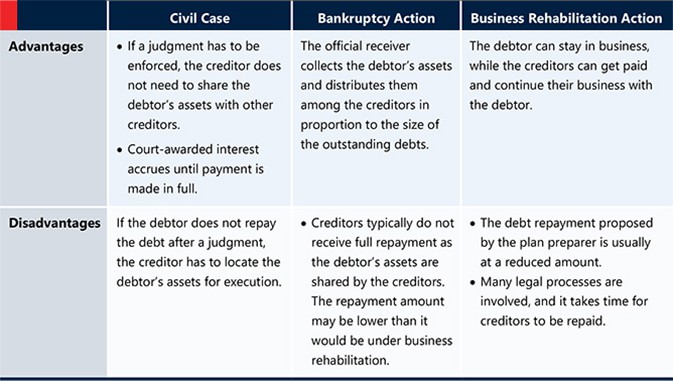
  • Bankruptcy action. A legal proceeding under the Bankruptcy Act in which a government authority can collect a debtor’s assets, sell the assets by public auction, and distribute the net proceeds among creditors. In bankruptcy proceedings, the creditors will receive repayment in proportion to the size of the outstanding debts.
  • Business rehabilitation action. A legal proceeding under the Bankruptcy Act aimed at helping a debtor recover from insolvency and continue its business. Debtors are given debt relief and a “new start” through business rehabilitation, while creditors are able to collect a higher percentage of outstanding debt under rehabilitation than they would under a bankruptcy action.

In short, a civil case is a claim in court for repayment of a specific debt, a bankruptcy action results in distribution of the debtor’s assets among the creditors, and a business rehabilitation action aims to enable the debtor to stay in business while repaying their debts to some degree.

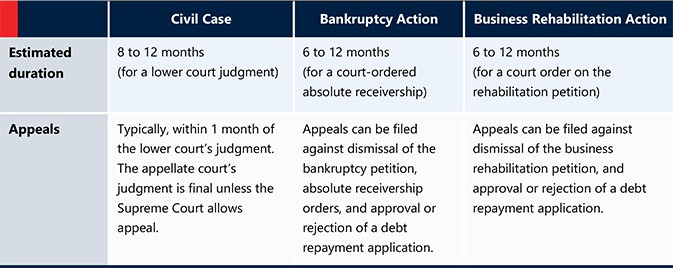
A civil case may be appropriate when the debtor defaults on debt repayment and is indebted to only the creditor bringing the action. A bankruptcy action should be considered when the debtor’s liabilities are greater than its assets, and its business cannot continue. Business rehabilitation may be a good option when there is still a reasonable chance of reforming and rebuilding the debtor’s business. The three options also differ in a number of other ways, as laid out below.


Legal Particulars
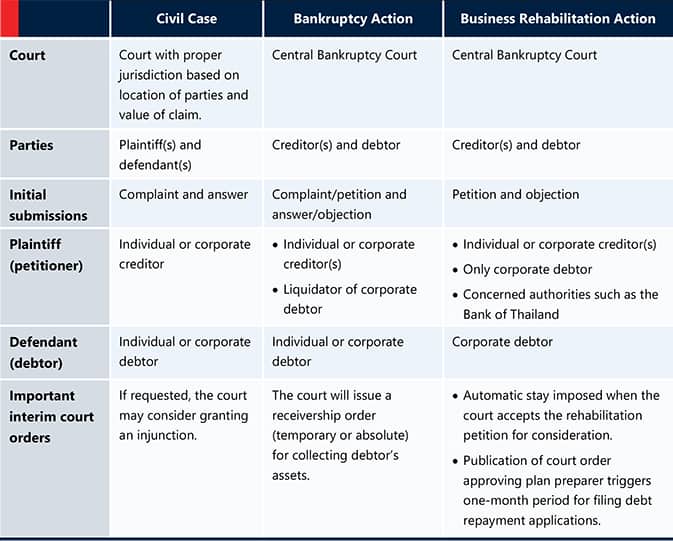
 

Requirements for Initiating Action
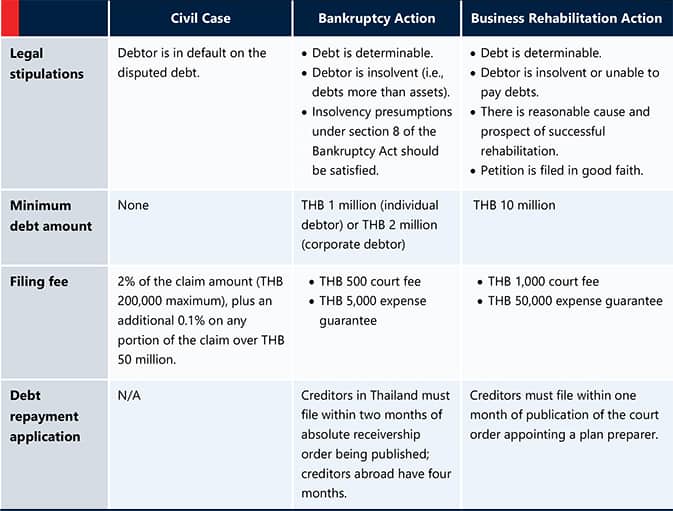
 

Proceedings
 

Advantages and Disadvantages
 

Conclusion

An essential step in pursuing any of these actions is retaining experienced local counsel who can offer tailored advice. Creditors should consider which of these three legal actions in Thailand best suits their needs and circumstances, and chart their course with the help of their legal advisor in Thailand. As noted above, a civil case might be the right option for a single creditor pursuing repayment, while bankruptcy actions and business rehabilitation are more far-reaching options that may be appropriate when there are serious underlying financial or structural issues affecting the debtor. With the aid of a specialist in debt recovery, bankruptcy, and business rehabilitation in Thailand, the creditor can consider the specific circumstances, lay out and execute a winning strategy, and resolve their debt recovery problems efficiently and cost-effectively.


RELATED INSIGHTS​ 

March 13, 2026
For decades, intellectual property rights holders seeking to eliminate counterfeit goods from the Thai market have relied primarily on criminal raid actions to seize infringing products and hold infringers accountable. The deterrent value of this approach is typically threefold: imposing criminal liability on infringers, removing counterfeit goods from circulation, and subjecting violators to imprisonment and fines. However, these outcomes often fall short of fulfilling brand owners’ broader objectives. In many cases, those prosecuted are merely staff or intermediaries rather than the principals orchestrating the infringing operations. Moreover, any fines imposed are remitted to the Thai government—not to the rights holders who have suffered commercial harm and invested substantial resources in investigation and coordination with law enforcement authorities. As in other jurisdictions worldwide, rights holders seeking monetary compensation for IP infringement in Thailand have traditionally pursued separate civil litigation. Before initiating such proceedings, a brand owner must gather sufficient evidence to establish both the infringement and the resulting damages. Notably, Thai law does not recognize punitive damages; courts award only actual damages proven by the claimant. In the absence of seized infringing goods, the damages awarded in such cases are typically minimal. This all leaves rights holders with limited recourse despite possibly having suffered significant commercial injury. In 2005, Thailand amended its Criminal Procedure Code to introduce Section 44/1, which enables rights holders to claim damages within criminal proceedings at the Intellectual Property and International Trade Court prior to the evidentiary hearing. In practice, this mechanism allows an injured party to submit a petition for civil damages directly within the criminal case initiated by the public prosecutor. Historically, rights holders in Thailand have been reluctant to use Section 44/1 because the compensation awarded by courts was often insufficient to justify the effort. However, recent years have seen a notable shift
March 9, 2026
Over the past several years, numerous automobile manufacturers have brought electric vehicles (EVs) to the market and received positive feedback from consumers in Thailand and around the world. EVs have gained popularity due to their lower maintenance costs, reduced energy expenses, and environmental benefits. However, reports have emerged of EVs causing problems such as battery fires, autopilot malfunctions leading to accidents, and safety systems such as brakes engaging automatically under inappropriate conditions. Even when these situations do not cause injury to drivers or passengers, they raise significant concerns for EV manufacturers, importers, and sellers operating in Thailand. These problems may seriously impact businesses if the products are identified as unsafe under Thailand’s Product Liability Act (PLA), officially known as the Liability for Damages Arising from Unsafe Products Act. Under this law, authorities or courts can order business operators to recall products from the market or prohibit their export, import, or sale. To manage and mitigate the risk of being found liable for damages due to an unsafe product under the PLA, EV business operators should be aware of the scope of the law. Potentially Liable Parties The PLA identifies several types of entrepreneurs and business operators—both individuals and entities—as “potentially liable parties” (PLPs) who may be held liable under the law. In the EV context, this could include vehicle manufacturers, battery suppliers, software developers whose systems are integrated into the vehicle, and local importers or distributors. Specifically, the PLA covers: Manufacturers or hirers Importers Sellers of goods for which the manufacturer, hirer, or importer cannot be identified Any other party who uses the name, trade name, trademark, or statements associated with the alleged unsafe products, or acts in a manner that causes them to be perceived as a manufacturer, hirer, or importer Definition of “Product” and “Unsafe Product” The
March 5, 2026
Amid increasing financial globalization, Vietnam’s establishment of an International Financial Center (IFC) represents a strategic initiative to attract high-quality foreign investment and enhance the country’s position in the global financial system. In support of this objective, a Specialized Court was introduced under Resolution No. 222/2025/QH15 as a dedicated dispute resolution mechanism within the IFC framework. The Specialized Court at the IFC was subsequently operationalized by Law on the Specialized Court No. 150/2025/QH15, effective from January 1, 2026. Organizational Structure of the Specialized Court The Specialized Court at the IFC is a court within the system of the People’s Courts, organized and operating in accordance with the Law on the Specialized Court, and vested with jurisdiction to adjudicate and resolve cases at the IFC. The Specialized Court is located in Ho Chi Minh City and comprises (i) a Court of First Instance; (ii) a Court of Appeal, and (iii) a supporting apparatus. Jurisdiction of the Specialized Court The jurisdiction of the Specialized Court at the IFC is strictly defined based on both (i) the subject matter of the cases and (ii) the membership status of the parties involved. Specifically, the Specialized Court has jurisdiction over (except for cases involving public interests or the interests of the state) the following: Disputes arising from investment and business activities. Requests for recognition and enforcement in Vietnam of judgments and decisions of foreign courts and foreign arbitral awards. Requests related to dispute resolution by arbitration. Other disputes directly related to investment and business activities (to be specified by the Supreme People’s Court). Additionally, at least one party in the case must be a member of the IFC. The IFC’s membership status is established through registration, recognition as a member, or the grant of a license for establishment and operation within the IFC. In the
February 25, 2026
In December 2025, the National Assembly of Vietnam enacted a new Law on Construction, replacing the 2014 Law on Construction as amended in 2020. The 2025 Law on Construction will, in principle, take effect on July 1, 2026, subject to certain exceptions. Among its notable reforms, one development has attracted particular attention from both legal practitioners and market participants: the introduction of a statutory framework governing predetermined damages, commonly referred to as “liquidated damages.” This marks the first time liquidated damages have been expressly recognized at the level of primary legislation in Vietnam. While liquidated damages clauses have long been a common feature of construction contracts in practice, their legal enforceability has historically been subject to uncertainty. Although the new provision appears to represent a positive step toward greater legal clarity, it remains an open question whether it is sufficient, on its own, to provide a solid legal basis for the enforceability of liquidated damages clauses in construction disputes in Vietnam. What’s New? Article 86.2 of the 2025 Law on Construction provides (emphasis added): “Compensation for damages shall be determined on the basis of actual damages [or] predetermined damages corresponding to obligations under the construction contracts that are breached [and] the extent of such breaches.” This provision is significant in that it expressly recognizes predetermined damages, or liquidated damages, as a lawful basis for determining compensation for damage. However, the new law does not define “predetermined damages.” The absence of a statutory definition creates potential ambiguity as to the scope and nature of this concept and may give rise to disputes over how—and whether—a particular contractual clause qualifies as predetermined damages for the purposes of Article 86.2. Further, Article 86.2 qualifies the application of predetermined damages by requiring that such damages correspond to the obligations not fulfilled and the