You are using an outdated browser and your browsing experience will not be optimal. Please update to the latest version of Microsoft Edge, Google Chrome or Mozilla Firefox. Install Microsoft Edge

September 7, 2021

Legal Options in Thailand When a Debtor Can’t (or Won’t) Pay Up

COVID-19 and the resulting lockdown measures to limit outbreaks in Thailand have caused significant financial difficulties for many business operators, large and small. Whether a business is a creditor or debtor, there is a high likelihood they have faced or will face a default caused by the pandemic. This article identifies three legal options available when a party defaults—civil cases, bankruptcy actions, and business rehabilitation actions—and compares key elements associated with each option. For context, those three options are defined as follows:

  • Civil case. A legal proceeding in which a creditor files a civil lawsuit (or arbitration claim) against a debtor for debt collection. If a debtor fails to settle a debt in accordance with a judgment, the creditor can ask the court to enforce the judgment by seizure and sale of the debtor’s assets through public auction.
  • Bankruptcy action. A legal proceeding under the Bankruptcy Act in which a government authority can collect a debtor’s assets, sell the assets by public auction, and distribute the net proceeds among creditors. In bankruptcy proceedings, the creditors will receive repayment in proportion to the size of the outstanding debts.
  • Business rehabilitation action. A legal proceeding under the Bankruptcy Act aimed at helping a debtor recover from insolvency and continue its business. Debtors are given debt relief and a “new start” through business rehabilitation, while creditors are able to collect a higher percentage of outstanding debt under rehabilitation than they would under a bankruptcy action.

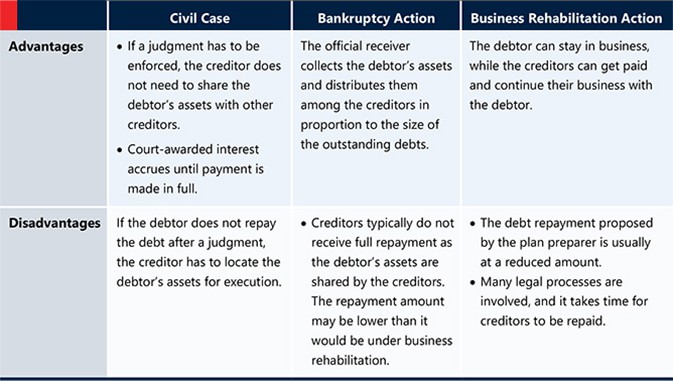
In short, a civil case is a claim in court for repayment of a specific debt, a bankruptcy action results in distribution of the debtor’s assets among the creditors, and a business rehabilitation action aims to enable the debtor to stay in business while repaying their debts to some degree.

A civil case may be appropriate when the debtor defaults on debt repayment and is indebted to only the creditor bringing the action. A bankruptcy action should be considered when the debtor’s liabilities are greater than its assets, and its business cannot continue. Business rehabilitation may be a good option when there is still a reasonable chance of reforming and rebuilding the debtor’s business. The three options also differ in a number of other ways, as laid out below.


Legal Particulars
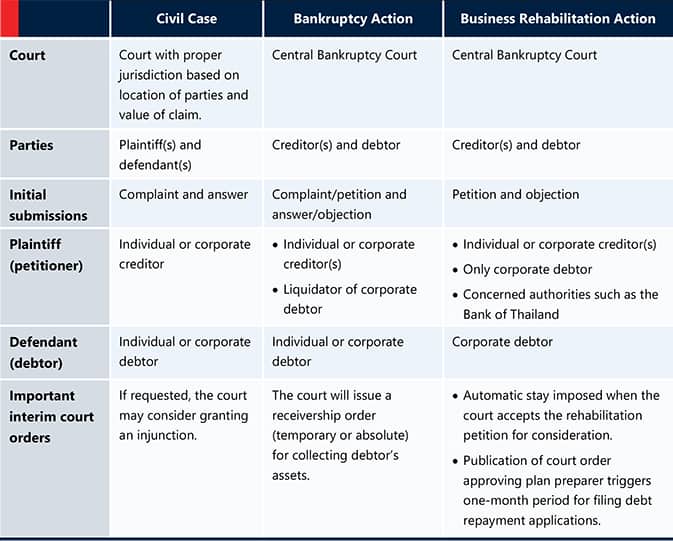
 

Requirements for Initiating Action
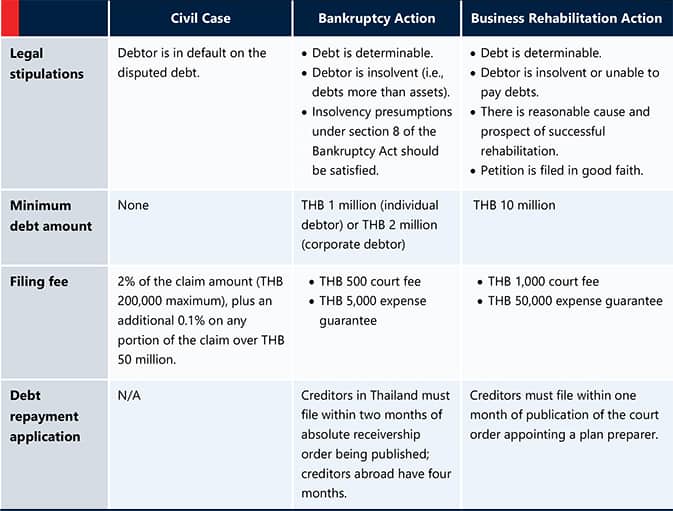
 

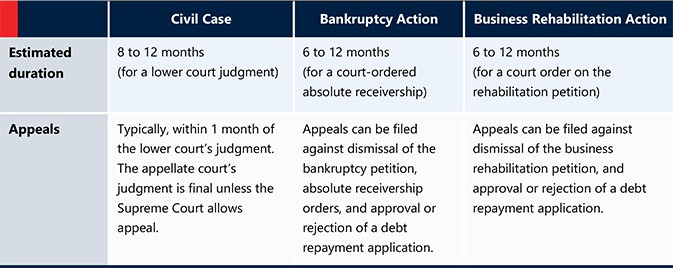
Proceedings
 

Advantages and Disadvantages
 

Conclusion

An essential step in pursuing any of these actions is retaining experienced local counsel who can offer tailored advice. Creditors should consider which of these three legal actions in Thailand best suits their needs and circumstances, and chart their course with the help of their legal advisor in Thailand. As noted above, a civil case might be the right option for a single creditor pursuing repayment, while bankruptcy actions and business rehabilitation are more far-reaching options that may be appropriate when there are serious underlying financial or structural issues affecting the debtor. With the aid of a specialist in debt recovery, bankruptcy, and business rehabilitation in Thailand, the creditor can consider the specific circumstances, lay out and execute a winning strategy, and resolve their debt recovery problems efficiently and cost-effectively.


RELATED INSIGHTS​ 

June 29, 2026
Thailand’s cabinet has approved the draft Act on Liability for Defective Goods, commonly called Thailand’s “Lemon Law.” The Draft Act is currently pending consideration by Parliament. The draft law aims to strengthen buyers’ position in pursuing cases against sellers. While the Civil and Commercial Code offers provisions governing liability for defective goods, it is difficult in practice for buyers to successfully make a claim against sellers, particularly where defects are latent and not discoverable at the time of sale or delivery. By introducing product-specific rules and clearer remedies, the new law is intended to modernize Thailand’s consumer protection framework and align it more closely with international standards, and to help relieve the buyer’s burden of proof against the seller in product liability cases. If enacted, the draft act will take effect 180 days after publication in the Government Gazette, giving businesses a transition period to assess their compliance obligations. This article provides an overview of the key provisions of the draft act and highlights some practical considerations for businesses operating in Thailand. Scope and Key Definitions The draft act applies to sellers—defined as persons who sell goods in the ordinary course of business—and protects buyers, a term defined broadly to include not just the original purchaser but also transferees and successors in title. This expands the class of people who can bring claims. The law does not apply to used goods, live animals, or goods exempted by future ministerial regulation. It also leaves intact any separate warranties, promises, advertisements, or other guarantees a seller has given; those remain enforceable alongside the new statutory rights. General Liability for Defective Goods Sellers are liable for defects that exist at the time of delivery, regardless of whether the seller knew about them. Liability arises where a defect reduces: The benefit intended under
June 23, 2026
Thailand’s Board of Investment (BOI) has significantly revised its post-approval compliance framework for projects that receive investment promotion incentives, replacing the previous semiannual reporting system for project progress with a new quarterly reporting regime. The initial report is due by July 30, 2026, covering the second-quarter reporting period of April to June 2026. The new requirements—implemented through BOI Announcement No. 8/2569 and Office of the BOI Notification No. Por. 8/2569, both of which became effective on March 30, 2026—apply both to newly promoted projects and to existing promoted projects that remain in the implementation stage. Background Under the previous reporting framework, BOI-promoted companies that had not yet commenced full operations were generally required to submit reports on project progress to the BOI twice a year (February and July) through the BOI’s e-Monitoring system. By adopting a quarterly reporting regime, the BOI seeks to strengthen monitoring and evaluation of investment progress and project implementation. Reporting Requirements Under the new regulations, BOI-promoted companies must submit project progress reports on a quarterly basis during the implementation phase of a promoted project. The reporting periods and submission deadlines are: Q1 (January–March): April 30 Q2 (April–June): July 30 Q3 (July–September): October 30 Q4 (October–December): January 30 of the following year The quarterly reporting obligation runs from the date the BOI promotion certificate is issued until the BOI grants approval for commencement of full operations. For newly promoted projects, no quarterly report is required for the quarter in which the BOI promotion certificate is issued—the first reporting obligation arises in the immediately following reporting period. All project progress reports must be submitted electronically through the BOI’s e-Monitoring system. The existing annual reporting requirement also remains in effect, requiring promoted companies to submit an annual operating results report through the e-Monitoring system by July 31 of
June 22, 2026
Arbitrator independence and impartiality form the cornerstone of a legitimate arbitral process. Under section 19 of the Thai Arbitration Act B.E. 2545 (2002), prospective arbitrators must disclose circumstances likely to give rise to justifiable doubts as to their impartiality or independence, and existing arbitrators must do so throughout proceedings. This mirrors article 12 of the UNCITRAL Model Law. Yet despite this clear mandate, practical implementation varies significantly across Thailand’s arbitration landscape. Background Thailand’s two principal arbitration institutions, the Thai Arbitration Institute (TAI) and the Thailand Arbitration Center (THAC), both maintain procedures for addressing arbitrator challenges and require compliance with the statutory disclosure obligation. Under both sets of rules, any party wishing to challenge an arbitrator must submit a challenge application within fifteen days of becoming aware of the relevant facts, and a committee is appointed to consider the matter on a case-by-case basis. The TAI additionally prescribes its Code of Ethics and Conduct for Arbitrators to further emphasize the expectation of impartiality and transparency. However, Thailand’s arbitration ecosystem extends well beyond the TAI and THAC. Several sector-specific institutions also administer arbitral proceedings, including the Thai Commercial Arbitration Office under the Board of Trade of Thailand, the Arbitration Centre of the Office of the Insurance Commission, the Arbitration Centre of the Securities and Exchange Commission, the Office for the Prevention and Resolution of Disputes regarding Intellectual Property, and the Arbitration Centre of the Thai General Insurance Association. These institutions each operate under their own procedural rules, which were developed to serve particular industries and dispute profiles. The procedural mechanisms for securing and documenting an independence declaration are not uniformly established across these forums. Consequences of Procedural Inconsistency This creates a notable gap. Not all arbitration bodies have a formalized procedure requiring written independence statements before proceedings commence. Some tribunals proceed
June 16, 2026
The president of Thailand’s Supreme Court has issued new recommendations providing courts with criminal jurisdiction with a comprehensive framework for identifying and dismissing criminal cases brought in bad faith. Published in the Government Gazette on May 29, 2026, after being signed on May 25, the Recommendations of the President of the Supreme Court Concerning Bad-Faith Litigation in Criminal Cases B.E. 2569 were issued under Section 5 of the Act on the Organization of Courts of Justice. The recommendations took effect upon publication and represent a significant step in Thailand’s efforts to curb abusive criminal litigation, including strategic lawsuits against public participation (SLAPP). Background Section 161/1 of Thailand’s Criminal Procedure Code empowers courts to dismiss criminal cases filed dishonestly or with the intent to harass or take unfair advantage of a defendant. The new recommendations provide detailed guidance that courts previously lacked on identifying and handling such prosecutions. Definition of Bad-Faith Litigation Under recommendation 1, filing a criminal case in bad faith is defined broadly to encompass three categories: Harassment-type filings involving intimidation, threats, or creating unreasonable hardship for the defendant; Coercive filings designed to pressure the defendant into acting or refraining from acting for illegitimate benefit; and False or misleading filings that deliberately assert incorrect material facts or conceal such facts. Circumstances Indicating Bad Faith Recommendation 2 sets out specific circumstances that should raise a court’s suspicion that a filing may violate section 161/1. These include: Filing in a distant court far from the defendant’s domicile without benefiting the adjudication; Retaliation against the defendant’s advocacy for human rights, environmental protection, consumer rights, labor rights, or other public interests—effectively establishing an express anti-SLAPP framework; Retaliation against whistleblowers who disclosed corruption or unlawful conduct; Retaliation against individuals responsible for investigating the plaintiff’s wrongdoing or who concluded such an investigation; Filing multiple