You are using an outdated browser and your browsing experience will not be optimal. Please update to the latest version of Microsoft Edge, Google Chrome or Mozilla Firefox. Install Microsoft Edge

September 7, 2021

Legal Options in Thailand When a Debtor Can’t (or Won’t) Pay Up

COVID-19 and the resulting lockdown measures to limit outbreaks in Thailand have caused significant financial difficulties for many business operators, large and small. Whether a business is a creditor or debtor, there is a high likelihood they have faced or will face a default caused by the pandemic. This article identifies three legal options available when a party defaults—civil cases, bankruptcy actions, and business rehabilitation actions—and compares key elements associated with each option. For context, those three options are defined as follows:

  • Civil case. A legal proceeding in which a creditor files a civil lawsuit (or arbitration claim) against a debtor for debt collection. If a debtor fails to settle a debt in accordance with a judgment, the creditor can ask the court to enforce the judgment by seizure and sale of the debtor’s assets through public auction.
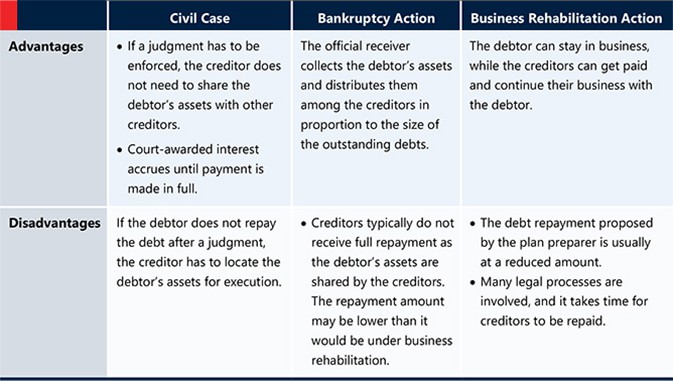
  • Bankruptcy action. A legal proceeding under the Bankruptcy Act in which a government authority can collect a debtor’s assets, sell the assets by public auction, and distribute the net proceeds among creditors. In bankruptcy proceedings, the creditors will receive repayment in proportion to the size of the outstanding debts.
  • Business rehabilitation action. A legal proceeding under the Bankruptcy Act aimed at helping a debtor recover from insolvency and continue its business. Debtors are given debt relief and a “new start” through business rehabilitation, while creditors are able to collect a higher percentage of outstanding debt under rehabilitation than they would under a bankruptcy action.

In short, a civil case is a claim in court for repayment of a specific debt, a bankruptcy action results in distribution of the debtor’s assets among the creditors, and a business rehabilitation action aims to enable the debtor to stay in business while repaying their debts to some degree.

A civil case may be appropriate when the debtor defaults on debt repayment and is indebted to only the creditor bringing the action. A bankruptcy action should be considered when the debtor’s liabilities are greater than its assets, and its business cannot continue. Business rehabilitation may be a good option when there is still a reasonable chance of reforming and rebuilding the debtor’s business. The three options also differ in a number of other ways, as laid out below.


Legal Particulars
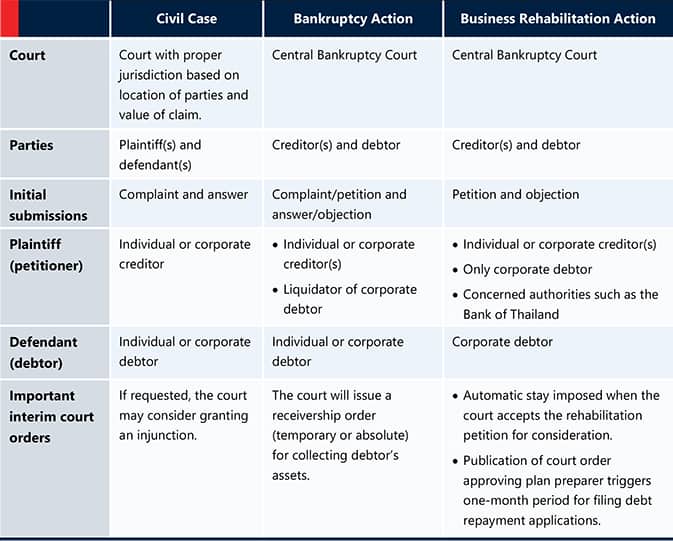
 

Requirements for Initiating Action
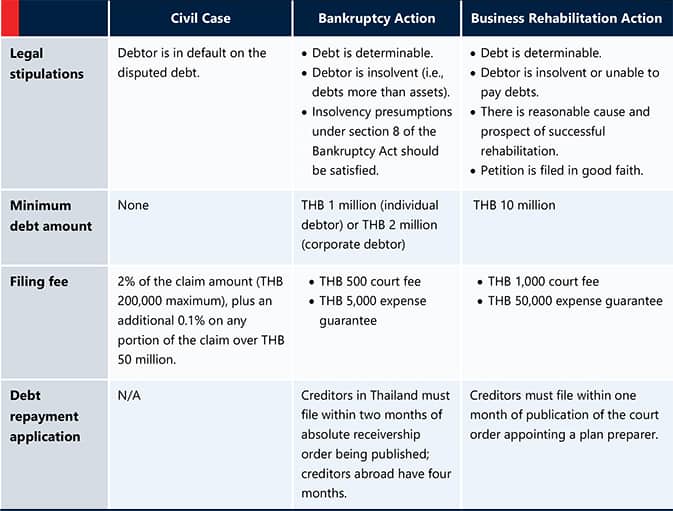
 

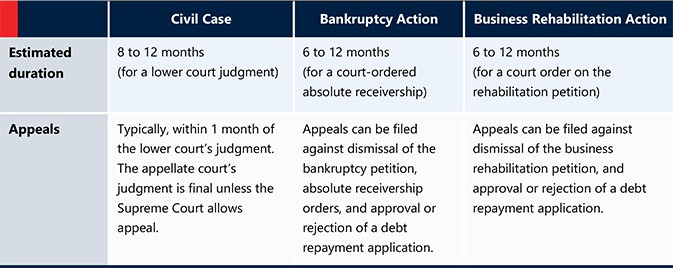
Proceedings
 

Advantages and Disadvantages
 

Conclusion

An essential step in pursuing any of these actions is retaining experienced local counsel who can offer tailored advice. Creditors should consider which of these three legal actions in Thailand best suits their needs and circumstances, and chart their course with the help of their legal advisor in Thailand. As noted above, a civil case might be the right option for a single creditor pursuing repayment, while bankruptcy actions and business rehabilitation are more far-reaching options that may be appropriate when there are serious underlying financial or structural issues affecting the debtor. With the aid of a specialist in debt recovery, bankruptcy, and business rehabilitation in Thailand, the creditor can consider the specific circumstances, lay out and execute a winning strategy, and resolve their debt recovery problems efficiently and cost-effectively.


RELATED INSIGHTS​ 

October 30, 2025
Thailand has introduced a comprehensive overhaul of its tax litigation procedures that will significantly impact how tax disputes are handled. The Regulations for Tax Cases B.E. 2568 (2025) take effect on November 24, 2025, and repeal the prior B.E. 2544 (2001) regulations in full. These regulations support the implementation of the Act on the Establishment of the Tax Court and Tax Case Procedure (No. 3) B.E. 2568 (2025), which expands the Tax Court’s jurisdiction to certain criminal tax matters. Published in the Government Gazette on October 14, 2025, the regulations have been reorganized into three parts covering civil cases, criminal cases, and forms, and are designed to accelerate proceedings, tighten evidentiary discipline, and modernize court operations. Structural Reform and Scope The prior regime governed only civil tax disputes. Under the new framework, the regulations introduce a dedicated chapter for criminal cases alongside updated civil procedures, as the Tax Court now has express authority to adjudicate specified criminal tax offenses. Select mechanisms applied in civil case proceedings, such as electronic communication, recording testimony, and appointing experts, also apply to criminal proceedings mutatis mutandis where they do not conflict with criminal procedure. Civil Cases: Evidence Submission, Deadlines, and Scheduling Parties must submit, together with the witness list, originals of all documentary evidence, media, or electronic data (such as files, USB drives, or CDs), and all physical evidence in the party’s possession. Failure to submit any original within the deadline (see below) results in a loss of the right to adduce that item at trial, subject only to narrow exceptions where submission is impossible due to force majeure or where receipt of the evidence is indispensable to the interests of justice. The practical impact is that parties are now obligated to assemble and verify all original documents and data at the very
October 24, 2025
The Thai Arbitration Institute (TAI), a division of Thailand’s Office of the Judiciary, has taken a step toward harmonizing the tools available for dispute resolution. On August 8, 2025, the institute formally launched the TAI Mediation Center (TAI-MC). Although the amendments to TAI’s Arbitration Rules that will govern the TAI-MC have not yet been finalized, the framework now under consideration suggests that TAI is positioning itself to become a more attractive venue for commercial dispute resolution. In the regime contemplated under the current version of the amendments, TAI proceedings will adopt an “arbitration-annexed mediation” mechanism—commonly termed the “Med-Arb” model—while preserving the procedural safeguards indispensable to arbitral neutrality. Mediation will be entrusted to a separate, dedicated mediator appointed under the TAI-MC who is precluded from serving on the arbitral tribunal in the same matter. By clearly separating the functions of mediator and arbitrator, the institute eliminates any risk that confidential information disclosed during mediation could influence the adjudicatory outcome if the parties do not settle. Only when all parties subsequently make a request may that same mediator assume arbitral duties in the case. The parties will retain substantial autonomy in selecting the mediator. They may either designate a mediator by mutual consent or invite the TAI-MC to appoint one from its authorized panel. TAI has announced its intention to curate that panel with particular emphasis on commercial expertise and cross-cultural negotiation skills, supplemented by ongoing professional training. Where the parties cannot agree on remuneration, the mediator’s fee will default to a tariff comparable to the TAI-MC’s cost schedule, which under the current version of the amendments will be approximately THB 45,000 for disputes in which the aggregate claims do not exceed THB 10 million, with incremental increases tied to higher claim values. This predictable cost matrix is aimed at enhancing
October 24, 2025
In Vietnam, litigation is generally treated as a last resort in dispute resolution. Businesses often strive to avoid court proceedings, given the potential for disrupted relationships, higher costs, and lengthy timelines. Yet, litigation is sometimes unavoidable, whether to secure a remedy or respond to a claim. Familiarity with Vietnam’s court system and procedures is therefore crucial for any party involved in such matters. Civil Litigation in Vietnam offers a concise overview of the country’s civil court system and litigation process. The guide a highlights essential points for navigating legal disputes in Vietnam, whether as a plaintiff or a defendant. Tilleke & Gibbins also publishes a similar guide for Thailand. The full Civil Litigation in Vietnam guide is available as a PDF through the button below.
October 24, 2025
On October 22, 2025, the Thai government posted a directive not to grant gambling licenses for gambling involving poker nationwide to crack down on illegal gambling activities. The directive was issued by Thailand’s Ministry of Interior to align with government policies to prevent the legalization of all types of gambling businesses, including poker as a sporting activity. This will result in the revocation of poker activities as sport and institute a strict ban on such activities nationwide. Businesses should note the new government’s strict approach toward gambling activities as the legal situation regarding gambling in the country continues to draw close attention.