You are using an outdated browser and your browsing experience will not be optimal. Please update to the latest version of Microsoft Edge, Google Chrome or Mozilla Firefox. Install Microsoft Edge

September 7, 2021

Legal Options in Thailand When a Debtor Can’t (or Won’t) Pay Up

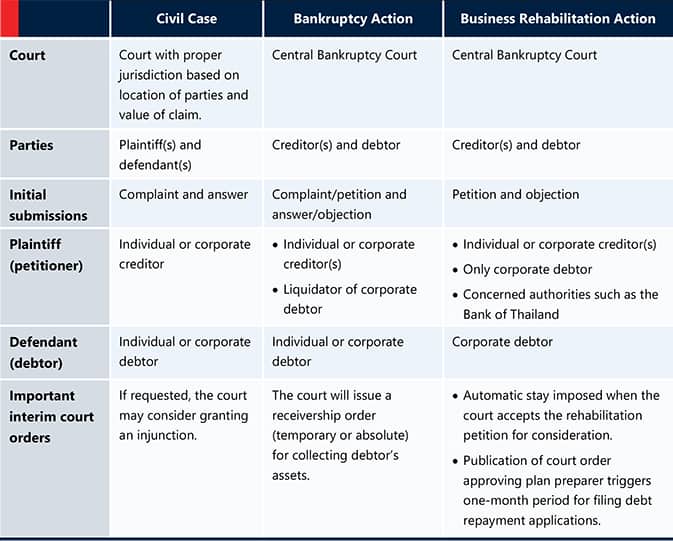
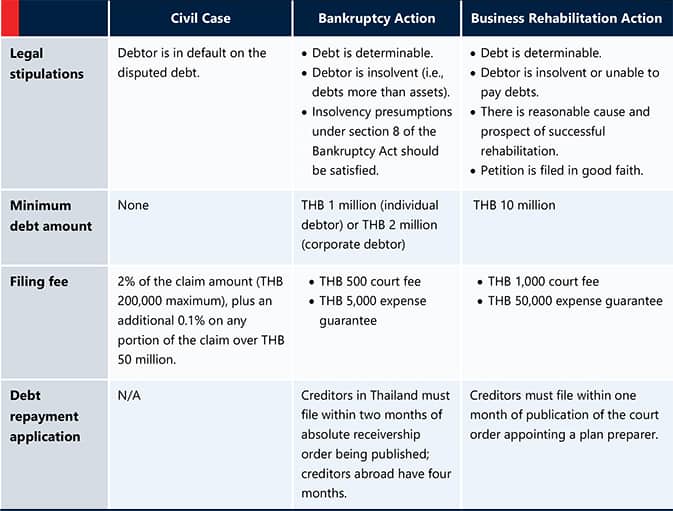
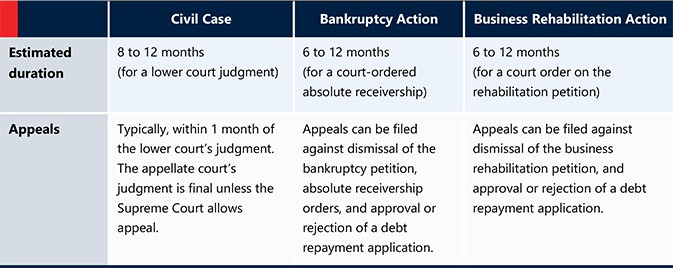
COVID-19 and the resulting lockdown measures to limit outbreaks in Thailand have caused significant financial difficulties for many business operators, large and small. Whether a business is a creditor or debtor, there is a high likelihood they have faced or will face a default caused by the pandemic. This article identifies three legal options available when a party defaults—civil cases, bankruptcy actions, and business rehabilitation actions—and compares key elements associated with each option. For context, those three options are defined as follows:

  • Civil case. A legal proceeding in which a creditor files a civil lawsuit (or arbitration claim) against a debtor for debt collection. If a debtor fails to settle a debt in accordance with a judgment, the creditor can ask the court to enforce the judgment by seizure and sale of the debtor’s assets through public auction.
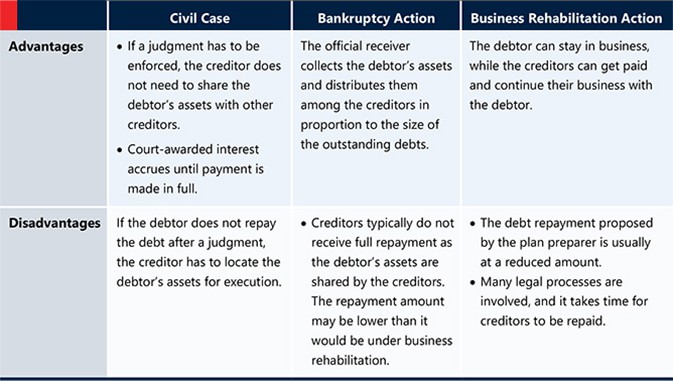
  • Bankruptcy action. A legal proceeding under the Bankruptcy Act in which a government authority can collect a debtor’s assets, sell the assets by public auction, and distribute the net proceeds among creditors. In bankruptcy proceedings, the creditors will receive repayment in proportion to the size of the outstanding debts.
  • Business rehabilitation action. A legal proceeding under the Bankruptcy Act aimed at helping a debtor recover from insolvency and continue its business. Debtors are given debt relief and a “new start” through business rehabilitation, while creditors are able to collect a higher percentage of outstanding debt under rehabilitation than they would under a bankruptcy action.

In short, a civil case is a claim in court for repayment of a specific debt, a bankruptcy action results in distribution of the debtor’s assets among the creditors, and a business rehabilitation action aims to enable the debtor to stay in business while repaying their debts to some degree.

A civil case may be appropriate when the debtor defaults on debt repayment and is indebted to only the creditor bringing the action. A bankruptcy action should be considered when the debtor’s liabilities are greater than its assets, and its business cannot continue. Business rehabilitation may be a good option when there is still a reasonable chance of reforming and rebuilding the debtor’s business. The three options also differ in a number of other ways, as laid out below.


Legal Particulars
 

Requirements for Initiating Action
 

Proceedings
 

Advantages and Disadvantages
 

Conclusion

An essential step in pursuing any of these actions is retaining experienced local counsel who can offer tailored advice. Creditors should consider which of these three legal actions in Thailand best suits their needs and circumstances, and chart their course with the help of their legal advisor in Thailand. As noted above, a civil case might be the right option for a single creditor pursuing repayment, while bankruptcy actions and business rehabilitation are more far-reaching options that may be appropriate when there are serious underlying financial or structural issues affecting the debtor. With the aid of a specialist in debt recovery, bankruptcy, and business rehabilitation in Thailand, the creditor can consider the specific circumstances, lay out and execute a winning strategy, and resolve their debt recovery problems efficiently and cost-effectively.


RELATED INSIGHTS​ 

January 26, 2026
Tilleke & Gibbins has contributed an updated Vietnam chapter to Foreign Investment Review 2026, a recently published global guide to the legal and regulatory environment for foreign investment in 25 jurisdictions worldwide. Published and distributed by Lexology Panoramic, the guide discusses law and policy on oversight of foreign investment, regulatory frameworks, procedural requirements, and other important stipulations for foreign investors. The Vietnam chapter was prepared by Kien Trung Trinh, a partner in the Tilleke & Gibbins’ Hanoi office, Dung Thi Phuong Le, an associate in the firm’s office in Ho Chi Minh City, Nguyen Thi Huong Nguyen, associate in Hanoi, and Ngan Thuc Nguyen, paralegal in Ho Chi Minh City. The Vietnam chapter covers the following topics: Law and Policy: Government policies and practices, main laws and their scope of application (including details on investment promotional measures), definitions, rules for state-owned enterprises and sovereign wealth funds, relevant authorities and oversight, and national interest provisions. Procedure: Jurisdictional thresholds, national interest clearance, securing approval, the review process for competition clearance and associated penalties, involvement of authorities, facilitation of clearance, and post-closing regulatory powers. Substantive assessment: Substantive tests for clearance, authorities’ consultation with other countries and other relevant parties, transactional prohibitions and objections, mitigating arrangements and challenges to a decision, and protection of confidential information. Recent cases, updates, and trends: Relevant recent case law, key recent and ongoing developments. A PDF of the Vietnam chapter can be accessed through the button below. Tilleke & Gibbins also contributed the Cambodia, Laos, and Myanmar chapters to Foreign Investment Review 2026. Readers can also gain 30 days of complementary access to the full Foreign Investment Review 2026 guide and the rest of Lexology Panoramic’s varied offerings through this link.
January 26, 2026
Tilleke & Gibbins has contributed an updated Myanmar chapter to the recently published Foreign Investment Review 2026, a global guide to the legal and regulatory environment for foreign investment in 25 jurisdictions worldwide. Published and distributed by Lexology Panoramic, the guide discusses law and policy on oversight of foreign investment, regulatory frameworks, procedural requirements, and other important concerns for foreign investors. The Myanmar chapter was prepared by Nwe Oo and Aye Thuzar Hlaing, senior associates in Tilleke & Gibbins’ office in Yangon. The Myanmar chapter covers the following topics: Law and Policy: Government policies and practices, main laws and their scope of application (including details on investment promotional measures), definitions, rules for state-owned enterprises and sovereign wealth funds, relevant authorities and oversight, and national interest provisions. Procedure: Jurisdictional thresholds, national interest clearance, securing approval, the review process for competition clearance and associated penalties, involvement of authorities, facilitation of clearance, and post-closing regulatory powers. Substantive assessment: Substantive tests for clearance, authorities’ consultation with other countries and other relevant parties, transactional prohibitions and objections, mitigating arrangements and challenges to a decision, and protection of confidential information. Recent cases, updates, and trends: Relevant recent case law, key recent and ongoing developments. A PDF of the Myanmar chapter can be downloaded through the button below. Tilleke & Gibbins also contributed the Cambodia, Laos, and Vietnam chapters to Foreign Investment Review 2026. Readers can also gain 30 days of complementary access to the full Foreign Investment Review 2026 guide and the rest of Lexology Panoramic’s varied offerings through this link.
January 26, 2026
Prisna Sungwanna, head of Tilleke & Gibbins’ office in Vientiane, and Sayphin Singsouvong, associate, provided an updated Laos chapter for Foreign Investment Review 2026, a global guide to the legal and regulatory environment for foreign investment in 25 jurisdictions worldwide. Published and distributed by Lexology Panoramic, the guide discusses law and policy on oversight of foreign investment, regulatory frameworks, procedural requirements, and other important considerations for foreign investors. The Laos chapter aims to give investors an understanding of what to expect when establishing operations and operating in the Lao market, covering: Law and Policy: Government policies and practices, main laws and their scope of application (including details on investment promotional measures), definitions, rules for state-owned enterprises and sovereign wealth funds, relevant authorities and oversight, and national interest provisions. Procedure: Jurisdictional thresholds, national interest clearance, securing approval, the review process for competition clearance and associated penalties, involvement of authorities, facilitation of clearance, and post-closing regulatory powers. Substantive assessment: Substantive tests for clearance, authorities’ consultation with other countries and other relevant parties, transactional prohibitions and objections, mitigating arrangements and challenges to a decision, and protection of confidential information. Recent cases, updates, and trends: Relevant recent case law, key recent and ongoing developments. A PDF of the Laos chapter can be accessed through the button below. Tilleke & Gibbins also contributed the Cambodia, Myanmar, and Vietnam chapters to Foreign Investment Review 2026. Readers can also gain 30 days of complementary access to the full Foreign Investment Review 2026 guide and the rest of Lexology Panoramic’s varied offerings through this link.
January 26, 2026
Tilleke & Gibbins has contributed an updated Cambodia chapter to Foreign Investment Review 2026, a global guide to the legal and regulatory environment for foreign investment in 25 jurisdictions around the world. Published and distributed by Lexology Panoramic, the guide is focused on law and policy regarding foreign investment oversight, regulatory frameworks, procedural requirements, and other notable concerns for foreign investors. The updated Cambodia chapter was prepared by Jay Cohen, partner and director of Tilleke & Gibbins’ Phnom Penh office, and Nitikar Nith, associate. The chapter focuses most closely on the law and policy section, which explains the government’s policies and practices regarding foreign direct investment, the main investment laws and their scope, and the relevant authorities responsible for regulating mergers, acquisitions, and other business transactions. The chapter also brings up key recent developments, such as the prospect of Cambodia establishing a competition regulator. A PDF of the Cambodia chapter can be downloaded through the button below. Tilleke & Gibbins also provided the Laos, Myanmar, and Vietnam chapters to Foreign Investment Review 2026. Readers can also gain 30 days of complementary access to the full Foreign Investment Review 2026 guide and the rest of Lexology Panoramic’s varied offerings through this link.