
You are using an outdated browser and your browsing experience will not be optimal. Please update to the latest version of Microsoft Edge, Google Chrome or Mozilla Firefox. Install Microsoft Edge

June 7, 2024

Laos Regulates Management of Foreign Currency from Exports

On March 7, 2024, Laos moved to regulate the management of foreign-currency income from the exportation of goods and services. Effective March 29, 2024, Decision No. 333 (formally the Decision on Management of Income in Foreign Currency from Exportation of Goods and Services No. 333/BOL) from the Bank of Lao PDR (BOL) aims to incentivize the inflow of such foreign currency into Laos and its sale to licensed commercial banks.

Decision No. 333 sets minimum required proportions for importing income in foreign currency derived from the exportation of goods and services, as well as the timeframe for doing so. It also stipulates the requirements for selling such foreign currency to commercial banks in Laos and the minimum proportions that must be sold.

Importing Foreign-Currency Income

Exporters must receive payments from abroad via bank transfer into a dedicated bank account designated for import-export business activities within the timeline specified in the sale-purchase agreement, but not exceeding 180 days from the date of export. Each sector must import income in foreign currency into the Lao PDR according to the minimum proportion of currency to be imported, and it must be done within the required timeframes, as specified in the table below.
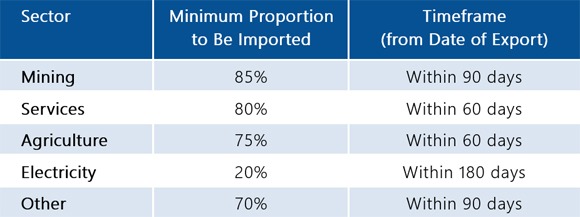
The ratios and timeframes are subject to change depending on the circumstances. If exporters cannot comply with the required ratio and timeline, exporters must provide relevant explanatory documents for the BOL’s consideration.

Selling Foreign-Currency Income

Exporters of goods and services must sell at least the minimum required proportion of their foreign-currency income (see table below) to a commercial bank in Laos. This foreign currency exchange must occur within three working days of receiving the foreign currency into the dedicated bank account in Laos. The selling rate will be determined by the prevailing rate of the commercial bank on the day of the transaction.
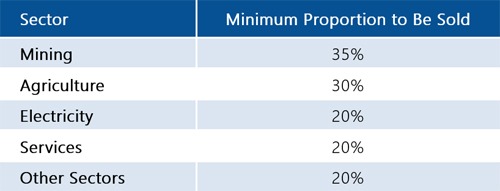
In conducting these transactions, commercial banks are required to carefully consider and manage their reserves and overall liquidity to ensure that they can meet public demand.

If an exporter does not sell at least the minimum required amount of foreign currency within three working days, the relevant commercial bank must proceed with the minimum required exchange and notify the exporter that they are doing so.

These requirements do not apply to re-exporters, such as importers of unprocessed raw materials for re-export to other countries, as determined by the Department of Foreign Currency Management (DFCM).

After selling the minimum required amount to a commercial bank, the remaining foreign-currency income must be used for foreign-currency exchange purposes, such as payments to parties in foreign countries, fulfilling obligations to the state, and so on.

Exporters can sell foreign currency to the BOL by notifying it of the need to sell the foreign currency to the DFCM in the BOL, after which they can sell the currency to the BOL through a commercial bank.

Registration

Decision No. 333 requires service exporters to register as importers and exporters to bring in income generated from exporting services. Although it doesn’t specify the types of service businesses that need to register, a March 2024 notice from the Ministry of Industry and Commerce offers examples of such businesses, including those in international transport, insurance, tourism and hotels, construction, and consulting.

Violations

First-time violations of Decision No. 333 that do not cause damage are subject to training on the importance of complying with Lao law or a warning. If the violation persists after the training or warning, the violator will face suspension of its ability to export goods and services.

For more information on Decision No. 333, or on any aspect of foreign currency management in Laos, please contact Tilleke & Gibbins at [email protected].

RELATED INSIGHTS​ 

December 17, 2025
Tilleke & Gibbins has authored the Vietnam chapter in International Trade 2026, published by Chambers and Partners. The guide offers comprehensive coverage of international trade regulation in leading jurisdictions and serves as a practical resource for organizations engaged in global trade and investment. The Vietnam chapter addresses a wide range of trade-related issues, including: WTO participation and regional and bilateral trade agreements Customs administration, enforcement, and applicable legal instruments Sanctions regimes and enforcement authorities Export controls, sensitive exports, and licensing requirements Antidumping and countervailing duty investigations and reviews Investment security mechanisms and notification requirements Subsidies, incentives, and measures affecting domestic production Standards, technical requirements, and sanitary and phytosanitary measures Geographical indications and other regulatory measures affecting trade In addition to outlining the current regulatory landscape, the chapter discusses recent developments and anticipated changes relevant to businesses trading with or operating in Vietnam. Chambers’ International Trade 2026 guide brings together contributions from leading law firms worldwide, offering up-to-date, jurisdiction-specific insight into the evolving global trade environment. Tilleke & Gibbins also contributed the Thailand chapter to International Trade 2026. A PDF of the Vietnam chapter can be downloaded through the button below, and the full International Trade 2026 guide is available for free on the Chambers and Partners website.
December 8, 2025
On November 18, 2025, Thailand’s Ministry of Finance issued an announcement that revises and expands the scope of goods that may be imported duty-free for educational, research, and cultural purposes, streamlining the framework for institutions and organizations engaged in academic and scientific activities. The announcement, which took effect the following day, amends customs duty exemptions under section 12 of the Customs Tariff Decree B.E. 2530 (1987). Expanded Institutional Coverage The announcement broadens the types of entities eligible to import duty-free goods. Under the revised framework, the Ministry of Higher Education, Science, Research and Innovation (MHESI) now certifies imports for educational and research purposes by: Public and private educational institutions operating under the National Education Act; Government agencies with statutory mandates for education and research; and Associations and foundations whose objectives include educational research. This expansion recognizes a wider range of organizations engaged in knowledge-based activities and removes previous limitations that may have excluded certain nonprofit entities. To qualify for duty exemption, goods must be imported specifically for educational and research use, as certified by the MHESI. Additionally, equivalent goods must not already be available from domestic producers, although the certifying ministry may approve imports of domestically available items if it determines that foreign procurement is critically necessary. Categories of Duty-Free Goods The announcement specifies seven categories of goods eligible for duty exemption: Newspapers, printed materials, and documents Art objects and collectibles related to education, science, or culture Audiovisual equipment for educational, scientific, or cultural purposes Scientific materials, instruments, and equipment Goods for persons with disabilities Musical instruments, sports equipment, and skill-enhancement tools Art and architecture education equipment Qualification Procedures Before importing goods under this exemption, operators must secure certification from the MHESI. This certification process requires demonstrating that the goods will be used for educational or research purposes and,
December 4, 2025
Thailand has expanded the circumstances under which state agencies may bypass competitive bidding procedures to address urgent security challenges. On November 28, 2025, Thailand’s Ministry of Finance published the Ministerial Regulation Determining Cases of Procurement by Specific Method (No. 6) B.E. 2568 in the Royal Gazette, introducing a new pathway for procuring supplies and services needed to address cyber and military threats that may affect the stability of government agencies or the nation. For technology vendors, cybersecurity firms, and defense contractors, this regulatory change creates immediate opportunities to engage directly with government buyers facing urgent security challenges. New Fast-Track Category for Security Threats The regulation amends Thailand’s Public Procurement and Supplies Management Act B.E. 2560 (2017) to add a new category of procurement that qualifies for the “specific method”—a noncompetitive, direct selection process. Previously, agencies could use this expedited method only in limited circumstances, such as emergencies, cases with proprietary technology requirements, or national security operations. The new provision explicitly covers procurement of supplies related to preventing or resolving cyber or military threats that could impact the stability of a state agency or the country. This addition recognizes the urgent nature of modern security challenges, where competitive bidding timelines may leave agencies vulnerable during critical threat windows. State agencies dealing with active cyberattacks, preparing defensive measures against anticipated threats, or responding to military security concerns can now move directly to negotiate with qualified vendors rather than conducting lengthy public tender processes. Vendor Considerations Vendors offering cybersecurity solutions now have a regulatory avenue to work directly with government clients when stability concerns are present. These solutions include threat detection systems, anti-ransomware tools, incident response services, firewalls, and security consulting. Similarly, defense contractors providing military equipment or specialized security supplies can pursue direct engagement channels where traditional procurement methods would create
November 26, 2025
On November 21, 2025, Myanmar’s Ministry of Commerce (MOC) issued Notification No. 103/2025 promulgating the Geographical Indication Rules (GI Rules), establishing a comprehensive framework for the registration and administration of geographical indications (GI), which are primarily governed by the Trademark Law of 2019. On the same day, the MOC released Notification No. 104/2025 specifying the required forms for GI-related matters. The GI Rules establish a comprehensive set of procedures for the entire GI application process, including filing applications, oppositions, cancellations, and invalidations, and appointing a local representative for GI-related matters. Under the Trademark Law and the GI Rules, domestic and foreign legal entities (organizations) that formally represent a defined group of stakeholders (such as producers or manufacturers of natural products or resources, agricultural products, handicrafts, or industrial products) and other competent authorities from government departments are eligible to apply for GI registration with the Intellectual Property Department (IPD) in Myanmar. Application A GI application can be submitted in either English or Myanmar language electronically, in person, or via post. Foreign applicants seeking to register a GI in Myanmar are required to submit a copy of the registration certificate from their country of origin with the GI application. This certificate must explicitly state the GI name of the protected product. Notably, foreign applicants are mandated to appoint a local representative in Myanmar to act on their behalf for GI-related matters with the IPD and appeal-related matters with the IP Agency. The form for appointing the local representative must be duly notarized in the applicant’s home country to ensure its legal validity and acceptance in accordance with the GI Rules. Application for Use of GI Logo Pursuant to the GI Rules, any interested individual, local or foreign, may submit an application to the IPD for authorization to use the GI logo,