
You are using an outdated browser and your browsing experience will not be optimal. Please update to the latest version of Microsoft Edge, Google Chrome or Mozilla Firefox. Install Microsoft Edge

June 7, 2024

Laos Regulates Management of Foreign Currency from Exports

On March 7, 2024, Laos moved to regulate the management of foreign-currency income from the exportation of goods and services. Effective March 29, 2024, Decision No. 333 (formally the Decision on Management of Income in Foreign Currency from Exportation of Goods and Services No. 333/BOL) from the Bank of Lao PDR (BOL) aims to incentivize the inflow of such foreign currency into Laos and its sale to licensed commercial banks.

Decision No. 333 sets minimum required proportions for importing income in foreign currency derived from the exportation of goods and services, as well as the timeframe for doing so. It also stipulates the requirements for selling such foreign currency to commercial banks in Laos and the minimum proportions that must be sold.

Importing Foreign-Currency Income

Exporters must receive payments from abroad via bank transfer into a dedicated bank account designated for import-export business activities within the timeline specified in the sale-purchase agreement, but not exceeding 180 days from the date of export. Each sector must import income in foreign currency into the Lao PDR according to the minimum proportion of currency to be imported, and it must be done within the required timeframes, as specified in the table below.
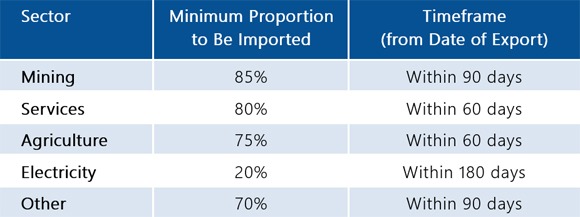
The ratios and timeframes are subject to change depending on the circumstances. If exporters cannot comply with the required ratio and timeline, exporters must provide relevant explanatory documents for the BOL’s consideration.

Selling Foreign-Currency Income

Exporters of goods and services must sell at least the minimum required proportion of their foreign-currency income (see table below) to a commercial bank in Laos. This foreign currency exchange must occur within three working days of receiving the foreign currency into the dedicated bank account in Laos. The selling rate will be determined by the prevailing rate of the commercial bank on the day of the transaction.
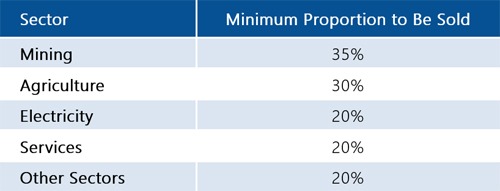
In conducting these transactions, commercial banks are required to carefully consider and manage their reserves and overall liquidity to ensure that they can meet public demand.

If an exporter does not sell at least the minimum required amount of foreign currency within three working days, the relevant commercial bank must proceed with the minimum required exchange and notify the exporter that they are doing so.

These requirements do not apply to re-exporters, such as importers of unprocessed raw materials for re-export to other countries, as determined by the Department of Foreign Currency Management (DFCM).

After selling the minimum required amount to a commercial bank, the remaining foreign-currency income must be used for foreign-currency exchange purposes, such as payments to parties in foreign countries, fulfilling obligations to the state, and so on.

Exporters can sell foreign currency to the BOL by notifying it of the need to sell the foreign currency to the DFCM in the BOL, after which they can sell the currency to the BOL through a commercial bank.

Registration

Decision No. 333 requires service exporters to register as importers and exporters to bring in income generated from exporting services. Although it doesn’t specify the types of service businesses that need to register, a March 2024 notice from the Ministry of Industry and Commerce offers examples of such businesses, including those in international transport, insurance, tourism and hotels, construction, and consulting.

Violations

First-time violations of Decision No. 333 that do not cause damage are subject to training on the importance of complying with Lao law or a warning. If the violation persists after the training or warning, the violator will face suspension of its ability to export goods and services.

For more information on Decision No. 333, or on any aspect of foreign currency management in Laos, please contact Tilleke & Gibbins at [email protected].

RELATED INSIGHTS​ 

January 6, 2026
Among the eight implementing decrees issued on December 18, 2025, to provide the legal framework for Vietnam’s new International Financial Centers (IFC), Decree No. 323/2025/ND‑CP serves the core function of officially establishing the IFC as a unified entity in two locations—Ho Chi Minh City and Da Nang—and setting out a plan for its development and governance. The key contents of the decree are summarized below. Location and Focus of IFCs The Vietnam International Financial Center in Ho Chi Minh City (VIFC‑HCMC) and the Vietnam International Financial Center in Da Nang (VIFC‑DN) are designed to attract capital, fintech, and international market participants under a dedicated regulatory framework. The IFCs will host functional zones for financial trading, banking, securities and commodities exchanges, offices, dispute resolution (via specialized court and international arbitration center), and related activities as set by the executive authority of each IFC. VIFC-HCMC, with a total area of 898 hectares in central Ho Chi Minh City, is oriented to develop a comprehensive and diverse financial ecosystem, providing traditional and specialized financial services, and leveraging synergies between financial services such as capital mobilization, investment, payment services, issuance and trading of financial products, asset management, fintech, and green financial services. VIFC-DN, with a total area of 300 hectares, is oriented to develop as a modern IFC, closely integrated with the innovation ecosystem, digital technology, and sustainable finance. VIFC-DN will establish a controlled testing platform for new financial models, taking the lead in the deployment and scaling of digital-asset products, digital payments, and specialized trading platforms and exchanges, while promoting supply chain finance, third-party services, and non-bank financial intermediaries to complement and support the traditional financial market, developing specialized, flexible, and innovative financial products. Near‑Term Priorities and Review Timeline In 2026, the government will prioritize completing the essential infrastructure and ensuring adequate
January 5, 2026
Resolution No. 222/2025/QH15 dated June 27, 2025, of the National Assembly of Vietnam (the “IFC Resolution” – see our previous article) set out the foundational legal framework for the establishment and development of Vietnam’s first-ever International Financial Centers (IFC). In furtherance of this framework, on December 18, 2025, the government of Vietnam issued eight implementing decrees to provide detailed regulatory guidance and to operationalize the IFC Resolution in practice. The Eight Implementing Decrees: An Integrated Regulatory Ecosystem The new decrees governing the IFC include the following: Decree No. 323/2025/ND-CP on the establishment of the IFC. Decree No. 324/2025/ND-CP on financial policies applicable within the IFC. Decree No. 325/2025/ND-CP on labor, employment, and social security within the IFC. Decree No. 326/2025/ND-CP on land and environmental matters within the IFC. Decree No. 327/2025/ND-CP on entry, exit, and residence of foreign nationals in the IFC. Decree No. 328/2025/ND-CP on the International Arbitration Center of the IFC. Decree No. 329/2025/ND-CP on banking licensing, foreign exchange management, and anti-money laundering and combating the financing of terrorism (AML/CFT) within the IFC. Decree No. 330/2025/ND-CP on the establishment and operation of commodity exchanges within the IFC. Taken as a whole, these eight decrees translate the IFC Resolution into a coherent and fully operational legal regime governing the establishment, organization, and functioning of Vietnam’s IFC. Collectively, they demonstrate that Vietnam’s IFC framework is best understood not as a collection of isolated incentives, but as a deliberately designed and integrated regulatory system. The Legal Architecture of the IFC: Four Interlocking Pillars Read together, the decrees seem to be designed to address four core regulatory questions from the outset: (i) what the IFC is, from a legal and institutional perspective; (ii) who may participate in the IFC and what activities are permitted; (iii) how people, capital, and projects operate
December 26, 2025
The Bank of Thailand (BOT) has released the Guidelines for Digital Fraud Management, which took effect on December 17, 2025, incorporating certain amendments to the draft guidelines issued in March 2025. These official guidelines aim for end-to-end digital fraud prevention, with a particular focus on mule accounts, to enhance trust and security in Thailand’s financial system. The guidelines apply to “financial service providers,” including: Financial institutions and special financial institutions under the Financial Institution Business Act; and Operators of Inter-institutional Fund Transfer System e-money services and e-fund transfer services under the Payment Systems Act. Besides commercial banks and e-money operators that offer fund-transfer services, other providers may adopt requirements based on risk proportionality and baseline standards set out in the guidelines (for instance, an e-money operator that does not offer e-fund transfer services could consider implementing a fraud monitoring and detection system according to the risk level of its service). The guidelines establish the following key requirements: Policy and oversight. Directors and senior executives of financial service providers must adopt appropriate “end-to-end” fraud management policies and KPIs to manage digital fraud, covering prevention, monitoring, detection, management, resolution, and support for affected customers. The fraud management policy must be regularly reviewed, and whenever there is a situation or change that significantly affects the efficiency of the fraud management. Any significant update to the policy must first be approved by the board of the financial service provider. The BOT also encourages providers to collaborate in establishing industry standards aligned with applicable laws and regulations to ensure consistency and best practices across the sector. Fraud management processes. Financial service providers must establish a clear framework for managing digital fraud throughout the customer lifecycle—from customer onboarding to service termination—covering at least the following processes: Know your customer (KYC) and customer due diligence (CDD):
December 17, 2025
Tilleke & Gibbins has contributed the Thailand chapter to International Trade 2026, published by Chambers and Partners. International Trade 2026 provides an overview of international trade laws and regulations across major jurisdictions. The guide is designed as a practical reference for businesses, in-house counsel, and legal practitioners dealing with cross-border trade, customs, and regulatory compliance. The Thailand chapter examines key aspects of Thailand’s international trade framework, including: WTO membership, plurilateral arrangements, and free trade agreements Customs authorities, enforcement agencies, and customs regulations Trade sanctions regimes and compliance obligations Export controls, restricted persons, and licensing requirements Antidumping, countervailing duties, and safeguard measures Investment security mechanisms and regulatory oversight Subsidy and incentive programs for domestic production Standards, technical requirements, and sanitary and phytosanitary measures Geographical protections and other trade-related regulatory measures The chapter also highlights recent developments and pending regulatory changes affecting trade and investment in Thailand. Chambers’ International Trade 2026 guide brings together contributions from leading law firms worldwide, offering up-to-date, jurisdiction-specific insight into the evolving global trade environment. Tilleke & Gibbins also contributed the Vietnam chapter to International Trade 2026. A PDF of the Thailand chapter can be downloaded through the button below, and the full International Trade 2026 guide is available for free on the Chambers and Partners website.