
You are using an outdated browser and your browsing experience will not be optimal. Please update to the latest version of Microsoft Edge, Google Chrome or Mozilla Firefox. Install Microsoft Edge

June 7, 2024

Laos Regulates Management of Foreign Currency from Exports

On March 7, 2024, Laos moved to regulate the management of foreign-currency income from the exportation of goods and services. Effective March 29, 2024, Decision No. 333 (formally the Decision on Management of Income in Foreign Currency from Exportation of Goods and Services No. 333/BOL) from the Bank of Lao PDR (BOL) aims to incentivize the inflow of such foreign currency into Laos and its sale to licensed commercial banks.

Decision No. 333 sets minimum required proportions for importing income in foreign currency derived from the exportation of goods and services, as well as the timeframe for doing so. It also stipulates the requirements for selling such foreign currency to commercial banks in Laos and the minimum proportions that must be sold.

Importing Foreign-Currency Income

Exporters must receive payments from abroad via bank transfer into a dedicated bank account designated for import-export business activities within the timeline specified in the sale-purchase agreement, but not exceeding 180 days from the date of export. Each sector must import income in foreign currency into the Lao PDR according to the minimum proportion of currency to be imported, and it must be done within the required timeframes, as specified in the table below.
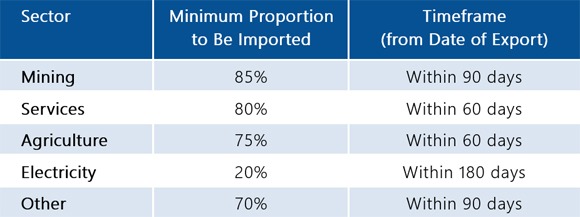
The ratios and timeframes are subject to change depending on the circumstances. If exporters cannot comply with the required ratio and timeline, exporters must provide relevant explanatory documents for the BOL’s consideration.

Selling Foreign-Currency Income

Exporters of goods and services must sell at least the minimum required proportion of their foreign-currency income (see table below) to a commercial bank in Laos. This foreign currency exchange must occur within three working days of receiving the foreign currency into the dedicated bank account in Laos. The selling rate will be determined by the prevailing rate of the commercial bank on the day of the transaction.
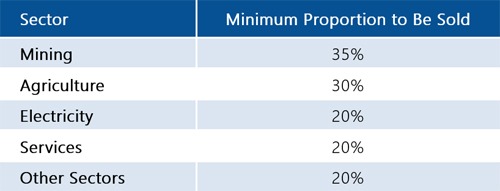
In conducting these transactions, commercial banks are required to carefully consider and manage their reserves and overall liquidity to ensure that they can meet public demand.

If an exporter does not sell at least the minimum required amount of foreign currency within three working days, the relevant commercial bank must proceed with the minimum required exchange and notify the exporter that they are doing so.

These requirements do not apply to re-exporters, such as importers of unprocessed raw materials for re-export to other countries, as determined by the Department of Foreign Currency Management (DFCM).

After selling the minimum required amount to a commercial bank, the remaining foreign-currency income must be used for foreign-currency exchange purposes, such as payments to parties in foreign countries, fulfilling obligations to the state, and so on.

Exporters can sell foreign currency to the BOL by notifying it of the need to sell the foreign currency to the DFCM in the BOL, after which they can sell the currency to the BOL through a commercial bank.

Registration

Decision No. 333 requires service exporters to register as importers and exporters to bring in income generated from exporting services. Although it doesn’t specify the types of service businesses that need to register, a March 2024 notice from the Ministry of Industry and Commerce offers examples of such businesses, including those in international transport, insurance, tourism and hotels, construction, and consulting.

Violations

First-time violations of Decision No. 333 that do not cause damage are subject to training on the importance of complying with Lao law or a warning. If the violation persists after the training or warning, the violator will face suspension of its ability to export goods and services.

For more information on Decision No. 333, or on any aspect of foreign currency management in Laos, please contact Tilleke & Gibbins at [email protected].

RELATED INSIGHTS​ 

April 2, 2021
On March 3, 2021, two new types of license became available to operators of securities businesses in Thailand, following the enactment of an amendment to the ministerial regulation regarding securities business licensing in Thailand, which was announced by the Ministry of Finance four months prior. While existing license types are broader, and subject to high-level conditions and compliance levels, the two new licenses are more specific and may be more suitable and cost-effective for operators whose activities are limited to a narrower scope of securities business. The details of the two new license types—the Type E Securities Business License and the Private Fund Management License—are as follows: Type E Securities Business License A Type E Securities Business License covers the following business activities: Equity brokerage Equity dealing Equity underwriting Investment advisory service Securities borrowing and lending Operators eligible to apply for a Type E License include: securities companies; commercial banks; life insurance companies; special-purpose financial institutions; and, Thai incorporated companies. Private Fund Management License Previously, business operators who only intended to conduct private fund management business had to apply for a Type C license—a broad category of license covering mutual fund management, private fund management, brokerage for investment units or trust certificates, and so on. The new Private Fund Management License provides a more targeted alternative to the Type C license, which is subject to higher license fees and more comprehensive compliance requirements. New applicants for a securities business license may now specify one of the additional license types when applying to the Ministry of Finance through the SEC. Holders of existing securities business licenses can also apply to change to one of the new license types.
March 10, 2021
Getting the Deal Through – Licensing 2021, published by Law Business Research (part of the Lexology network), provides a comprehensive guide to licensing in 18 countries around the world with contributions by several leading international law firms. Alan Adcock, partner and deputy director of intellectual property, Siraprapha Claassen, consultant, and Kasama Sriwatanakul, attorney-at-law from Tilleke & Gibbins’ Bangkok office, co-authored the Licensing 2021 Thailand chapter, which covers the following topics: Laws: Unfair Contract Terms Act, Trade Competition Act, pre-contractual disclosure, registration of international licensing, implied obligations, Civil and Commercial Code, Trademark Act, Patent Act, and Trade Secrets Act. Intellectual property issues: Paris Convention for the Protection of Industrial Property, PCT, TRIPs. Contesting the validity of licensor’s IP rights, invalidity and expiry of IP rights, evidence of use, licensing unregistered IP, opposability requirements, sub-licensing, co-owners, trade secrets, and copyright. Software licensing: perpetual licensing, import/export restrictions, improvements and modifications, user restrictions, and legal developments. Competition law: Trade Competition Act, specific restrictions on licensing agreements, and significant court decisions. Indemnification, disclaimers, and damages: prevalence and enforceability of indemnity provisions and contractual waivers of damages. Termination: conditions, indemnity, agency, and impact on sub-licenses. Bankruptcy: impact of licensee bankruptcy on licensor and vice versa, protection, and rights to terminate. Dispute resolution: governing law, arbitration, enforcement, injunctions, contractual waivers Royalties and payments: currency conversion, tax, remittance restrictions, and jurisdiction-specific payments. The Thailand chapter is available below as a PDF. Tilleke & Gibbins also contributed the Vietnam chapter to Licensing 2021. To browse all 18 jurisdictions covered by the guide, please visit the Getting the Deal Through website.
March 10, 2021
Attorneys from Tilleke & Gibbins’ office in Hanoi have written the Vietnam chapter for Getting the Deal Through – Licensing 2021, a comparative guide to licensing law and practice in 18 countries around the world. Licensing 2021 provides an overview of a wide range of licensing relationships, including licensing of copyrights, trademarks, and patents; software licenses; technology transfer agreements; and franchise agreements. The book also addresses issues of royalties and other payments, taxes, competition law, and termination of licensing relationships. The Vietnam chapter was authored by Linh Thi Mai Nguyen, Son Thai Hoang, and Chi Lan Dang of Tilleke & Gibbins’ trademark team, along with corporate and commercial attorney Tu Ngoc Trinh, who has extensive experience in franchising and competition law. The Vietnam chapter is available below as a PDF. Tilleke & Gibbins also contributed the Thailand chapter to Licensing 2021. To browse all 18 jurisdictions covered by the guide, please visit the Getting the Deal Through website.
March 2, 2021
Background On May 8, 2020, the Lao Ministry of Justice published the Decree on Consumer Protection regarding Financial Services No. 225/GOV, dated April 6, 2020, in its online Official Gazette. The decree was drafted by the Bank of the Lao PDR (BOL), which is the central bank in Laos. In addition to supplementing the country’s guidelines on commercial banks’ obligations to their customers, the new decree bolsters the country’s consumer protection regulatory regime under its primary relevant piece of legislation, the Law on Consumer Protection No. 02/NA, dated June 30, 2010. Scope of Application The decree was drafted to elaborate on Article 57 of the Law on Commercial Banks No. 56/NA, dated December 7, 2018, which requires commercial banks to devise clear procedures for receiving and resolving consumer complaints. Besides its application to commercial banks as defined by the law, the decree also applies to a wide range of service providers, including microfinance institutions (deposit-taking or otherwise), deposit and savings cooperatives, leasing companies, pawnshops, and providers proposing other types of financial services under the supervision of the BOL (referred to collectively as “service providers”). Likewise, the decree addresses a spectrum of financial services, including: Monetary deposits and issuance of deposit certificates; Provision of credit; Card services; Hire-purchase and leasing; Mortgages; Payment services; Buying and selling currencies; and, Other services authorized by the BOL, which covers all types of banking services in Laos. Fee Restrictions and Disclosure Requirements for Financial Services The decree requires service providers to set a written policy determining the appropriateness of the selected product, official fee, service fee, representation fee, interests rate, and other fees, in accordance with the relevant law and regulations (if any), and to document the justification for the price of each product. Service providers are also required to advise consumers on financial