
You are using an outdated browser and your browsing experience will not be optimal. Please update to the latest version of Microsoft Edge, Google Chrome or Mozilla Firefox. Install Microsoft Edge

June 7, 2024

Laos Regulates Management of Foreign Currency from Exports

On March 7, 2024, Laos moved to regulate the management of foreign-currency income from the exportation of goods and services. Effective March 29, 2024, Decision No. 333 (formally the Decision on Management of Income in Foreign Currency from Exportation of Goods and Services No. 333/BOL) from the Bank of Lao PDR (BOL) aims to incentivize the inflow of such foreign currency into Laos and its sale to licensed commercial banks.

Decision No. 333 sets minimum required proportions for importing income in foreign currency derived from the exportation of goods and services, as well as the timeframe for doing so. It also stipulates the requirements for selling such foreign currency to commercial banks in Laos and the minimum proportions that must be sold.

Importing Foreign-Currency Income

Exporters must receive payments from abroad via bank transfer into a dedicated bank account designated for import-export business activities within the timeline specified in the sale-purchase agreement, but not exceeding 180 days from the date of export. Each sector must import income in foreign currency into the Lao PDR according to the minimum proportion of currency to be imported, and it must be done within the required timeframes, as specified in the table below.
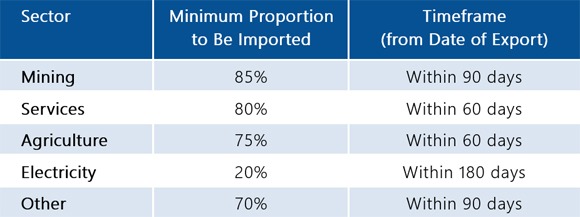
The ratios and timeframes are subject to change depending on the circumstances. If exporters cannot comply with the required ratio and timeline, exporters must provide relevant explanatory documents for the BOL’s consideration.

Selling Foreign-Currency Income

Exporters of goods and services must sell at least the minimum required proportion of their foreign-currency income (see table below) to a commercial bank in Laos. This foreign currency exchange must occur within three working days of receiving the foreign currency into the dedicated bank account in Laos. The selling rate will be determined by the prevailing rate of the commercial bank on the day of the transaction.
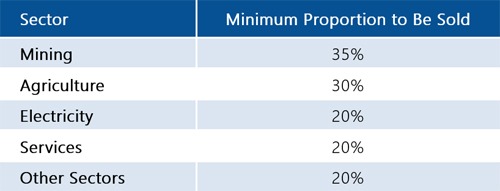
In conducting these transactions, commercial banks are required to carefully consider and manage their reserves and overall liquidity to ensure that they can meet public demand.

If an exporter does not sell at least the minimum required amount of foreign currency within three working days, the relevant commercial bank must proceed with the minimum required exchange and notify the exporter that they are doing so.

These requirements do not apply to re-exporters, such as importers of unprocessed raw materials for re-export to other countries, as determined by the Department of Foreign Currency Management (DFCM).

After selling the minimum required amount to a commercial bank, the remaining foreign-currency income must be used for foreign-currency exchange purposes, such as payments to parties in foreign countries, fulfilling obligations to the state, and so on.

Exporters can sell foreign currency to the BOL by notifying it of the need to sell the foreign currency to the DFCM in the BOL, after which they can sell the currency to the BOL through a commercial bank.

Registration

Decision No. 333 requires service exporters to register as importers and exporters to bring in income generated from exporting services. Although it doesn’t specify the types of service businesses that need to register, a March 2024 notice from the Ministry of Industry and Commerce offers examples of such businesses, including those in international transport, insurance, tourism and hotels, construction, and consulting.

Violations

First-time violations of Decision No. 333 that do not cause damage are subject to training on the importance of complying with Lao law or a warning. If the violation persists after the training or warning, the violator will face suspension of its ability to export goods and services.

For more information on Decision No. 333, or on any aspect of foreign currency management in Laos, please contact Tilleke & Gibbins at [email protected].

RELATED INSIGHTS​ 

March 10, 2022
The Securities and Exchange Commission of Thailand (SEC) will refresh its definitions of institutional, high-net-worth (HNW), and ultra-high-net-worth (UHNW) investors according to its recently issued Notification No. Kor Jor 39/2564, effective on October 1, 2022. The key changes to these classifications are described below. Institutional Investors The SEC’s list of types of institutional investors will be expanded by the addition of the following four types: Venture capital. This refers to juristic persons established under Thai or foreign law for the purpose of investing in a startup, whereby the investors must not be retail investors. Private equity. This describes businesses established under Thai or foreign law for the purpose of investment by three or more nonretail investors who have appointed a person to manage the investment funds and accrued assets. The business must also have a policy to invest in other enterprises through arrangements that involve either stock investment agreements or other financial support giving rise to the right to acquire stock in the enterprise in the future. Under such arrangements, the private equity investor must demonstrate involvement in the enterprise’s business management (e.g., through planning, developmental, or other operational control). Sophisticated/professional investors. This type of investor includes (1) fund managers or derivatives fund managers in accordance with the Capital Market Supervisory Board’s rules on capital market business personnel; (2) investment analysts authorized by the SEC; and (3) angel investors, defined as experienced and knowledgeable SEC-approved financial advisors or crowdfunding portal providers, or other individual or juristic investors, with net assets of at least THB 50 million, annual revenue of at least THB 4 million, or gross direct investment in securities and derivatives of at least THB 10 million (or THB 20 million if cash deposits are aggregated). Investments by angel investors are limited to securities offered by SMEs or
March 8, 2022
On February 15, 2022, Thailand’s cabinet approved in principle a package of incentives to promote electric vehicle (EV) adoption in Thailand, with the aim of making the country an EV manufacturing hub in Asia. A week later, the cabinet approved further draft regulations including specific information on customs duty reductions and exemptions for certain types of imported EVs. The plan includes both tax and non-tax incentives from 2022 until 2025. In the first two years (2022–2023), the package incentivizes the widespread use of EVs in Thailand by providing exemption or reduction of import duties and excise tax, as well as subsidies to increase the demand for EVs and attract investment in the EV industry. These incentives will cover the importation of completely built up (CBU) cars and motorcycles, and the local manufacturing of completely knocked down (CKD) vehicles in Thailand. For the following two years (2024–2025), the plan promotes the use of domestically produced EVs by eliminating the exemption or reduction of import duties for CBU vehicles while maintaining the other incentives (e.g., reduced excise tax rates, and subsidies). The aim of this is to make the cost of CBU vehicles higher than locally produced vehicles to encourage operators to produce EVs in the country to meet increasing demand. Additional measures encourage the manufacturing of EVs in Thailand, including exemption of import duties for parts imported between 2022 and 2025, and treatment of the value of imported battery cells as a cost of local manufacturing (up to 15% of an EV’s retail price). This is beneficial to local manufacturers of EVs, as their activities will be entitled to a more generous incentive package than importation of EVs. At their meeting on February 22, 2022, Thailand’s cabinet further approved draft subordinate regulations, including specific reductions and exemptions of customs duty
March 7, 2022
Attorneys from Tilleke & Gibbins wrote the Thailand chapter for Licensing 2022, a comprehensive guide from Lexology Getting the Deal Through to licensing in 17 countries around the world. Two specialists from Tilleke & Gibbins’ Bangkok office—Alan Adcock, partner and deputy director of intellectual property, and Kasama Sriwatanakul, senior associate—authored the Licensing 2021 Thailand chapter, which covers the following topics: Laws: Unfair Contract Terms Act, Trade Competition Act, pre-contractual disclosure, registration of international licensing, implied obligations, Civil and Commercial Code, Trademark Act, Patent Act, and Trade Secrets Act. Intellectual property issues: Paris Convention for the Protection of Industrial Property, PCT, TRIPs. Contesting the validity of licensor’s IP rights, invalidity and expiry of IP rights, evidence of use, licensing unregistered IP, opposability requirements, sub-licensing, co-owners, trade secrets, and copyright. Software licensing: Perpetual licensing, import/export restrictions, improvements and modifications, user restrictions, and legal developments. Competition law: Trade Competition Act, specific restrictions on licensing agreements, and significant court decisions. Indemnification, disclaimers, and damages: Prevalence and enforceability of indemnity provisions and contractual waivers of damages. Termination: Conditions, indemnity, agency, and impact on sub-licenses. Bankruptcy: Impact of licensee bankruptcy on licensor and vice versa, protection, and rights to terminate. Dispute resolution: Governing law, arbitration, enforcement, injunctions, contractual waivers Royalties and payments: Currency conversion, tax, remittance restrictions, and jurisdiction-specific payments. The Thailand chapter is available below as a PDF. Tilleke & Gibbins also contributed the Vietnam chapter to Licensing 2022. To browse all 17 jurisdictions covered by the guide, please visit the Getting the Deal Through website.
March 7, 2022
Attorneys from Tilleke & Gibbins have written the Vietnam chapter for Licensing 2022, a comparative guide from Lexology Getting the Deal Through to licensing law and practice in 17 countries around the world. Licensing 2022, a guide that provides an overview of a wide range of licensing relationships, including licensing of copyrights, trademarks, and patents; software licenses; technology transfer agreements; and franchise agreements. The book also addresses issues of royalties and other payments, taxes, competition law, and termination of licensing relationships. The Vietnam chapter was authored by Linh Thi Mai Nguyen, partner and head of Tilleke & Gibbins’ trademark team in Vietnam; Son Thai Hoang, trademark executive; and Chi Lan Dang, associate, of Tilleke & Gibbins’ trademark team, along with corporate and commercial senior associate Tu Ngoc Trinh, who has extensive experience in franchising and competition law. The Vietnam chapter is available below as a PDF. Tilleke & Gibbins also contributed the Thailand chapter to Licensing 2022. To browse all 17 jurisdictions covered by the guide, please visit the Getting the Deal Through website.