
You are using an outdated browser and your browsing experience will not be optimal. Please update to the latest version of Microsoft Edge, Google Chrome or Mozilla Firefox. Install Microsoft Edge

June 7, 2024

Laos Regulates Management of Foreign Currency from Exports

On March 7, 2024, Laos moved to regulate the management of foreign-currency income from the exportation of goods and services. Effective March 29, 2024, Decision No. 333 (formally the Decision on Management of Income in Foreign Currency from Exportation of Goods and Services No. 333/BOL) from the Bank of Lao PDR (BOL) aims to incentivize the inflow of such foreign currency into Laos and its sale to licensed commercial banks.

Decision No. 333 sets minimum required proportions for importing income in foreign currency derived from the exportation of goods and services, as well as the timeframe for doing so. It also stipulates the requirements for selling such foreign currency to commercial banks in Laos and the minimum proportions that must be sold.

Importing Foreign-Currency Income

Exporters must receive payments from abroad via bank transfer into a dedicated bank account designated for import-export business activities within the timeline specified in the sale-purchase agreement, but not exceeding 180 days from the date of export. Each sector must import income in foreign currency into the Lao PDR according to the minimum proportion of currency to be imported, and it must be done within the required timeframes, as specified in the table below.
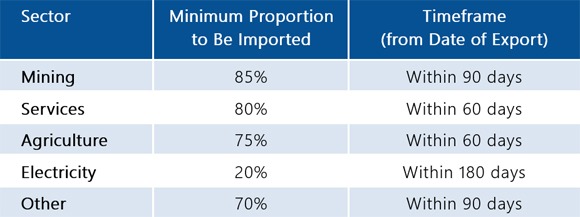
The ratios and timeframes are subject to change depending on the circumstances. If exporters cannot comply with the required ratio and timeline, exporters must provide relevant explanatory documents for the BOL’s consideration.

Selling Foreign-Currency Income

Exporters of goods and services must sell at least the minimum required proportion of their foreign-currency income (see table below) to a commercial bank in Laos. This foreign currency exchange must occur within three working days of receiving the foreign currency into the dedicated bank account in Laos. The selling rate will be determined by the prevailing rate of the commercial bank on the day of the transaction.
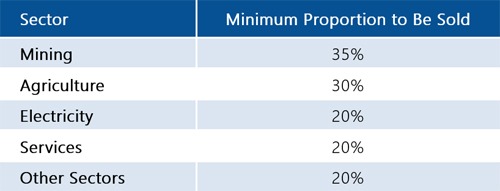
In conducting these transactions, commercial banks are required to carefully consider and manage their reserves and overall liquidity to ensure that they can meet public demand.

If an exporter does not sell at least the minimum required amount of foreign currency within three working days, the relevant commercial bank must proceed with the minimum required exchange and notify the exporter that they are doing so.

These requirements do not apply to re-exporters, such as importers of unprocessed raw materials for re-export to other countries, as determined by the Department of Foreign Currency Management (DFCM).

After selling the minimum required amount to a commercial bank, the remaining foreign-currency income must be used for foreign-currency exchange purposes, such as payments to parties in foreign countries, fulfilling obligations to the state, and so on.

Exporters can sell foreign currency to the BOL by notifying it of the need to sell the foreign currency to the DFCM in the BOL, after which they can sell the currency to the BOL through a commercial bank.

Registration

Decision No. 333 requires service exporters to register as importers and exporters to bring in income generated from exporting services. Although it doesn’t specify the types of service businesses that need to register, a March 2024 notice from the Ministry of Industry and Commerce offers examples of such businesses, including those in international transport, insurance, tourism and hotels, construction, and consulting.

Violations

First-time violations of Decision No. 333 that do not cause damage are subject to training on the importance of complying with Lao law or a warning. If the violation persists after the training or warning, the violator will face suspension of its ability to export goods and services.

For more information on Decision No. 333, or on any aspect of foreign currency management in Laos, please contact Tilleke & Gibbins at [email protected].

RELATED INSIGHTS​ 

November 3, 2022
On October 31, 2022, the Department of Trade in Myanmar’s Ministry of Commerce announced that payments for importation at the border are to be made via bank transaction. This announcement comes into force with Import/Export Newsletter No. 10/2022, dated October 31, 2022, issued by the Department of Trade, with the purpose of implementing a systematic payment system for import and export at the border, in accordance with a suggestion made by the Financial Action Task Force (FATF), an international financial watchdog. (This follows the recent news that the FATF has blacklisted Myanmar.) This requirement means that only bank transactions will be accepted for import payments in the border trade. Initially, this system will be applied to trade at the Myanmar-Thailand border only. The new requirement to pay for imports only via bank transaction states that export earnings and other types of foreign currency earnings (including salary and income remitted by Myanmar workers overseas) will be allowed to be used for imports. Importers are required to make the payments for import goods—using these earnings—via their banks. That is, Importers operating in the border trade must have foreign currency earnings received through official banking channels and must make import payments abroad through official banking channels using those earnings. In contrast to previous practices, they are unable to use other sources of income and are not able to make other payment arrangements that do not involve bank transactions. The procedures for importation at the Myanmar-Thailand border are as follows: Companies applying to the Department of Trade for an import license must produce credit advice and original bank statements that prove the receipt of export earnings or other earnings into their bank account. The Department of Trade will scrutinize the reported export earnings or other earnings, and approve the import license for an
October 31, 2022
On October 21, 2022, the Financial Action Task Force (FATF) added Myanmar to the list of high-risk jurisdictions having significant deficiencies to counter money laundering, terrorist financing, and financing of proliferation. The FATF is an international financial watchdog that aims to impede global money laundering and terrorist financing. It is a policymaking body that monitors implementation of FATF Recommendations and FATF Standards and is not binding as a supervisory authority for financial institutions. Myanmar will remain on the list of countries subject to a call for action until the country has implemented an action plan that: demonstrates an improved understanding of money laundering risks in key areas; demonstrates that onsite and offsite inspections are risk-based, and hundi (a type of informal remittance instrument for transferring money) operators are registered and supervised; demonstrates enhanced use of financial intelligence in law enforcement authorities’ investigations, and increasing operational analysis and dissemination by Myanmar’s Financial Intelligence Unit; ensures that money laundering is investigated and prosecuted in line with risks; demonstrates investigation of transnational money laundering cases with international cooperation; demonstrates an increase in the freezing, seizure, and confiscation of criminal proceeds, instrumentalities, and property of equivalent value; manages seized assets to preserve the value of seized goods until confiscation; and demonstrates implementation of targeted financial sanctions related to proliferation financing. Enhanced Customer Due Diligence Unlike other blacklisted countries, Myanmar is not applicable to countermeasures. Instead, the financial institutions of members and nonmember states of the FATF are urged to conduct “enhanced customer due diligence (CDD) measures” to mitigate the risk of money laundering, terrorist financing, and proliferation financing from Myanmar. Examples of these enhanced CDD measures to be applied to certain higher-risk activities include: Obtaining additional identifying information about the customer (available through public databases or internet sources) and regularly updating the identifying
September 27, 2022
The Bank of Thailand (BOT) and the Fiscal Policy Office have drafted a royal decree that will regulate the hire purchase and leasing of cars and motorcycles under the Financial Institution Business Act B.E. 2551 (2008). This draft royal decree, which comes at a time when the level of household debt is surging in Thailand, aims to address the rise in outstanding debts related to hire purchase and leasing of cars and motorcycles. In recent years, there has been growing concern about such financing for cars and motorcycles, as these arrangements conducted by non-banks are currently unregulated and have sparked many public complaints relating to fees and practices. Scope of Regulated Businesses By virtue of the draft royal decree, businesses carrying out hire purchase and leasing of cars and motorcycles will become regulated businesses under the Financial Institution Business Act B.E. 2551 (2008). The draft royal decree defines “hire purchase” and “leasing” as follows: “Hire purchase” refers to hire purchase of cars and motorcycles according to the Civil and Commercial Code—that is, a contract whereby an owner of a car or motorcycle hires out the vehicle to a customer, and either promises to sell it to the customer or promises that it will become the property of the customer, on the condition that the customer makes a certain number of payments. “Leasing” refers to renting of a car or motorcycle under a financial lease contract in which the lessor procures a car or motorcycle according to the lessee’s request from a manufacturer, distributor, or other party, or a car or motorcycle repossessed from another lessee, in order to allow the lessee to utilize the vehicle. The lessee is obligated to maintain and repair the leased car or motorcycle during the leasing term. However, the lessee cannot terminate the contract unilaterally before maturity. Upon
September 12, 2022
Throughout 2022, the Central Bank of Myanmar (CBM) has implemented a series of rules surrounding the compulsory conversion of foreign currency balances in the country. This began on April 3, when the CBM issued a notification directing foreign currency holders in Myanmar to convert their foreign earnings into Myanmar kyat (MMK), within one day, at the official exchange rate. Since then, the CBM has issued further clarifications and instructions for banks authorized to handle foreign currency, responded to some concerns from foreign investors by exempting certain foreign investment projects from the conversion requirement, and relaxed the currency conversion requirements for trade at the Chinese and Thai borders. The process has not been without some trial-and-error as well, with the CBM walking back some exemptions after they were enacted. Foreign investors and business owners, both in the country and abroad, have raised concerns about this centralized control of foreign currency flow and the depletion of foreign currency in Myanmar’s business community. To help readers understand the sometimes-surprising moves by the CBM over the past months, this article will summarize the key developments in the CBM’s efforts relating to foreign currency conversion. Establishment of Compulsory Exchange Requirement On April 3, 2022, the CBM issued Notification No. 12/2022 and Directive No. 4/2022 requiring nearly all individuals, companies, and other organizations in Myanmar to convert foreign-currency income received from abroad to MMK within one working day of receipt. These requirements took immediate effect for all transfers and applied retroactively to foreign currency balances already in the country. All authorized dealer (AD) banks (i.e., those licensed to exchange foreign currency) were instructed to convert foreign currency held in the foreign currency accounts of “internal residents”—which included locally registered companies, organizations, and offices; Myanmar branches of foreign companies; and individuals residing or established in Myanmar