
You are using an outdated browser and your browsing experience will not be optimal. Please update to the latest version of Microsoft Edge, Google Chrome or Mozilla Firefox. Install Microsoft Edge

June 7, 2024

Laos Regulates Management of Foreign Currency from Exports

On March 7, 2024, Laos moved to regulate the management of foreign-currency income from the exportation of goods and services. Effective March 29, 2024, Decision No. 333 (formally the Decision on Management of Income in Foreign Currency from Exportation of Goods and Services No. 333/BOL) from the Bank of Lao PDR (BOL) aims to incentivize the inflow of such foreign currency into Laos and its sale to licensed commercial banks.

Decision No. 333 sets minimum required proportions for importing income in foreign currency derived from the exportation of goods and services, as well as the timeframe for doing so. It also stipulates the requirements for selling such foreign currency to commercial banks in Laos and the minimum proportions that must be sold.

Importing Foreign-Currency Income

Exporters must receive payments from abroad via bank transfer into a dedicated bank account designated for import-export business activities within the timeline specified in the sale-purchase agreement, but not exceeding 180 days from the date of export. Each sector must import income in foreign currency into the Lao PDR according to the minimum proportion of currency to be imported, and it must be done within the required timeframes, as specified in the table below.
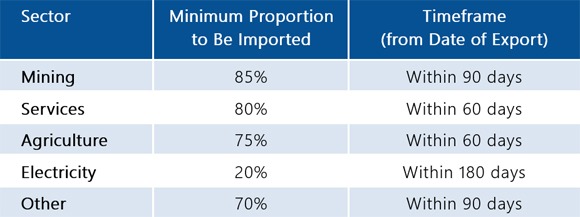
The ratios and timeframes are subject to change depending on the circumstances. If exporters cannot comply with the required ratio and timeline, exporters must provide relevant explanatory documents for the BOL’s consideration.

Selling Foreign-Currency Income

Exporters of goods and services must sell at least the minimum required proportion of their foreign-currency income (see table below) to a commercial bank in Laos. This foreign currency exchange must occur within three working days of receiving the foreign currency into the dedicated bank account in Laos. The selling rate will be determined by the prevailing rate of the commercial bank on the day of the transaction.
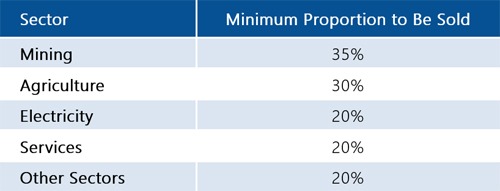
In conducting these transactions, commercial banks are required to carefully consider and manage their reserves and overall liquidity to ensure that they can meet public demand.

If an exporter does not sell at least the minimum required amount of foreign currency within three working days, the relevant commercial bank must proceed with the minimum required exchange and notify the exporter that they are doing so.

These requirements do not apply to re-exporters, such as importers of unprocessed raw materials for re-export to other countries, as determined by the Department of Foreign Currency Management (DFCM).

After selling the minimum required amount to a commercial bank, the remaining foreign-currency income must be used for foreign-currency exchange purposes, such as payments to parties in foreign countries, fulfilling obligations to the state, and so on.

Exporters can sell foreign currency to the BOL by notifying it of the need to sell the foreign currency to the DFCM in the BOL, after which they can sell the currency to the BOL through a commercial bank.

Registration

Decision No. 333 requires service exporters to register as importers and exporters to bring in income generated from exporting services. Although it doesn’t specify the types of service businesses that need to register, a March 2024 notice from the Ministry of Industry and Commerce offers examples of such businesses, including those in international transport, insurance, tourism and hotels, construction, and consulting.

Violations

First-time violations of Decision No. 333 that do not cause damage are subject to training on the importance of complying with Lao law or a warning. If the violation persists after the training or warning, the violator will face suspension of its ability to export goods and services.

For more information on Decision No. 333, or on any aspect of foreign currency management in Laos, please contact Tilleke & Gibbins at [email protected].

RELATED INSIGHTS​ 

January 16, 2023
The January–March 2023 issue of Asia Franchise & Business Opportunities magazine features an article by two franchising specialists in Tilleke & Gibbins’ Bangkok office. Written by Alan Adcock, partner, and Sher Hann Chua, consultant, the article provides a summary of the legislative developments of 2022 most relevant to franchisors and franchisees. The update looks especially at amendments to Thailand’s unfair trade practices in franchising, as well as the far-reaching Personal Data Protection Act, which is reshaping the way businesses—including franchises—are handling the personal data of customers, partners, and employees. The article is accompanied by a Chinese-language summary of the developments. The full article can be read online in the January–March 2023 issue of Asia Franchise & Business Opportunities.
January 12, 2023
Experts from Tilleke & Gibbins’ intellectual property team have written the Vietnam chapter of Practical Law’s Intellectual Property Transactions Global Guide 2022, a high-level comparative overview of intellectual property laws and regulations across more than 30 jurisdictions. The Intellectual Property Transactions Global Guide focuses on business-related aspects of intellectual property, such as the value of intellectual assets in M&A transactions, and the licensing of IP portfolios. The topics covered include the following: IP assignment IP licensing Research and development collaborations IP audits IP aspects of M&A Lending and security interests Settlement agreements Employee and consultant agreements Key issues in IP transactions To read the Vietnam chapter, please visit the Practical Law website or click on the link below.
December 8, 2022
The rapidly growing middle class in Southeast Asia is bringing with it increased household wealth, increased consumption, and increased investment. As a result, the commercial banking sector has seen a boom in the more economically developed countries of the region—especially in Thailand. A select few foreign banks have also been very successful in Cambodia, Laos, Myanmar, and Vietnam for many years, but as other banks seek to replicate their Thai success in these new markets, the field looks likely to become much more crowded in coming years. Six major Thai banks are active in at least one other jurisdiction in mainland Southeast Asia, with some already operating across them all, and many larger international banks also beginning to take note. Amid that background, this guide examines the legal frameworks for foreign banks seeking to operate in these jurisdictions, and addresses some current and upcoming developments that investors should note. The full guide is available as a PDF through the button below.
December 2, 2022
On November 11, 2022, Myanmar’s Ministry of Commerce (MOC) announced a pilot period for importing electric vehicles into Myanmar, which came into force with MOC Order No. 62/2022, issued under the Import and Export Law. A separate order (No. 61/2022) issued on the same day specifies rules for importation of motorcycles by companies that do not have a certificate to open a showroom, as well as rules for opening motorcycle showrooms. Electric Vehicle Importation According to the order, which takes effect January 1, 2023, “electric vehicles” includes only battery electric vehicles (BEVs) for both personal use and passenger use. In order to import electric vehicles into Myanmar without having a certificate to open a showroom, companies must: Be registered as a company, either wholly owned by nationals or a joint venture, at the Directorate of Investment and Company Administration (DICA); Be able to present the purchase and sales agreement for each brand of imported electric vehicles; Receive approval from the National Steering Committee for Development of Electric Vehicles and Associated Businesses, and import according to the quality and quantity of electric vehicles permitted by the committee; Arrange the necessary warranty, spare parts availability, and after-sales service for the imported electric vehicles; Deposit a bank guarantee of MMK 50 million at a bank recognized by the Central Bank of Myanmar; and Apply for a purchase permit at the MOC, for the purpose of registering the imported vehicles with the Road Transport Administration Department. BEV Tax Exemption Following MOC Order No. 62/2022, BEVs and their batteries are now exempted from commercial tax and special goods tax, which came into force with the Law Amending the Union Tax Law 2022 (State Administrative Council Law No. 48/2022) dated November 17, 2022. These tax exemptions will be effective from October 1, 2022, to March