
You are using an outdated browser and your browsing experience will not be optimal. Please update to the latest version of Microsoft Edge, Google Chrome or Mozilla Firefox. Install Microsoft Edge

June 7, 2024

Laos Regulates Management of Foreign Currency from Exports

On March 7, 2024, Laos moved to regulate the management of foreign-currency income from the exportation of goods and services. Effective March 29, 2024, Decision No. 333 (formally the Decision on Management of Income in Foreign Currency from Exportation of Goods and Services No. 333/BOL) from the Bank of Lao PDR (BOL) aims to incentivize the inflow of such foreign currency into Laos and its sale to licensed commercial banks.

Decision No. 333 sets minimum required proportions for importing income in foreign currency derived from the exportation of goods and services, as well as the timeframe for doing so. It also stipulates the requirements for selling such foreign currency to commercial banks in Laos and the minimum proportions that must be sold.

Importing Foreign-Currency Income

Exporters must receive payments from abroad via bank transfer into a dedicated bank account designated for import-export business activities within the timeline specified in the sale-purchase agreement, but not exceeding 180 days from the date of export. Each sector must import income in foreign currency into the Lao PDR according to the minimum proportion of currency to be imported, and it must be done within the required timeframes, as specified in the table below.
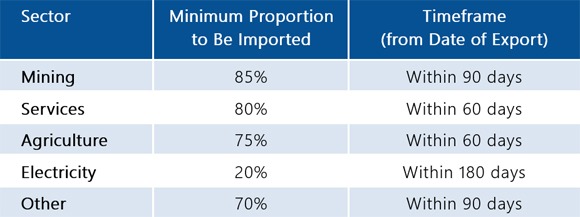
The ratios and timeframes are subject to change depending on the circumstances. If exporters cannot comply with the required ratio and timeline, exporters must provide relevant explanatory documents for the BOL’s consideration.

Selling Foreign-Currency Income

Exporters of goods and services must sell at least the minimum required proportion of their foreign-currency income (see table below) to a commercial bank in Laos. This foreign currency exchange must occur within three working days of receiving the foreign currency into the dedicated bank account in Laos. The selling rate will be determined by the prevailing rate of the commercial bank on the day of the transaction.
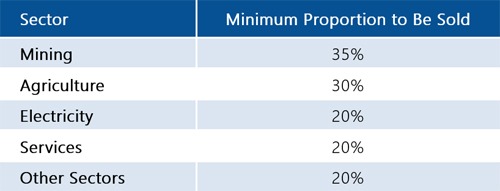
In conducting these transactions, commercial banks are required to carefully consider and manage their reserves and overall liquidity to ensure that they can meet public demand.

If an exporter does not sell at least the minimum required amount of foreign currency within three working days, the relevant commercial bank must proceed with the minimum required exchange and notify the exporter that they are doing so.

These requirements do not apply to re-exporters, such as importers of unprocessed raw materials for re-export to other countries, as determined by the Department of Foreign Currency Management (DFCM).

After selling the minimum required amount to a commercial bank, the remaining foreign-currency income must be used for foreign-currency exchange purposes, such as payments to parties in foreign countries, fulfilling obligations to the state, and so on.

Exporters can sell foreign currency to the BOL by notifying it of the need to sell the foreign currency to the DFCM in the BOL, after which they can sell the currency to the BOL through a commercial bank.

Registration

Decision No. 333 requires service exporters to register as importers and exporters to bring in income generated from exporting services. Although it doesn’t specify the types of service businesses that need to register, a March 2024 notice from the Ministry of Industry and Commerce offers examples of such businesses, including those in international transport, insurance, tourism and hotels, construction, and consulting.

Violations

First-time violations of Decision No. 333 that do not cause damage are subject to training on the importance of complying with Lao law or a warning. If the violation persists after the training or warning, the violator will face suspension of its ability to export goods and services.

For more information on Decision No. 333, or on any aspect of foreign currency management in Laos, please contact Tilleke & Gibbins at [email protected].

RELATED INSIGHTS​ 

August 23, 2023
On August 21, 2023, the Central Bank of Myanmar (CBM) issued a public notice in local newspapers reiterating the rights and obligations associated with holding and exchanging foreign currency. The notice emphasized that foreign exchange-dealing license holders can perform foreign currency exchange business in the country with both cash and travelers’ checks. The permissible foreign currencies for sale at money changers include US dollars (USD), euros, Singapore dollars (SGD), Thai baht (THB), Malaysian ringgit, Chinese yuan, and Japanese yen. The CBM has regularly warned the public that internal residents can only possess amounts of foreign currency equivalent to USD 10,000 for up to six months from the date of receipt. Under the Foreign Exchange Management Law, internal residents are: individuals who have resided in or have had their main establishment in Myanmar for a period of at least 183 days during the preceding twelve-month period, with the exception of diplomatic personnel from foreign countries and foreign civil servants who carry out similar assignments; companies, organizations, and offices formed under any domestic law and companies, organizations, offices, and branches formed legally in Myanmar under any foreign law; and diplomatic or other personnel appointed by Myanmar in foreign countries. If foreign currency is not used within six months, it must be sold to and exchanged by licensed foreign currency exchangers at the official exchange rate (currently 1 USD to 2100 MMK) or deposited in a bank account. Anyone who possesses foreign currencies without permission or without the necessary license will be subject to penalties under the Foreign Exchange Management Law. For more details on foreign currency exchange in Myanmar, or on any aspect of the country’s financial regulations, please contact Tilleke & Gibbins at [email protected].    
August 23, 2023
Self-reporting of customs violations in Thailand is normally carried out at the ports. However, in 2020, the Customs Department launched a campaign called the One Stop Service Program (OSSP) for business operators to self-report issues relating to unpaid customs duty from a central location in Bangkok. The current extension of the OSSP, which has been extended several times over the past few years, is due to expire on September 30, 2026, although a further extension seems likely. The OSSP offers a number of benefits. As noted above, settlement of unpaid duties can be done centrally in Bangkok even though the customs clearance itself is performed at Thai ports. Crucially, the fine for unpaid duty can be waived or reduced, and there is no late-payment penalty, which would normally amount to 20% of the unpaid duty if there is an official assessment and the duty is not paid within 30 days. The surcharge is reduced from 1% to 0.25%–0.75% per month on the unpaid duty. Nevertheless, any value-added tax (VAT), VAT surcharge, and VAT penalty on the unpaid duty still apply. To participate in the OSSP, the following conditions must be met: The offense must be considered a false declaration charge (Section 202 of the Customs Act), such as one involving value, price, tariff code, tariff rate, privileges, or other similar issues. The business operator must have committed the offense without intending to evade duty or restrictions. The goods must not be prohibited or infringe intellectual property. The declarations must not be under investigation by any authority in Thailand. Applications to participate in the OSSP can be submitted to the Post-Clearance Audit Division of the Customs Department, and applicants must provide the necessary documentation, such as customs declaration forms, invoices, purchase orders, sales contracts, and other payment documents. The officers
August 23, 2023
Laos has expanded its registration requirements for importers and exporters by mandating additional registration and financial procedures. Bank of Lao PDR (BOL) Decision No. 677, which was issued on July 24, 2023, requires importers and exporters to register with the BOL and to open a dedicated commercial bank account for their import-export business activities. These requirements are in addition to the May 2023 stipulation ordering importers and exporters to register with the Ministry of Industry and Commerce (MOIC). Registration and Account Opening After registering with the MOIC and receiving their MOIC registration certificate, importers and exporters have 10 days to register with the BOL. Within five working days of receiving a complete application, the BOL will issue a registration notification, after which the importer or exporter has 10 days to present its BOL registration certificate and the required supporting documents to a commercial bank for opening the specified bank account. Banking Requirements and Supporting Documents Payment for goods and services made or received from abroad by importers and exporters must take place via electronic wire transfer via the dedicated bank account opened specifically for import-export activities. The importer must provide the commercial bank with various required documents as evidence for each transaction. Likewise, exporters’ receipt of payment from abroad via bank transfer must take place using the bank account opened for import-export activities within the timeline specified in the sale-purchase agreement, but not exceeding 180 days from the export date. After receiving payment from abroad, the exporter must provide copies of various payment-related documents to the commercial bank. Exporters that wish to use any of this income to repay a loan must submit an application and supporting documents to the BOL for approval. The BOL will decide on the application within 10 working days of receiving the complete application
August 21, 2023
On September 1, 2023, Circular No. 06/2023/TT-NHNN (“Circular 06”) issued by the State Bank of Vietnam on June 28, 2023, will take effect. This circular introduces noteworthy amendments to the regulations concerning the offering of onshore loans to customers by credit institutions (including commercial banks and foreign bank branches). Introducing New Lending Restrictions but Loosening Refinancing Restrictions Circular 06 introduces several new categories of loans that credit institutions are not allowed to provide. These include loans for depositing money in accounts; loans for making or acquiring capital contributions or shares in other companies which have not yet been listed on the securities market or registered for trading on the UPCoM system; and loans for paying capital contributions under capital contribution contracts, investment cooperation contracts, or business cooperation contracts for implementation of investment projects that fail to satisfy conditions for being put into business operation. [However, Circular No. 10/2023/TT-NHNN, issued shortly before Circular 06 was to take effect (see related story here), suspended the restrictions on the latter two categories until further notice.] A new exception in Circular 06 allows credit institutions to offer loans for repaying foreign loans if the foreign loans were granted in the form of deferred payment for purchase of goods. Circular 06 also amends an exception of the previous regulations that new loans for repaying foreign loans or onshore loans from other credit institutions can be offered, as long as the term of the new loan does not exceed the remaining term of the original loan and the refinanced loan has not yet undergone any repayment rescheduling. This exception removes a requirement under the previous regulations that the original loan had to be made “for business purposes.” Further, Circular 06 introduces the term “financial reimbursement” (“cho vay bù đắp tài chính” in Vietnamese) whereby credit