
You are using an outdated browser and your browsing experience will not be optimal. Please update to the latest version of Microsoft Edge, Google Chrome or Mozilla Firefox. Install Microsoft Edge

June 7, 2024

Laos Regulates Management of Foreign Currency from Exports

On March 7, 2024, Laos moved to regulate the management of foreign-currency income from the exportation of goods and services. Effective March 29, 2024, Decision No. 333 (formally the Decision on Management of Income in Foreign Currency from Exportation of Goods and Services No. 333/BOL) from the Bank of Lao PDR (BOL) aims to incentivize the inflow of such foreign currency into Laos and its sale to licensed commercial banks.

Decision No. 333 sets minimum required proportions for importing income in foreign currency derived from the exportation of goods and services, as well as the timeframe for doing so. It also stipulates the requirements for selling such foreign currency to commercial banks in Laos and the minimum proportions that must be sold.

Importing Foreign-Currency Income

Exporters must receive payments from abroad via bank transfer into a dedicated bank account designated for import-export business activities within the timeline specified in the sale-purchase agreement, but not exceeding 180 days from the date of export. Each sector must import income in foreign currency into the Lao PDR according to the minimum proportion of currency to be imported, and it must be done within the required timeframes, as specified in the table below.
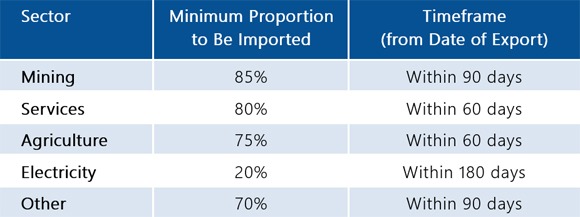
The ratios and timeframes are subject to change depending on the circumstances. If exporters cannot comply with the required ratio and timeline, exporters must provide relevant explanatory documents for the BOL’s consideration.

Selling Foreign-Currency Income

Exporters of goods and services must sell at least the minimum required proportion of their foreign-currency income (see table below) to a commercial bank in Laos. This foreign currency exchange must occur within three working days of receiving the foreign currency into the dedicated bank account in Laos. The selling rate will be determined by the prevailing rate of the commercial bank on the day of the transaction.
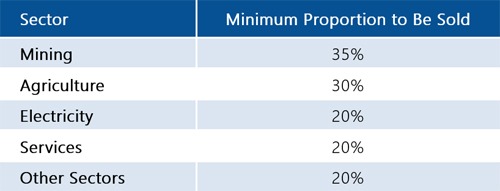
In conducting these transactions, commercial banks are required to carefully consider and manage their reserves and overall liquidity to ensure that they can meet public demand.

If an exporter does not sell at least the minimum required amount of foreign currency within three working days, the relevant commercial bank must proceed with the minimum required exchange and notify the exporter that they are doing so.

These requirements do not apply to re-exporters, such as importers of unprocessed raw materials for re-export to other countries, as determined by the Department of Foreign Currency Management (DFCM).

After selling the minimum required amount to a commercial bank, the remaining foreign-currency income must be used for foreign-currency exchange purposes, such as payments to parties in foreign countries, fulfilling obligations to the state, and so on.

Exporters can sell foreign currency to the BOL by notifying it of the need to sell the foreign currency to the DFCM in the BOL, after which they can sell the currency to the BOL through a commercial bank.

Registration

Decision No. 333 requires service exporters to register as importers and exporters to bring in income generated from exporting services. Although it doesn’t specify the types of service businesses that need to register, a March 2024 notice from the Ministry of Industry and Commerce offers examples of such businesses, including those in international transport, insurance, tourism and hotels, construction, and consulting.

Violations

First-time violations of Decision No. 333 that do not cause damage are subject to training on the importance of complying with Lao law or a warning. If the violation persists after the training or warning, the violator will face suspension of its ability to export goods and services.

For more information on Decision No. 333, or on any aspect of foreign currency management in Laos, please contact Tilleke & Gibbins at [email protected].

RELATED INSIGHTS​ 

September 26, 2023
Cambodia has issued a set of regulations that aim to encourage greater energy efficiency from appliances marketed in the country. The regulations follow Cambodia’s adoption of its National Energy Efficiency Policy, which sets out the government’s energy efficiency targets and policies to reach them by 2030, including the ambitious national target of reducing the country’s total energy consumption by at least 19%. This set of regulations for appliances marketed in Cambodia is contained in Sub-Decree No. 254 on the Management and Improvement of Energy Efficiency of Electrical Appliances, dated August 11, 2023. This sub-decree sets out product registration and energy efficiency labeling requirements for electrical appliances marketed in Cambodia. It further provides that appliances should meet energy efficiency standards and all other mandatory standards that apply to electrical appliances. During the product registration process, the appliances are checked against such standards, and registration is only granted if the standards are met. The sub-decree identifies the Ministry of Mines and Energy as the main ministry responsible for the implementation of the sub-decree. To assist with the wide scope of regulations as set by the sub-decree, it further appoints assisting ministries that may implement and enforce only certain aspects. These effective implementation and enforcement mechanisms suggest that once the sub-decree’s 12-month implementation period has passed, there is likely to be a rather strict enforcement approach to the requirements. Key Features of the Sub-Decree Several mandatory standards have already been applied to most electrical appliances over the past years, but the required product registration process to check for compliance with those standards has not always been completed by those importing, distributing, or manufacturing electrical appliances in Cambodia. The new sub-decree clearly mandates a product registration requirement as a check to verify the applicable standards are met, and sets penalties for non-compliance. Penalties
September 25, 2023
Laos’ Ministry of Industry and Commerce (MOIC) has added to the list of goods subject to the country’s recently imposed import-export registration requirement. Traders who import or export goods on the expanded list, which was issued in MOIC Notification No. 1941 on September 18, 2023, must first obtain a certificate authorizing their import or export activities. The six additional categories of goods specified by the notification, along with the corresponding Harmonized System (HS) codes from the World Customs Organization, are: Mining – HS 2601–2611, 2613–2617 Electricity – HS 27160000 Wood and wood products – HS 4401–4421, 4701–4707, 4801–4812, 94 Spare parts and electronic equipment, electrical equipment – HS 8501–8548 Cigarettes – HS 240220 Alcoholic beverages – 2203–2206, 2208 Enterprises that import or export these goods must complete registration with the MOIC’s Department of Import and Export (DIMEX) by October 31, 2023. Enterprises not registered with DIMEX will be prohibited from importing or exporting these goods. Importers and exporters of other goods not covered by this list may also register, with the option of registering until any future changes to the import-export registration requirements dictate otherwise. Registrants must also seek Bank of Lao PDR certification of their commercial bank accounts. Following this, they must ask the relevant commercial bank to convert their account to an import-export account. For more details on Laos’ new import-export registration rules, or on any aspect of trade involving Laos, please contact Tilleke & Gibbins at [email protected].
August 25, 2023
Michael Ramirez, a counsel in Tilleke & Gibbins’ dispute resolution department, has contributed an article to a series on contractual terms in Asia from the Asian Business Law Institute. Previous articles in the series have looked at administrative and tax requirements and contract breach and remedy under Thai law. The article gives an overview of how extracontractual liabilities are treated under Thai law. It addresses issues related to contract negotiations, no-reliance clauses, entire agreement clauses, and concurrent liability. ABLI, which is based in Singapore, conducts legal research and dissemination in order to provide knowledge, guidance, and recommendations surrounding development of legal systems in Asia. The full article on extracontractual liabilities is available as a PDF through the button below.
August 25, 2023
On August 23, 2023, the State Bank of Vietnam (SBV) issued Circular No. 10/2023/TT-NHNN (“Circular 10”), suspending the implementation of certain provisions of Circular No. 06/2023/TT-NHNN (“Circular 06”) concerning the offering of onshore loans to customers by credit institutions, including commercial banks and foreign bank branches. (See our previous coverage of Circular 06 here.) Both Circular 06 and Circular 10 will take effect on September 1, 2023. Circular 10 re-allows three categories of loans that credit institutions were not allowed to provide under Circular 06, including: Loans for making or acquiring capital contributions or shares in other companies which have not yet been listed on the securities market or registered for trading on the unlisted public company market (UPCoM) system. Loans for paying capital contributions under capital contribution contracts, investment cooperation contracts, or business cooperation contracts for implementation of investment projects that fail to satisfy conditions for being put into business operation. Loans for financial reimbursement. This change is a result of the working session between Deputy Prime Minister Le Minh Khai and the Governor of the State Bank of Vietnam to consider loosening restrictions for loans to borrowers after the issuance of Circular No. 06/2023/TT-NHNN.