
You are using an outdated browser and your browsing experience will not be optimal. Please update to the latest version of Microsoft Edge, Google Chrome or Mozilla Firefox. Install Microsoft Edge

June 7, 2024

Laos Regulates Management of Foreign Currency from Exports

On March 7, 2024, Laos moved to regulate the management of foreign-currency income from the exportation of goods and services. Effective March 29, 2024, Decision No. 333 (formally the Decision on Management of Income in Foreign Currency from Exportation of Goods and Services No. 333/BOL) from the Bank of Lao PDR (BOL) aims to incentivize the inflow of such foreign currency into Laos and its sale to licensed commercial banks.

Decision No. 333 sets minimum required proportions for importing income in foreign currency derived from the exportation of goods and services, as well as the timeframe for doing so. It also stipulates the requirements for selling such foreign currency to commercial banks in Laos and the minimum proportions that must be sold.

Importing Foreign-Currency Income

Exporters must receive payments from abroad via bank transfer into a dedicated bank account designated for import-export business activities within the timeline specified in the sale-purchase agreement, but not exceeding 180 days from the date of export. Each sector must import income in foreign currency into the Lao PDR according to the minimum proportion of currency to be imported, and it must be done within the required timeframes, as specified in the table below.
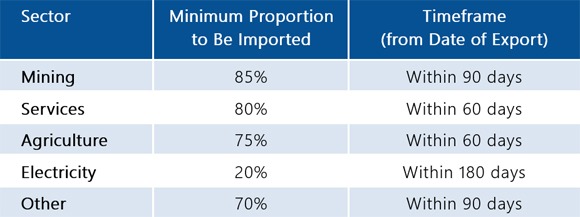
The ratios and timeframes are subject to change depending on the circumstances. If exporters cannot comply with the required ratio and timeline, exporters must provide relevant explanatory documents for the BOL’s consideration.

Selling Foreign-Currency Income

Exporters of goods and services must sell at least the minimum required proportion of their foreign-currency income (see table below) to a commercial bank in Laos. This foreign currency exchange must occur within three working days of receiving the foreign currency into the dedicated bank account in Laos. The selling rate will be determined by the prevailing rate of the commercial bank on the day of the transaction.
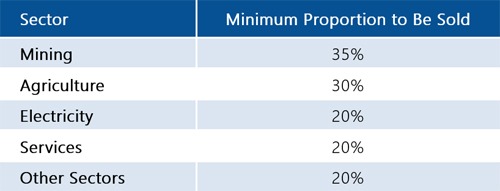
In conducting these transactions, commercial banks are required to carefully consider and manage their reserves and overall liquidity to ensure that they can meet public demand.

If an exporter does not sell at least the minimum required amount of foreign currency within three working days, the relevant commercial bank must proceed with the minimum required exchange and notify the exporter that they are doing so.

These requirements do not apply to re-exporters, such as importers of unprocessed raw materials for re-export to other countries, as determined by the Department of Foreign Currency Management (DFCM).

After selling the minimum required amount to a commercial bank, the remaining foreign-currency income must be used for foreign-currency exchange purposes, such as payments to parties in foreign countries, fulfilling obligations to the state, and so on.

Exporters can sell foreign currency to the BOL by notifying it of the need to sell the foreign currency to the DFCM in the BOL, after which they can sell the currency to the BOL through a commercial bank.

Registration

Decision No. 333 requires service exporters to register as importers and exporters to bring in income generated from exporting services. Although it doesn’t specify the types of service businesses that need to register, a March 2024 notice from the Ministry of Industry and Commerce offers examples of such businesses, including those in international transport, insurance, tourism and hotels, construction, and consulting.

Violations

First-time violations of Decision No. 333 that do not cause damage are subject to training on the importance of complying with Lao law or a warning. If the violation persists after the training or warning, the violator will face suspension of its ability to export goods and services.

For more information on Decision No. 333, or on any aspect of foreign currency management in Laos, please contact Tilleke & Gibbins at [email protected].

RELATED INSIGHTS​ 

March 25, 2024
Tilleke & Gibbins has provided an updated Thailand chapter for Fashion Law 2024 from Global Legal Post. The guide covers 20 key jurisdictions in the global fashion industry, offering insights into local legal frameworks surrounding issues such as brand enforcement and protection, e-commerce and marketing, and sustainability considerations. The Thailand chapter of Fashion Law 2024 provides detailed information on the following topics: Main intellectual property rights for fashion products Contractual arrangements in manufacturing, distribution, and advertising Regulations and enforcement of online marketing Unfair competition rules and judicial interpretation Specific regulations on sustainability and ESG in fashion Special import and export rules for fashion products The full Thailand chapter is available for free through the button below and on the Global Legal Post website. Tilleke & Gibbins also contributed the Vietnam chapter to the guide.
March 15, 2024
Vietnam’s fintech industry is booming, and the rapid emergence of tech startups and non-bank institutions offering innovative financial services has been outpacing existing regulations. This regulatory gap not only creates uncertainty for both innovators and consumers, but also poses a number of imminent risks in areas such as consumer protection, data privacy, cybersecurity, and anti-money laundering, among others. The State Bank of Vietnam (SBV) is stepping up to tackle these challenges by accelerating the promulgation of a long-awaited Fintech Sandbox Decree with the issuance of an updated draft (“Draft Fintech Sandbox Decree”) on March 4, 2024. The Draft Fintech Sandbox Decree establishes a controlled environment where fintech companies and financial institutions can test solutions that do not fall squarely within the parameters of existing regulations. The pilot activities will be limited in scope, scale, and duration, with a number of precautionary measures in place. The SBV will supervise this “sandbox” closely, effectively mitigating risks and gathering valuable data to inform future regulations. Who Can Participate in the Sandbox? Traditional financial institutions (credit institutions): Banks and other institutions licensed to provide financial services can participate in the sandbox to test new offerings or refine existing ones. Independent fintech companies: Startups and established companies specializing in fintech solutions can leverage the sandbox to pilot innovative ideas before seeking wider market adoption. Other relevant organizations involved in the pilot: Depending on the specific solution being tested, other entities may also be involved in the sandbox. Geographical scope: Limited to Vietnamese territory; cross-border testing is not allowed. Focusing on Three Solution Categories Earlier versions of the Draft Fintech Sandbox Decree included categories like blockchain technology and other innovative business models, but these were removed in the latest version. To allow the SBV to assess the associated risks and work on the solutions more
March 12, 2024
Thailand’s Ministry of Finance has issued the Notification re: Criteria, Methods and Conditions for Applying for and Issuing Licenses to Operate Virtual Bank Business, which was published in the Government Gazette on March 4, 2024. This notification opens an opportunity for qualified experts in technology, digital services, and diverse data usage fields to apply for virtual bank licenses to provide financial services through new digital channels. The main goal is to serve the financial needs of target groups that may not have received sufficient or tailored financial services from the traditional banking system. Licensing Timeline Application submission period: 6 months (March 20–September 19, 2024). Announcement of successful applicants: Mid-2025 (approx. 9 months–1 year from the end of the submission period) After the announcement, successful licensees must demonstrate their readiness to commence virtual bank operations within 1 year (extendable for up to 1 additional year) via the following: Having paid-up registered capital of THB 5 billion and plans to increase the paid-up registered capital to at least THB 10 billion after the initial business period; Establishment or adjustment of a financial business group; Procurement of human resources, IT systems, and relevant risk management tools. Number of Licenses to be Issued No written or specified limit, subject to the discretion of the Bank of Thailand (BOT). Key Qualifications Applicants must have the following: Experience and resources to support virtual banking operations according to the business model and plan. Expertise and experience in conducting business that utilizes technology and provides services through digital channels. Experience demonstrating the ability to obtain, access, manage, and utilize data, including development of systems or data connections to facilitate user activities, allowing them to use their data to conduct transactions with other providers. Criteria In assessing applicants’ qualifications for a virtual bank license, the BOT will consider
February 23, 2024
The newly released Licensing 2024 guide, published by Lexology Panoramic, features a chapter on Vietnam by four licensing specialists from Tilleke & Gibbins. The comparative guide provides companies and other interested readers with information on licensing law and practice in various countries around the world. Licensing 2024 provides detailed information on the following topics: Restrictions, laws and licensing arrangements Intellectual property issues: Paris Convention for the Protection of Industrial Property, contesting the validity of licensor’s IP rights, invalidity and expiry of IP rights, security interests, proceedings against third parties, sublicensing, jointly owned IP, first to file, scope of patent protection, trade secrets, copyright Software licensing: Perpetual licensing, legal requirements, user restrictions Royalties and payments, currency conversion, and taxes: Relevant legislation, restrictions, taxation of foreign licensors Competition law issues: Restrictions on trade, legal restrictions, and IP-related court rulings Indemnification, disclaimers, and damages: Prevalence and enforceability of indemnity provisions and contractual waivers of damages Termination: Right to terminate, impact of termination Bankruptcy: Impact of licensee or licensor bankruptcy Dispute resolution: Governing law, arbitration, enforceability, injunctive relief, contractual waivers The Vietnam chapter was authored by Linh Thi Mai Nguyen, partner and head of Tilleke & Gibbins’ trademark team in Vietnam; Son Thai Hoang, trademark executive; and Chi Lan Dang, associate, of Tilleke & Gibbins’ trademark team, along with corporate and commercial senior associate Tu Ngoc Trinh, who has extensive experience in franchising and competition law. The Vietnam chapter is available below as a PDF. Tilleke & Gibbins also contributed the Thailand chapter to Licensing 2024. Readers can gain 30 days of complementary access to the full Licensing 2024 guide and the rest of Lexology Panoramic’s varied offerings through this link.