
You are using an outdated browser and your browsing experience will not be optimal. Please update to the latest version of Microsoft Edge, Google Chrome or Mozilla Firefox. Install Microsoft Edge

June 7, 2024

Laos Regulates Management of Foreign Currency from Exports

On March 7, 2024, Laos moved to regulate the management of foreign-currency income from the exportation of goods and services. Effective March 29, 2024, Decision No. 333 (formally the Decision on Management of Income in Foreign Currency from Exportation of Goods and Services No. 333/BOL) from the Bank of Lao PDR (BOL) aims to incentivize the inflow of such foreign currency into Laos and its sale to licensed commercial banks.

Decision No. 333 sets minimum required proportions for importing income in foreign currency derived from the exportation of goods and services, as well as the timeframe for doing so. It also stipulates the requirements for selling such foreign currency to commercial banks in Laos and the minimum proportions that must be sold.

Importing Foreign-Currency Income

Exporters must receive payments from abroad via bank transfer into a dedicated bank account designated for import-export business activities within the timeline specified in the sale-purchase agreement, but not exceeding 180 days from the date of export. Each sector must import income in foreign currency into the Lao PDR according to the minimum proportion of currency to be imported, and it must be done within the required timeframes, as specified in the table below.
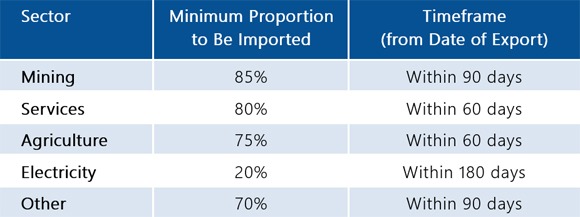
The ratios and timeframes are subject to change depending on the circumstances. If exporters cannot comply with the required ratio and timeline, exporters must provide relevant explanatory documents for the BOL’s consideration.

Selling Foreign-Currency Income

Exporters of goods and services must sell at least the minimum required proportion of their foreign-currency income (see table below) to a commercial bank in Laos. This foreign currency exchange must occur within three working days of receiving the foreign currency into the dedicated bank account in Laos. The selling rate will be determined by the prevailing rate of the commercial bank on the day of the transaction.
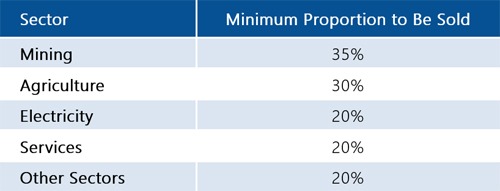
In conducting these transactions, commercial banks are required to carefully consider and manage their reserves and overall liquidity to ensure that they can meet public demand.

If an exporter does not sell at least the minimum required amount of foreign currency within three working days, the relevant commercial bank must proceed with the minimum required exchange and notify the exporter that they are doing so.

These requirements do not apply to re-exporters, such as importers of unprocessed raw materials for re-export to other countries, as determined by the Department of Foreign Currency Management (DFCM).

After selling the minimum required amount to a commercial bank, the remaining foreign-currency income must be used for foreign-currency exchange purposes, such as payments to parties in foreign countries, fulfilling obligations to the state, and so on.

Exporters can sell foreign currency to the BOL by notifying it of the need to sell the foreign currency to the DFCM in the BOL, after which they can sell the currency to the BOL through a commercial bank.

Registration

Decision No. 333 requires service exporters to register as importers and exporters to bring in income generated from exporting services. Although it doesn’t specify the types of service businesses that need to register, a March 2024 notice from the Ministry of Industry and Commerce offers examples of such businesses, including those in international transport, insurance, tourism and hotels, construction, and consulting.

Violations

First-time violations of Decision No. 333 that do not cause damage are subject to training on the importance of complying with Lao law or a warning. If the violation persists after the training or warning, the violator will face suspension of its ability to export goods and services.

For more information on Decision No. 333, or on any aspect of foreign currency management in Laos, please contact Tilleke & Gibbins at [email protected].

RELATED INSIGHTS​ 

March 14, 2025
The Bank of Thailand (BOT) has published the Draft Guidelines for Digital Fraud Management, which aim to help financial service providers tackle digital fraud and ensure safety and trust in the Thai financial system. These draft guidelines, which are available for public comment until March 18, 2025, provide a comprehensive framework for financial service providers, covering prevention, detection, management, and resolution of digital fraud, as well as support for customers affected by fraud. The BOT tentatively plans to implement these draft guidelines on April 1, 2025, along with circular letters on the minimum required measures for tackling “mule accounts” (deposit or e-money accounts used as tools to receive and transfer funds obtained through the commission of any offense) and measures to strengthen Thailand’s customer due diligence and enhanced due diligence procedures. Under the draft guidelines, “financial service providers” include financial institutions and special financial institutions under the Financial Institution Business Act and payment providers under the Payment Systems Act. Commercial banks, special financial institutions, and operators of transferable e-money services must adhere to every requirement in the draft guidelines. Other financial service providers (e.g., payment providers other than operators of transferable e-money services) can implement the draft guidelines as deemed appropriate to their services, products, and service channels. Digital Fraud Management Requirements The draft guidelines establish the following key requirements: Policy and oversight. Directors and senior executives of financial service providers must set and adopt appropriate “end-to-end” fraud management policies and KPIs to manage digital fraud, covering prevention, monitoring, detection, management, resolution, and support for affected customers. Fraud management processes. Financial service providers must establish a clear framework for managing digital fraud throughout the customer lifecycle, from customer onboarding to service termination, according to industry standards at a minimum and covering at least the following processes: Know your customer
March 13, 2025
Licensing specialists at Tilleke & Gibbins in Bangkok have contributed the Thailand chapter to the newly issued Licensing 2025, a comprehensive guide from Lexology Panoramic to licensing in various jurisdictions around the world. The Thailand chapter covers the following topics: Laws and licensing arrangements: Unfair Contract Terms Act, Trade Competition Act, pre-contractual disclosure, registration of international licensing, implied obligations, Civil and Commercial Code, Trademark Act, Patent Act, Trade Secrets Act Intellectual property issues: Paris Convention for the Protection of Industrial Property, contesting the validity of licensor’s IP rights, invalidity and expiry of IP rights, security interests, proceedings against third parties, sublicensing, jointly owned IP, first to file, scope of patent protection, trade secrets, copyright Software licensing: Perpetual licensing, legal requirements, user restrictions Royalties and payments, currency conversion, and taxes: Relevant legislation, restrictions, taxation of foreign licensors Competition law issues: Restrictions on trade, legal restrictions, and IP-related court rulings Indemnification, disclaimers, and damages: Prevalence and enforceability of indemnity provisions and contractual waivers of damages Termination: Right to terminate, impact of termination Bankruptcy: Impact of licensee or licensor bankruptcy Dispute resolution: Governing law, arbitration, enforceability, injunctive relief, contractual waivers The Thailand chapter was authored by Alan Adcock, partner, and Kasama Sriwatanakul, counsel, both in the Thailand regulatory affairs team. The full Thailand chapter is available below as a PDF. Tilleke & Gibbins also contributed the Vietnam chapter to Licensing 2025. Readers can gain 30 days of complementary access to the full Licensing 2025 guide and the rest of Lexology Panoramic’s varied offerings through this link.
March 6, 2025
On February 18, 2025, the Thai Senate approved an amendment to the Act on the Establishment of and Procedures for the Tax Court. This follows the July 2024 approval by the Thai cabinet and subsequent preparation of supporting secondary legislation. This important amendment to procedural law, once it takes effect, will extend the exclusive jurisdictional powers of the Tax Court to all criminal tax, customs, and excise tax claims in addition to the court’s existing jurisdiction over all such civil claims. The amendment, while now formally approved by the legislature, is awaiting the king’s signature and will take effect 180 days after its publication in the Government Gazette. Based upon its projected publication date, the amendment will likely take effect by the end of the third quarter of this year. This development is set to offer a more sophisticated Tax Court litigation process for highly specialized and often complex criminal tax and customs claims, something with which Thailand’s traditional criminal courts have struggled. It also ensures that all tax and customs matters are adjudicated before the same court, saving time, party costs, and judicial resources. This appears likely to result in more consistent adjudication of criminal tax and customs disputes, a benefit for the Thai government and party litigants alike. Any ongoing criminal tax and customs claims already commenced with the respective criminal courts on the date on which the amendment becomes effective will remain under the exclusive jurisdiction of those criminal courts. The Tax Court will have exclusive jurisdiction over all other claims. This important legislative change offers those managing or otherwise facing civil and/or criminal Thai tax or customs disputes the opportunity to more effectively plan and execute a uniform defense strategy before a single, qualified forum.
March 5, 2025
It is a common misconception that importers will never win classification assessments by the Thai Customs Department. However, this belief is far from the truth. Importers can indeed prevail in customs assessments, and one of the most effective tools at their disposal is the World Customs Organization’s (WCO) Explanatory Notes. The WCO’s Explanatory Notes are an indispensable resource for understanding the Harmonized System (HS) of tariff nomenclature. These notes provide detailed commentary on the scope of each heading, including lists of main products included and excluded, technical descriptions, and practical guidance for identifying goods. By leveraging these notes, importers can ensure accurate classification of their goods, which is crucial for fair customs assessments. Understanding the Explanatory Notes The Explanatory Notes serve as the official interpretation of the Harmonized System at the international level. They offer clarity on the classification of goods, which can significantly impact the duties and taxes imposed on imports. For instance, the notes provide insights into the properties, methods of production, and uses of various goods, helping importers to classify their products correctly and avoid misclassification disputes. Thailand’s Customs Tariff Decree holds that the classification interpretation must follow the General Rules for Interpretation together with the Explanatory Notes to the Harmonized System of the WCO. Most Thai Supreme Court decisions on classification also refer to the WCO’s Explanatory Notes and past rulings as the basis of their decisions. Successful Appeals There have been numerous instances of importers successfully appealing customs assessments by relying on the Explanatory Notes. For example, one importer of electronic components was initially assessed a higher duty due to misclassification. By presenting evidence from the Explanatory Notes that accurately described the components, the importer was able to demonstrate the correct classification and secure a favorable reassessment. Practical Steps for Importers To minimize the