
You are using an outdated browser and your browsing experience will not be optimal. Please update to the latest version of Microsoft Edge, Google Chrome or Mozilla Firefox. Install Microsoft Edge

June 7, 2024

Laos Regulates Management of Foreign Currency from Exports

On March 7, 2024, Laos moved to regulate the management of foreign-currency income from the exportation of goods and services. Effective March 29, 2024, Decision No. 333 (formally the Decision on Management of Income in Foreign Currency from Exportation of Goods and Services No. 333/BOL) from the Bank of Lao PDR (BOL) aims to incentivize the inflow of such foreign currency into Laos and its sale to licensed commercial banks.

Decision No. 333 sets minimum required proportions for importing income in foreign currency derived from the exportation of goods and services, as well as the timeframe for doing so. It also stipulates the requirements for selling such foreign currency to commercial banks in Laos and the minimum proportions that must be sold.

Importing Foreign-Currency Income

Exporters must receive payments from abroad via bank transfer into a dedicated bank account designated for import-export business activities within the timeline specified in the sale-purchase agreement, but not exceeding 180 days from the date of export. Each sector must import income in foreign currency into the Lao PDR according to the minimum proportion of currency to be imported, and it must be done within the required timeframes, as specified in the table below.
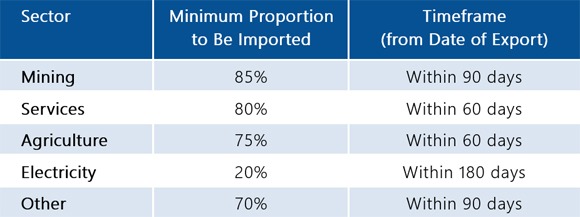
The ratios and timeframes are subject to change depending on the circumstances. If exporters cannot comply with the required ratio and timeline, exporters must provide relevant explanatory documents for the BOL’s consideration.

Selling Foreign-Currency Income

Exporters of goods and services must sell at least the minimum required proportion of their foreign-currency income (see table below) to a commercial bank in Laos. This foreign currency exchange must occur within three working days of receiving the foreign currency into the dedicated bank account in Laos. The selling rate will be determined by the prevailing rate of the commercial bank on the day of the transaction.
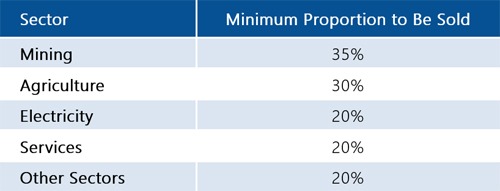
In conducting these transactions, commercial banks are required to carefully consider and manage their reserves and overall liquidity to ensure that they can meet public demand.

If an exporter does not sell at least the minimum required amount of foreign currency within three working days, the relevant commercial bank must proceed with the minimum required exchange and notify the exporter that they are doing so.

These requirements do not apply to re-exporters, such as importers of unprocessed raw materials for re-export to other countries, as determined by the Department of Foreign Currency Management (DFCM).

After selling the minimum required amount to a commercial bank, the remaining foreign-currency income must be used for foreign-currency exchange purposes, such as payments to parties in foreign countries, fulfilling obligations to the state, and so on.

Exporters can sell foreign currency to the BOL by notifying it of the need to sell the foreign currency to the DFCM in the BOL, after which they can sell the currency to the BOL through a commercial bank.

Registration

Decision No. 333 requires service exporters to register as importers and exporters to bring in income generated from exporting services. Although it doesn’t specify the types of service businesses that need to register, a March 2024 notice from the Ministry of Industry and Commerce offers examples of such businesses, including those in international transport, insurance, tourism and hotels, construction, and consulting.

Violations

First-time violations of Decision No. 333 that do not cause damage are subject to training on the importance of complying with Lao law or a warning. If the violation persists after the training or warning, the violator will face suspension of its ability to export goods and services.

For more information on Decision No. 333, or on any aspect of foreign currency management in Laos, please contact Tilleke & Gibbins at [email protected].

RELATED INSIGHTS​ 

August 3, 2026
On July 23, 2026, the Bank of Thailand (BOT) released for public comment its draft Notification on Digital Channel Security, which would significantly expand the scope and stringency of Thailand’s existing mobile banking security framework. If finalized in its current form, the draft notification would extend mandatory security requirements to credit card providers and credit providers, cover internet banking in addition to mobile applications, phase out SMS one-time passwords (OTPs) for transaction authentication, and introduce biometric verification requirements for high-value transactions. The public comment period is open through August 24, 2026. Background The BOT’s existing Mobile Banking Security Notification, issued in 2024, sets minimum security standards for financial institutions, specialized financial institutions (SFIs), and e-money providers, significantly reducing “money-draining app” fraud. However, fraudsters have since shifted to nonbank providers and internet banking channels, prompting the BOT to propose broader security requirements. Expanded Scope of Regulated Entities and Channels The existing Mobile Banking Security Notification covers only financial institutions, SFIs, and e-money providers offering mobile banking services. The draft expands coverage in two key areas: entities and channels. On the entity side, it adds credit card providers and credit providers that offer fund transfers to third parties at other financial service providers or that provide cash withdrawal services to individual retail customers. On the channel side, it broadens coverage to include internet banking in addition to mobile banking. Strengthened Customer Authentication The draft introduces enhanced authentication requirements in three areas: Service enrollment and device changes. Providers must implement rigorous identity verification, notify customers of enrollment results through out-of-band communication channels, and adopt risk-mitigation measures such as cooling-off periods and temporary transaction limits. Transaction-level authentication. Providers must use two-factor authentication for fund transfers, cardless ATM withdrawals, and transaction limit increases. Secure authentication factors. Key requirements include the following: “What-you-know” factors must
July 27, 2026
A new decree on penalties for violations related to the crypto asset market creates compliance risks for offshore crypto asset exchanges in Vietnam that do not hold, and practically cannot obtain, a Vietnamese license, and for Vietnamese users who continue to transact on those platforms. Decree No. 284/2026/ND-CP (Decree 284), issued by the government of Vietnam on July 16, 2026, formally establishes an administrative penalty framework for violations related to crypto assets and the crypto asset market. The decree takes effect on September 1, 2026, and will remain in force for the duration of the five-year pilot program under Resolution No. 05/2025/NQ-CP, which is scheduled to end in September 2030. Direct Penalties on Vietnamese Users The most immediate commercial risk to offshore platforms is that their Vietnamese users now face direct personal liability for using their exchanges. Vietnamese users who trade crypto assets outside of a Ministry of Finance-licensed service provider face fines of up to VND 50 million (approximately USD 1,900). Vietnamese users trading in crypto assets that are offered or issued to foreign users face higher penalties of up to VND 100 million (approximately USD 3,800). It is expected that Vietnamese users will be more willing to migrate away from offshore platforms now that there is a risk of real enforcement against them. Penalties on Unlicensed Service Providers Violations of providing crypto asset services or advertising crypto-related services without a license face fines of up to VND 200 million (approximately USD 7,700). Operating a crypto asset trading market without proper authorization falls within the same highest penalty bands. Organizations that violate issuance, provision, or disclosure rules may face fines of up to VND 200 million. Although the maximum administrative fine per violation is capped at VND 200 million for organizations and VND 100 million for individuals, these
July 21, 2026
On July 6, 2026, Myanmar’s Ministry of Finance and Revenue introduced revised procedures governing the importation and exportation of goods and vehicles, replacing the framework that had been in place since 2017. The revised procedures were introduced in Notification No. 115/2026, which establishes updated compliance requirements and penalties for importers and exporters, covering licensing, declarations, product specifications, prior arrival of goods, and imports or exports made without the required licenses or permits. Scope Unlike its predecessor (Notification No. 6/2017), which focused primarily on import-related noncompliance, the new notification regulates both import and export activities and introduces a separate penalty schedule for export violations. Exporters are now required to ensure that their exports comply with the approvals stated in export licenses and permits, match the information declared in export declarations, and are supported by the required licenses, permits, and accompanying documents. Import Compliance and Penalties The new notification imposes several compliance requirements on importers. Importers must ensure that the country of origin, branding, labeling, and other product information are consistent with the relevant import license or permit, import declaration, and the imported goods. For vehicles and machinery, the model year must match the year approved by the Ministry of Commerce. Importers must also ensure that goods are not imported before the issuance or after the expiry of the import license or permit, and that the imported quantity does not exceed the approved amount. Failure to comply with these requirements may result in regulatory action. As for the notification’s revised penalties for noncompliance with import licensing requirements, imports made without the required import license, permit, or import declaration may be subject to fines ranging from one to three times the assessable value (AV) of the goods, depending on the category of goods involved. Certain vehicles and machinery, as well as specific
July 17, 2026
On July 11, 2026, media reports conveyed key messages from Bank of Thailand (BOT) Governor Vitai Ratanakorn’s announcement of a sweeping regulatory crackdown on grey capital activities. The measures target high-value cash transactions, gold trading, and stablecoin flows, with new requirements set to take effect in the fourth quarter of 2026. The initiative aims to prevent financial institutions from facilitating shadow economy activity, money laundering—particularly through stablecoins—and capital flight, through enhanced compliance obligations on commercial banks across multiple transaction channels. Expanded Cash Controls Close the Deposit–Withdrawal Circuit New fourth-quarter guidelines will require individuals depositing THB 5 million or more in cash to formally verify the source of their funds. This builds on restrictions introduced in April 2026, which required anyone withdrawing 5 million baht or more in cash to provide their bank with verified commercial justification for why electronic transfers or checks could not be used. That initial measure caused high-value physical cash withdrawals to drop by 35 percent nationwide. The upcoming deposit-side requirement closes the circuit on large cash movements. The BOT is also assessing tracking mechanisms for high-value banknote swaps, specifically targeting individuals seeking to exchange large volumes of THB 1,000 notes into smaller THB 100 or THB 500 denominations without clear business justification. Governor Vitai emphasized that these measures require continuous deployment of multiple parallel strategies rather than short-term fixes. Tightened Bullion Reporting Frameworks Restrict Money Laundering Channels The BOT has also tightened reporting frameworks for gold trading to close money laundering loopholes and shield the Thai baht from speculative bullion volatility. Regulators identified a recurring pattern in which buyers purchased large quantities of gold through digital applications in the morning and then made same-day physical withdrawals from retail gold shops in the afternoon. Gold shops are reminded of their duties to flag and report cash