You are using an outdated browser and your browsing experience will not be optimal. Please update to the latest version of Microsoft Edge, Google Chrome or Mozilla Firefox. Install Microsoft Edge

October 30, 2023

Laos Raises Excise Tax Rate on Certain Products

On October 9, 2023, Laos issued Presidential Decree No. 003, which raised excise tax rates for certain goods, effective immediately.

The move to increase excise tax rates comes amid the marked depreciation of the Lao kip (LAK). The Lao government is trying to monitor and discourage imports of non-essential products in order to reduce the outflow of foreign currency from the country. Increasing the tax rate for some of these products is part of these efforts.

The specific products and excise tax rates are listed in the table below.
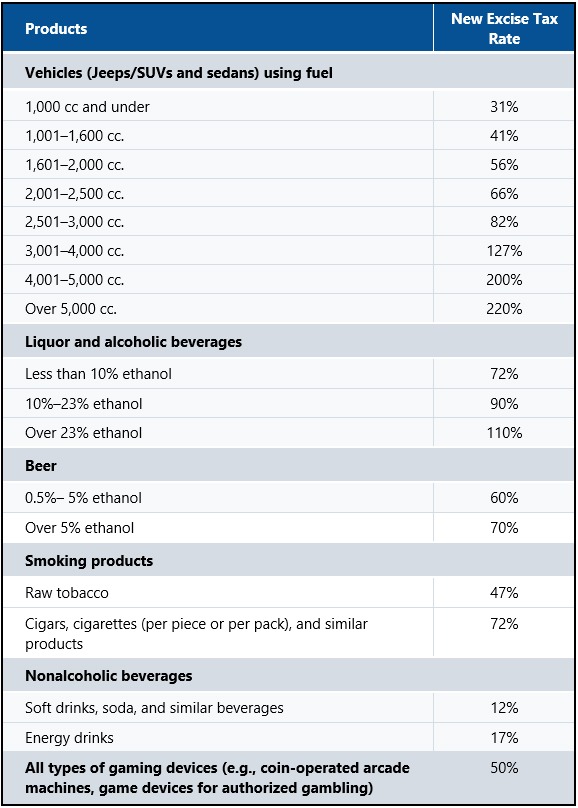
 

This new rate policy is also in line with recent government efforts to encourage avoiding payment in foreign currency to prevent the depletion of foreign currency reserves in Laos. In this regard, commercial banks have already taken action to ration the supply of foreign currency by prioritizing imports of essential goods, such as fuel. The products listed above formalize this impetus to prioritize certain imports and discourage others deemed not essential. In addition, the increased excise tax rates on fuel-powered vehicles show the commitment of the Lao government to move toward electric vehicles, which would also lessen the country’s dependence on fuel imports.

For more information on these excise tax changes, or on any aspect of Laos’ international trade regulations, please contact Tilleke & Gibbins at [email protected].

RELATED INSIGHTS​ 

April 23, 2026
Thailand’s Board of Investment (BOI) has introduced a new investment promotion measure to encourage partnerships between Thai and foreign automotive parts manufacturers. The measure, published in the Government Gazette on March 31, 2026, under Notification of the Board of Investment No. 5/2569 Re: Investment Promotion Measures for Joint Ventures between Thai and Foreign Companies in the Auto Parts Manufacturing Industry, aims to enhance local industry participation and create new business opportunities for Thai operators. Corporate Income Tax Exemption Under this measure, the BOI grants an additional corporate income tax (CIT) exemption of three years to both new investment projects and existing operators under the BOI’s business category 3.4 (manufacture of engines, equipment, or parts) or category 3.5 (manufacture of vehicle parts). If the CIT exemption period is added to an existing one, the total exemption period will be capped at a maximum of eight years. To benefit from the exemption, certain conditions must be met, as described below. Conditions for New Investment Projects The joint venture company must be newly established after January 15, 2026. At least 20% of the registered capital must be held by a Thai juristic person throughout the CIT exemption period. The Thai juristic person must have been operating in the automotive or auto parts industry for at least three years prior to the application date and must be at least 60%-owned by Thai individuals. Conditions for Existing BOI-Promoted Projects The company must have been wholly foreign-owned at the time the promotion certificate was issued. The shareholding structure must be amended following the issuance of the notification to establish a joint venture between a foreign juristic person and a Thai juristic person that has been operating in the automotive or auto parts industry for at least three years prior to the application date. This Thai
April 22, 2026
A new decree in Vietnam brings significant implementation clarity to the country’s existing extended producer responsibility (EPR) legal framework. An EPR mechanism was first codified in Vietnam in the 2020 Law on Environmental Protection amid ongoing challenges surrounding the collection and treatment of product and packaging waste. The mechanism was progressively detailed through Decree No. 08/2022/ND‑CP and its successive amendments, but the regulatory framework remained insufficiently developed, notably in terms of support mechanisms for waste collection, recycling, and treatment. The newly launched regulations in Decree No. 110/2026/ND-CP (Decree 110), issued on April 1, 2026, and taking effect on May 25, 2026, stipulate fully and clearly the responsibility of manufacturers and importers to recycle products and packaging and to treat waste. Some key provisions of Decree 110 for manufacturers, importers, and related stakeholders are presented below. Subjects of EPR The Law on Environmental Protection assigns responsibility to manufacturers and importers for product and packaging recycling (under Article 54) or waste collection and treatment (under Article 55), depending on the type of products and packaging they produce or import. Decree 110 elaborates on these EPR provisions by specifying the responsible entities and listing out the types of products and packaging subject to recycling and waste treatment responsibilities. Decree 110 clarifies the responsible entities in special cases, such as when products under the same brand are made by multiple manufacturers, when there is a contract manufacturing or entrusted import relationship, and when the manufacturer or importer is part of a corporate group. Notably, exemptions may be applied in some scenarios, such as for manufacturers and importers of products and packaging exclusively for export, temporary import and re-export, or research and testing purposes, as well as for entities with annual revenue from related products not exceeding VND 30 billion. Recycling Responsibilities Decree 110
April 21, 2026
Thailand’s Board of Investment (BOI) has introduced special investment promotion measures to accelerate the development of advanced automotive manufacturing technologies and the transitional electric vehicle ecosystem. Published in the Government Gazette on March 31, 2026, BOI Notification No. 4/2569 aims to stimulate the use of automation and robotic systems to improve production efficiency and increase the competitive capacity of Thailand’s automotive industry. Qualifying Project Categories All existing and new investment projects under the following promotional categories are eligible to apply for the new privileges: General automotive manufacturing (category 3.6) Manufacture of plug-in hybrid electric vehicles (PHEVs) and hybrid electric vehicles (HEVs) (category 3.8) Applications will be accepted until the end of 2027. Incentives and Benefits Eligible investment projects will receive exemption from import duties for machinery, and a 50% corporate income tax (CIT) exemption for three years on investment in automation and robotics systems, excluding land costs and working capital. If at least 30% of the total value of the modified or total machinery used is linked to or supports Thailand’s domestic automation machinery manufacturing industry, this CIT exemption will be increased to 100%. Eligible existing investment projects will be exempt from CIT on existing business income, with the exemption period counted from the date on which income is generated following receipt of the investment promotion certificate. Eligibility Conditions Projects must meet the following criteria to qualify for these privileges: The project must not currently benefit from CIT exemption. Those that have already received investment promotion may apply once their existing CIT exemption or reduction benefits have expired. The project must have an investment value of at least THB 1 million, excluding land cost and working capital but including expenditures for machinery, equipment, software, programs, information technology systems, and cloud or data center services, subject to conditions stipulated in
April 10, 2026
As digital commerce continues to reshape consumer behavior in Thailand, the Office of the Consumer Protection Board (OCPB) has been taking steps to review and update key regulations for online platforms. The OCPB has had a particular focus on addressing the risks posed by e-marketplace businesses—from misleading product information to fraudulent online transactions. Some of the regulator’s current legislative efforts related to Thailand’s labeling regulations as well as potential changes to the country’s law on direct sales and marketing. Proposed Changes to Consumer Protection Labeling Regulations On February 24, 2026, the OCPB convened a public hearing to review the Notification of the Committee on Labels re: Specification of Goods as Controlled Label Goods B.E. 2565 (2022) and its annex issued under the Consumer Protection Act. The closed-door session, which started the OPCD’s process of seeking feedback on the proposed changes, brought together representatives from government agencies, business operators, and consumer groups. The OCPB explained that its review of the labeling regulations aims to address regulatory gaps arising from evolving commercial practices, particularly the expansion of e-commerce and cross-border transactions. Authorities highlighted recurring issues involving product information that is unclear, incomplete, or potentially misleading in digital sales channels. The proposed revisions are intended to improve consumers’ access to accurate and complete product information, ensure that label disclosures remain relevant amid the growth of e-commerce, and strengthen protections against deceptive or misleading digital advertising. The review is being undertaken pursuant to the Consumer Protection Act B.E. 2522 (1979). As part of the initiative, the OCPB signaled a potential update to the categories of “controlled label products” as well as enhanced disclosure obligations for business operators, with the broader aim of promoting greater transparency, reinforcing operator accountability, and aligning Thailand’s labeling framework with current market conditions. The OCPB secretary general emphasized that