You are using an outdated browser and your browsing experience will not be optimal. Please update to the latest version of Microsoft Edge, Google Chrome or Mozilla Firefox. Install Microsoft Edge

October 30, 2023

Laos Raises Excise Tax Rate on Certain Products

On October 9, 2023, Laos issued Presidential Decree No. 003, which raised excise tax rates for certain goods, effective immediately.

The move to increase excise tax rates comes amid the marked depreciation of the Lao kip (LAK). The Lao government is trying to monitor and discourage imports of non-essential products in order to reduce the outflow of foreign currency from the country. Increasing the tax rate for some of these products is part of these efforts.

The specific products and excise tax rates are listed in the table below.
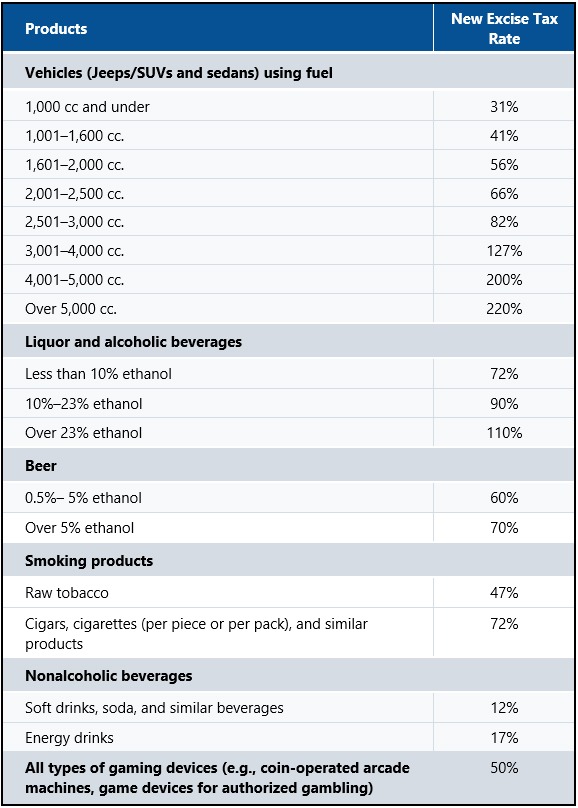
 

This new rate policy is also in line with recent government efforts to encourage avoiding payment in foreign currency to prevent the depletion of foreign currency reserves in Laos. In this regard, commercial banks have already taken action to ration the supply of foreign currency by prioritizing imports of essential goods, such as fuel. The products listed above formalize this impetus to prioritize certain imports and discourage others deemed not essential. In addition, the increased excise tax rates on fuel-powered vehicles show the commitment of the Lao government to move toward electric vehicles, which would also lessen the country’s dependence on fuel imports.

For more information on these excise tax changes, or on any aspect of Laos’ international trade regulations, please contact Tilleke & Gibbins at [email protected].

RELATED INSIGHTS​ 

September 19, 2025
Over the past two years—particularly since Thailand announced incentives for EVs, including tax exemptions and reductions—there has been a clear trend of manufacturers relocating their facilities to Thailand. This shift is reshaping the country’s industrial landscape and creating significant opportunities in the real estate sector for companies looking to establish or expand EV manufacturing operations in Southeast Asia. Incentive-Driven Market Transformation The government’s tax exemptions and reductions have proven effective in attracting foreign investment, with Chinese manufacturers currently dominating the market. Most EV parts and car manufacturers operating in Thailand are from China, reflecting the prominence of Chinese EV brands that have already established a presence in the country. The sector encompasses manufacturers of electrical equipment as well as companies seeking to establish facilities for producing electric vehicle components, parts, and accessories. The surge in activity is evident across Thailand’s EV manufacturing sector, with legal practices handling these transactions experiencing unprecedented demand. Industrial Real Estate Framework and Market Dynamics Thailand’s industrial real estate framework provides compelling advantages for foreign manufacturers, who typically face restrictions on foreign land ownership under the Land Code. However, foreign investors can benefit from exemptions to these restrictions if the land is located within industrial real estate zones designated by the Industrial Estate Authority of Thailand (IEAT) or they obtain investment promotion from the Board of Investment (BOI) if the land is located outside an industrial estate area governed by the IEAT. Both the IEAT and BOI provide special tax and nontax incentives, including foreign land ownership, with even greater incentives available for land situated within the country’s Eastern Economic Corridor (EEC). This regulatory advantage has sparked a parallel trend in land development. Industrial real estate developers in the EEC are actively consolidating land into large plots to develop new industrial estate projects, recognizing that
September 16, 2025
Thailand has enacted amended alcohol control legislation that significantly tightens restrictions on marketing and advertising, strengthens enforcement, and creates mechanisms to support the country’s tourism objectives. The Alcoholic Beverage Control Act (No. 2) B.E. 2568 (2025), published in the Government Gazette on September 9, 2025, will take effect on November 8, 2025. Key aspects of the new law are outlined below. Continuation of Sales-Hour Restrictions Sales-hour restrictions remain in effect, though now under an updated regulatory pathway. Alcohol sales are permitted only between 11:00 a.m. and 2:00 p.m. and between 5:00 p.m. and midnight, with exceptions for airport terminals, entertainment venues under the Entertainment Place Act 1966, and hotels. Despite earlier discussions about relaxing these hours, no changes have been implemented under the new law. Enhanced Seller Responsibilities Sellers are now expressly permitted to check identification cards to verify purchaser age and may assess the condition of intoxicated customers. The assessment conditions will be announced in a forthcoming notification from the director of the Department of Disease Control. Sellers who willfully or negligently violate the law and cause damage to life, health, or property face possible penalties. Alcohol Vending Machines Permitted The law allows alcohol to be sold in vending machines that can verify buyer information and comply with rules, procedures, and conditions to be prescribed by the Alcoholic Beverage Control Committee. This means the industry must await the committee’s implementing regulations before deploying such machines. Expanded Marketing and Advertising Restrictions The amended law introduces a new suite of advertising restrictions, including more detailed and expansive definitions involving marketing and promotions. “Marketing communication” is broadly defined to include any direct or indirect act of publicizing, presenting, or disseminating information about alcoholic beverages through advertising, public relations, sales promotions, sponsorships, or any other means that may induce or encourage the
September 8, 2025
The Indonesian government has implemented mandatory halal certification to protect its predominantly Muslim population. To ensure halal standards, the government has issued several key regulations, including Law No. 33 of 2014 concerning Halal Product Assurance, Government Regulation No. 42 of 2024 concerning Implementation of Halal Product Assurance, and specifically for imported products, Decision of the Head of Halal Product Assurance Agency (BPJPH) No. 90 of 2023 concerning Procedures of Implementing Foreign Halal Certificate Registration. Compliance Deadlines The government has established statutory deadlines for products and services to obtain halal certification under Government Regulation No. 39 of 2021 concerning Implementation of Halal Product Assurance. The deadline for imported food, beverages, and slaughtering products and services to comply with halal certification was extended to October 17, 2026 (from October 17, 2024, originally) with the issuance of Government Regulation No. 42 of 2024. Other product categories have varying deadlines: October 17, 2026: Natural drugs, quasi-drugs, health supplements, cosmetics, chemical products, genetically engineered products, clothing and accessories, household supplies, prayer equipment, stationery, and class A medical devices October 17, 2029: Over-the-counter drugs and class B medical devices October 17, 2034: Prescription drugs (excluding psychotropics) and class C medical devices SHLN Registration for Imports To simplify the halal certification process for imported products, BPJPH offers a foreign halal certificate registration (Registrasi Sertifikat Halal Luar Negeri, or SHLN registration) pathway. This allows eligible imported products to obtain halal certification without filing the standard national halal certification procedure. Under the Halal Law, imported products are not required to apply for national halal certification if their halal certificate is issued by a foreign halal institution that has entered into a mutual recognition agreement (MRA) with BPJPH. Currently, 89 foreign halal institutions from countries (including the United States, South Korea, Thailand, and the United Kingdom) have entered into
September 2, 2025
Thailand’s Office of the Consumer Protection Board (OCPB) has initiated a sweeping regulatory review of licensed direct sale and direct marketing businesses in Thailand and is in the process of notifying business operators to submit their annual business report and financial statement to the OCPB as part of their postlicensing obligations. This move marks a significant escalation in the government’s efforts to enforce compliance and transparency in the sector, which has faced growing scrutiny in recent years. Key Regulatory Considerations All businesses holding a direct sales or direct marketing license are required to submit their audited financial statement along with their business operation report to the OCPB within 60 days from the end of their fiscal year (extendable for up to 30 days by request, if necessary). The OCPB is currently conducting license audits as part of its enforcement duties. The office aims to complete audits for at least 90% of the 2,983 registered businesses that have obtained their license since 2022. This includes a review of the business conduct of the license holder. New license applications are also under scrutiny. Applicants are currently being subjected to background checks, and the OCPB has signaled a more rigorous vetting process moving forward. Impact of Noncompliance Failure to comply with these reporting obligations may result in escalating enforcement actions, including: Official notice to rectify noncompliance within a specified timeframe. Revocation of business registration, if the operator fails to respond. Revocation of business registration could result in a five-year prohibition on reapplying for a direct sales or direct marketing license following the revocation. The OCPB has already initiated outreach efforts, including SMS and email notifications, and has hosted seminars to raise awareness of these obligations. These measures are part of a broader initiative to enhance transparency and consumer trust in the sector. Businesses operating in the direct selling and