You are using an outdated browser and your browsing experience will not be optimal. Please update to the latest version of Microsoft Edge, Google Chrome or Mozilla Firefox. Install Microsoft Edge

October 30, 2023

Laos Raises Excise Tax Rate on Certain Products

On October 9, 2023, Laos issued Presidential Decree No. 003, which raised excise tax rates for certain goods, effective immediately.

The move to increase excise tax rates comes amid the marked depreciation of the Lao kip (LAK). The Lao government is trying to monitor and discourage imports of non-essential products in order to reduce the outflow of foreign currency from the country. Increasing the tax rate for some of these products is part of these efforts.

The specific products and excise tax rates are listed in the table below.
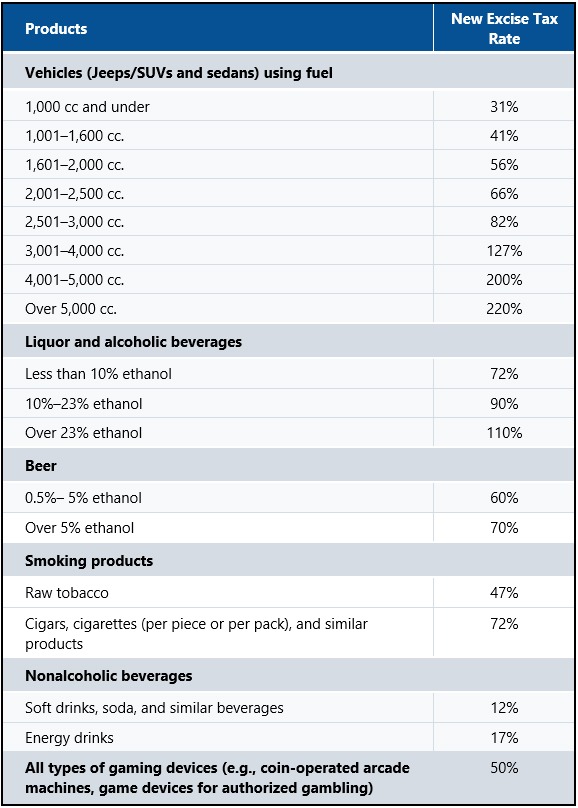
 

This new rate policy is also in line with recent government efforts to encourage avoiding payment in foreign currency to prevent the depletion of foreign currency reserves in Laos. In this regard, commercial banks have already taken action to ration the supply of foreign currency by prioritizing imports of essential goods, such as fuel. The products listed above formalize this impetus to prioritize certain imports and discourage others deemed not essential. In addition, the increased excise tax rates on fuel-powered vehicles show the commitment of the Lao government to move toward electric vehicles, which would also lessen the country’s dependence on fuel imports.

For more information on these excise tax changes, or on any aspect of Laos’ international trade regulations, please contact Tilleke & Gibbins at [email protected].

RELATED INSIGHTS​ 

April 1, 2026
On March 30, 2026, Thailand’s Customs Department announced a strategy to raise import duties on a broad range of consumer goods—including plastic items and electronics accessories—to their maximum statutory ceilings, which often sit at 30% or 40%. Many of these goods currently benefit from promotional or incentive rates as low as 5%. For importers, e-commerce platforms, and logistics providers, this development demands immediate attention. While these increases generally require cabinet approval, they do not require full parliamentary amendment of the Customs Tariff Decree B.E. 2530, as the Customs director-general and the finance minister hold delegated authority to adjust rates within existing statutory bounds. Businesses should not assume that the legislative process will provide significant lead time before higher rates take effect. Death of the De Minimis: Abolishing the THB 1,500 Loophole This “ceiling-rate” policy, which is designed to equalize the landed cost of foreign goods with the domestic production costs of Thai manufacturers, builds on a sweeping set of customs reforms that have already begun to reshape Thailand’s trade environment. The foundation of this new regime was laid on January 1, 2026, when Thailand formally abolished the longstanding THB 1,500 duty exemption for small imported parcels under Customs Notification No. 219/2568. Every imported item is now subject to VAT and applicable import duties for its declared value, regardless of parcel size or transaction amount. By narrowing the scope of exemptions previously granted to low-value goods under the Customs Tariff Decree B.E. 2530, the government has made clear that the era of tax-free cross-border micro-imports is over. Three-Phased Strategy and Legal Modernization The March 30 announcement is the second phase of a three-part regulatory roadmap: Immediate enforcement: The removal of the THB 1,500 loophole and the imposition of VAT on all parcels, effective January 1, 2026. Tariff realignment: The current
March 31, 2026
Thailand’s Office of the Consumer Protection Board has opened a public hearing period on draft regulations governing the transfer of direct sales and direct marketing businesses. The draft Notification of the Direct Sales and Direct Marketing Committee: Criteria and Procedures for Business Transfer and Amendment of Registration for Direct Sales or Direct Marketing Businesses establishes a compliance-focused process with strict documentation requirements and timelines for transferring direct sales and direct marketing businesses. The proposed framework also defines the roles of transferors and transferees and establishes application procedures with the Office of the Consumer Protection Board. Applications may be submitted in person or electronically and will be examined to confirm they are complete, authentic, and compliant with legal requirements. This includes verification that: The transferee meets all required qualifications; No disqualifying factors apply; and The applicant is not subject to legal restrictions. The public hearing period is open until April 29, 2026. Direct sales and direct marketing business operators should prepare for these proposed requirements to ensure compliant implementation once the regulations are finalized.
March 20, 2026
Myanmar has introduced a comprehensive new regulatory framework for alcoholic beverages that will impose stricter controls on production, distribution, advertising, and sales. On March 7, 2026, the National Defence and Security Council issued a new Excise Law (NDSC Law No. 13/2026), repealing the Excise Act of 1917. The law, which has not yet entered into force, will take effect on a date to be specified in a separate notification—likely within this year. The new Excise Law establishes clearer definitions, introduces multiple categories of excise licenses and permits, and significantly expands prohibitions and compliance obligations for businesses operating in the alcohol sector. Many operational details will be clarified through implementing rules and notifications. Scope and Definitions The new law defines “excise” to cover alcoholic liquor and excisable articles. Alcoholic liquor is broadly defined as any liquid containing more than 0.5% ethyl alcohol, including beer, wine, toddy sap, fermented liquor, and any other liquid declared as alcohol by notification of the relevant ministry, excluding denatured alcohol. Alcoholic liquor is further categorized into country liquor, foreign liquor, and international‑standard domestically produced liquor. Excise Licensing The law also introduces a more detailed licensing regime. The following types of liquor excise licenses are available: Production Production of value-added products Bottling Distribution Sales Other excise‑related businesses designated by General Administrative Department (GAD) notification The GAD will prescribe the licensing fees, requirements, and conditions for each category through notifications issued with the approval of the Ministry of Home Affairs. The GAD may also, with the approval of the Ministry of Home Affairs, prescribe quantities and volumes of alcoholic beverages that may be possessed without a liquor license. No such prescribed quantities have yet been issued. Holders of excise licenses for manufacturing, production of value-added products, or bottling must obtain approval from the relevant government department or
March 19, 2026
Thailand’s Electronic Transactions Development Agency (ETDA), which describes itself as a “co-creation regulator” working collaboratively with industry rather than imposing top-down rules, has unveiled its regulatory roadmap for digital platform businesses under the Royal Decree on Digital Platform Service Businesses B.E. 2565 (2022). The 2026 regulatory approach is guided by three core principles—“practicable, verifiable, shared responsibility”—aimed at elevating digital services to be safe, transparent, and fair. These principles inform ETDA’s 2026 priorities, which focus on three key dimensions: product and service standards on platforms, fair competition and fee transparency, and online fraud prevention. Product and Service Standards ETDA’s 2026 agenda addresses product and service standards across several platform categories: Online marketplace platforms. The Notification on Additional Measures for Online Marketplace Platforms under Section 18(2) came into force on December 31, 2025, designating 21 marketplace platforms that must verify products and merchants. Among other obligations, covered platforms must remove or suspend substandard products under the “notice and take down” principle. The ETDA has collaborated with the Food and Drug Administration and the Thai Industrial Standards Institute to develop inspection manuals and coordinate compliance procedures. Social commerce. The ETDA is preparing a new notification under Section 18(2) specifically targeting social commerce platforms with sales support functions, aiming to align regulation with evolving digital market conditions. Ride sharing. Since the postponement of the deadline to comply with the ETDA’s notification on ride-sharing platforms to March 31, 2026, the ETDA has supported drivers in registering with the Department of Land Transport through the Driver Verify registration system, which has already issued certifications to approximately 27,900 riders. The ETDA is also examining structural issues relating to appropriate insurance packages, motorcycle engine capacity expansion, and fair leasing fees and contract transfer costs in coordination with the Department of Land Transport, the Office of Insurance Commission,