You are using an outdated browser and your browsing experience will not be optimal. Please update to the latest version of Microsoft Edge, Google Chrome or Mozilla Firefox. Install Microsoft Edge

July 7, 2023

Laos Details Products Subject to Import-Export Registration Requirement

Following Laos’ announcement requiring importers and exporters to register with the Ministry of Industry and Commerce (MOIC), the MOIC has released a comprehensive list of products that are subject to the registration requirement. Traders that import or export goods on the list, which was finalized on June 9, 2023, and made public on June 28 in MOIC Notification No. 1224, must register with the MOIC by August 31, 2023, to obtain a certificate authorizing their import or export activities.

The notification specifies four main categories of goods for which importers and exporters must register with the Department of Import and Export (DIMEX) of the MOIC: agricultural products, construction materials, and edible and nonedible consumer goods.

The exact products in each category are listed below, along with the corresponding Harmonized System codes from the World Customs Organization:
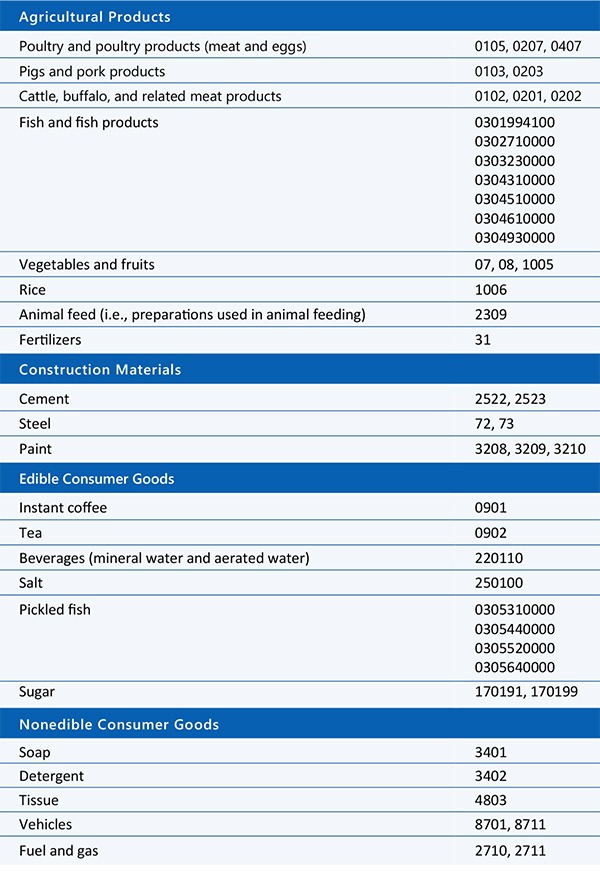
Enterprises engaged in the import and export of the goods listed in the table above must complete registration by August 31, 2023. Imports and exports of the listed goods by any enterprise not registered with the DIMEX will be prohibited after the deadline. The MOIC is also expected to add certain goods to the list in the future, but information on the timing and content of these additions is not yet available.

Enterprises that have completed registration must also ask the Bank of Lao PDR (BOL) to certify their accounts held at commercial banks, after which they must ask the relevant commercial banks to convert their current bank accounts into import-export accounts.

For more details on Laos’ new registration rules for importers and exporters, or on any aspect of international trade involving Laos, please contact Tilleke & Gibbins at [email protected].

RELATED INSIGHTS​ 

April 1, 2026
On March 30, 2026, Thailand’s Customs Department announced a strategy to raise import duties on a broad range of consumer goods—including plastic items and electronics accessories—to their maximum statutory ceilings, which often sit at 30% or 40%. Many of these goods currently benefit from promotional or incentive rates as low as 5%. For importers, e-commerce platforms, and logistics providers, this development demands immediate attention. While these increases generally require cabinet approval, they do not require full parliamentary amendment of the Customs Tariff Decree B.E. 2530, as the Customs director-general and the finance minister hold delegated authority to adjust rates within existing statutory bounds. Businesses should not assume that the legislative process will provide significant lead time before higher rates take effect. Death of the De Minimis: Abolishing the THB 1,500 Loophole This “ceiling-rate” policy, which is designed to equalize the landed cost of foreign goods with the domestic production costs of Thai manufacturers, builds on a sweeping set of customs reforms that have already begun to reshape Thailand’s trade environment. The foundation of this new regime was laid on January 1, 2026, when Thailand formally abolished the longstanding THB 1,500 duty exemption for small imported parcels under Customs Notification No. 219/2568. Every imported item is now subject to VAT and applicable import duties for its declared value, regardless of parcel size or transaction amount. By narrowing the scope of exemptions previously granted to low-value goods under the Customs Tariff Decree B.E. 2530, the government has made clear that the era of tax-free cross-border micro-imports is over. Three-Phased Strategy and Legal Modernization The March 30 announcement is the second phase of a three-part regulatory roadmap: Immediate enforcement: The removal of the THB 1,500 loophole and the imposition of VAT on all parcels, effective January 1, 2026. Tariff realignment: The current
February 27, 2026
On January 26, 2026, Vietnam’s Ministry of Finance issued Circular No. 06/2026/TT-BTC (Circular 06), amending and supplementing Circular No. 13/2015/TT-BTC, which provides guidance on dossiers and procedures for customs recordal and customs supervision in relation to intellectual property rights (IPR). Circular 06 has an effective date of March 1, 2026. Some notable points of Circular 06 include the following: Simplified Documentation for Customs Recordal Applications Circular 06 reduces some documentary requirements for IPR owners: A power of attorney is no longer required to be legalized. Applicants are no longer required to submit title or registration certificates if such documents are issued in digital form. In such cases, it is sufficient to declare comprehensive information on the relevant IPR, enabling customs authorities to verify the information through publicly accessible databases. In practice, this amendment is particularly beneficial for international trademark registrations designating Vietnam. IPR owners may no longer need to obtain a confirmation letter from the Intellectual Property Office of Vietnam regarding the validity of a trademark registration in Vietnam. Instead, they may rely on registration status information available from the World Intellectual Property Organization (WIPO) database, reflecting that the international registration has been granted protection in Vietnam. Clearer Mechanism for Ex Officio Suspension of Suspected Infringing Goods Although ex officio suspension has been referenced in earlier regulations, Circular 06 provides clearer guidance on the circumstances and procedures under which customs may proactively suspend customs procedures for consignments suspected of being counterfeit or pirated goods. Accordingly, customs authorities may initiate the suspension of clearance without waiting for a formal request from IPR owners. Enhanced Supervision of Imported/Exported Goods in E-Commerce Circular 06 also supplements provisions on the inspection of imported and exported goods transacted through e-commerce channels. Customs authorities may apply risk management measures to assess goods traded via e-commerce
February 25, 2026
Tilleke & Gibbins has updated the Vietnam chapter in the newly released Licensing 2026 guide, published by Lexology Panoramic. The comparative guide provides companies and other interested readers with information on licensing law and practice in various countries around the world. Licensing 2026 provides detailed information on the following topics: Restrictions, laws and licensing arrangements Intellectual property issues: Paris Convention for the Protection of Industrial Property, contesting the validity of licensor’s IP rights, invalidity and expiry of IP rights, security interests, proceedings against third parties, sublicensing, jointly owned IP, first to file, scope of patent protection, trade secrets, copyright Software licensing: Perpetual licensing, legal requirements, user restrictions Royalties and payments, currency conversion, and taxes: Relevant legislation, restrictions, taxation of foreign licensors Competition law issues: Restrictions on trade, legal restrictions, and IP-related court rulings Indemnification, disclaimers, and damages: Prevalence and enforceability of indemnity provisions and contractual waivers of damages Termination: Right to terminate, impact of termination Bankruptcy: Impact of licensee or licensor bankruptcy Dispute resolution: Governing law, arbitration, enforceability, injunctive relief, contractual waivers The Vietnam chapter is available below as a PDF. Readers can gain 30 days of complementary access to the full Licensing 2026 guide and the rest of Lexology Panoramic’s varied offerings through this link.
February 20, 2026
On February 2, 2026, Myanmar’s Ministry of Finance and Revenue issued Notification No. 19/2026, reducing the customs duty rate to 0% for certain battery‑electric vehicles, machinery, and related spare parts, applicable from February 2, 2026, through March 31, 2026. Under the notification, imports of battery‑electric special‑purpose vehicles, battery‑electric industrial machinery, and associated spare parts listed in the notification’s annex are eligible for a zero‑percent customs duty rate. These items must be supported by technical recommendations from the Ministry of Electric Power and a recommendation from the Ministry of Industry. The notification applies to a broad range of battery electric equipment, including the following categories: Special purpose vehicles, such as crane trucks, mobile drilling trucks, concrete mixers, mobile clinics, broadcast vans, and street‑cleaning vehicles. Heavy machinery, including excavators, bulldozers, loaders, cranes, rollers, forklifts, and port handling equipment. Spare parts, covering 16 specified categories, including key components such as chargers, inverters, and controllers. Importers and businesses using electric‑powered industrial equipment should review the scope of the eligible items and confirm whether their planned imports fall within the lists covered by the notification.