The Indonesian food and drug authority, also known as “BPOM,” issued a draft regulation on September 9, 2024, proposing standard labeling disclosing the sugar, salt, and fat content of packaged food products sold in the country.
The draft Regulation on Nutritional Value Information on Food Labels to implement Government Regulation No. 28 of 2024 on the Implementation of the Health Law seeks to mandate “Nutri-Level” front-of-pack nutrition labeling to indicate the amount of sugar, salt, and fat at four possible levels, with a modified stoplight-color system:
- Level “A” (lowest amount) has a dark green background
- Level “B” has a light green background
- Level “C” has a yellow background
- Level “D” (highest amount) has a red background
These levels are shown in the following sample image:
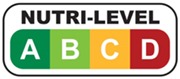
The requirements for sugar, salt, and fat content for each level are based on amounts per 100 milliliters of ready-to-eat processed food as follows:

Further requirements relating to nutrients reflected in the Nutri-Level labeling include:
- Foods labeled as level A are not allowed to contain natural or artificial sweetening food additives, either through direct addition or carried over from other ingredients.
- Foods labeled as level B may only contain natural sweetening food additives.
- Foods labeled as level C or D may use natural and artificial sweetening food additives.
- “Sugar” includes all monosaccharides and disaccharides, excluding lactose.
- Processed plain liquid milk and plain milk powder are exempt from the requirement to declare total fat content on the Nutri-Level label.
Labeling Implementation
The implementation of Nutri-Level labeling must comply with the following requirements:
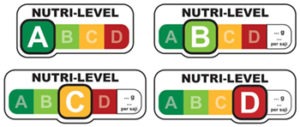
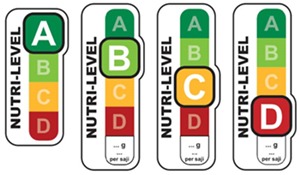
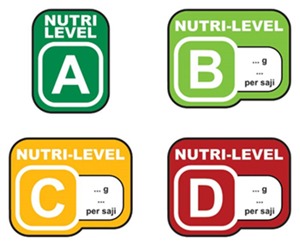
- The Nutri-Level label must list all four letters (as shown in the examples below) unless the package meets the criteria for display of a simplified format label.
- The Nutri-Level of the processed food must be indicated by enlarging the relevant letter, as shown in the examples below.
- Processed foods at levels C and D must include a Nutri-Level label, while processed foods at levels A and B may do so on a voluntary basis.
- The inclusion of a Nutri-Level label on processed foods at levels C and D must be accompanied by the sugar, salt, and fat content per serving (per saji in Indonesian, as shown in the examples below) or per package.
Nutri-Level Label Format
The draft regulation provides Nutri-Level label examples in both full and simplified formats. The simplified format applies to small packages of 30 square centimeters or less, while the full format must be used on other packages.
Full (horizontal)
Full (vertical)
Simplified
Timeline for Compliance
The draft regulation provides a grace period for existing product registrations:
- Processed food that has obtained a product registration or for which a product registration application is pending before the regulation comes into effect must be amended within 30 months of the effective date of the regulation.
- Ready-to-drink beverages, liquid concentrates, and powdered beverages must be amended within 18 months of the effective date of the regulation.
It is anticipated that the draft regulation will be finalized by the end of 2024.
For more details on this draft regulation, or on any aspect of food labeling requirements in Indonesia, please contact Tilleke & Gibbins at [email protected].