
You are using an outdated browser and your browsing experience will not be optimal. Please update to the latest version of Microsoft Edge, Google Chrome or Mozilla Firefox. Install Microsoft Edge

October 1, 2024

Indonesia Prepares to Require Nutritional Labeling for Sugar, Salt, and Fat Content

The Indonesian food and drug authority, also known as “BPOM,” issued a draft regulation on September 9, 2024, proposing standard labeling disclosing the sugar, salt, and fat content of packaged food products sold in the country.

The draft Regulation on Nutritional Value Information on Food Labels to implement Government Regulation No. 28 of 2024 on the Implementation of the Health Law seeks to mandate “Nutri-Level” front-of-pack nutrition labeling to indicate the amount of sugar, salt, and fat at four possible levels, with a modified stoplight-color system:

  • Level “A” (lowest amount) has a dark green background
  • Level “B” has a light green background
  • Level “C” has a yellow background
  • Level “D” (highest amount) has a red background

These levels are shown in the following sample image:
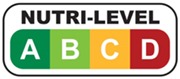
The requirements for sugar, salt, and fat content for each level are based on amounts per 100 milliliters of ready-to-eat processed food as follows:

Further requirements relating to nutrients reflected in the Nutri-Level labeling include:

  • Foods labeled as level A are not allowed to contain natural or artificial sweetening food additives, either through direct addition or carried over from other ingredients.
  • Foods labeled as level B may only contain natural sweetening food additives.
  • Foods labeled as level C or D may use natural and artificial sweetening food additives.
  • “Sugar” includes all monosaccharides and disaccharides, excluding lactose.
  • Processed plain liquid milk and plain milk powder are exempt from the requirement to declare total fat content on the Nutri-Level label.

Labeling Implementation

The implementation of Nutri-Level labeling must comply with the following requirements:

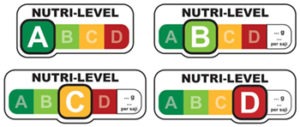
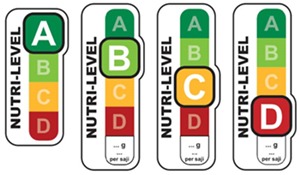
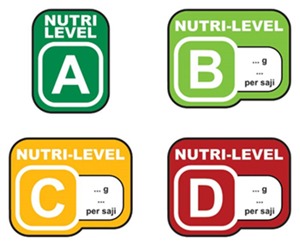
  • The Nutri-Level label must list all four letters (as shown in the examples below) unless the package meets the criteria for display of a simplified format label.
  • The Nutri-Level of the processed food must be indicated by enlarging the relevant letter, as shown in the examples below.
  • Processed foods at levels C and D must include a Nutri-Level label, while processed foods at levels A and B may do so on a voluntary basis.
  • The inclusion of a Nutri-Level label on processed foods at levels C and D must be accompanied by the sugar, salt, and fat content per serving (per saji in Indonesian, as shown in the examples below) or per package.

Nutri-Level Label Format

The draft regulation provides Nutri-Level label examples in both full and simplified formats. The simplified format applies to small packages of 30 square centimeters or less, while the full format must be used on other packages.

Full (horizontal)
Full (vertical)
Simplified
Timeline for Compliance

The draft regulation provides a grace period for existing product registrations:

  • Processed food that has obtained a product registration or for which a product registration application is pending before the regulation comes into effect must be amended within 30 months of the effective date of the regulation.
  • Ready-to-drink beverages, liquid concentrates, and powdered beverages must be amended within 18 months of the effective date of the regulation.

It is anticipated that the draft regulation will be finalized by the end of 2024.

For more details on this draft regulation, or on any aspect of food labeling requirements in Indonesia, please contact Tilleke & Gibbins at [email protected].

RELATED INSIGHTS​ 

April 20, 2023
Food safety is one important area of focus as Cambodia continues to improve its regulatory framework surrounding consumer protection. Last year, the new Law on Food Safety set out the main principles to regulate the food sector, providing general rights and obligations of food businesses and requirements for food products traded in Cambodia. Then in the first months of 2023, two implementing regulations were issued to clarify the overarching principles of the Law on Food Safety, as well as its enforcement mechanisms. The adoption of these enforcement-related regulations is once again a clear signal to the market that the Cambodian government is taking the enforcement of consumer protection laws seriously. Food Surveillance, Seizure, and Recalls The first of these implementing regulations was Sub-Decree No. 13 on the Conditions, Formalities and Procedures for Food Surveillance and Seizure, dated January 6, 2023 (SD 13), followed the next month by Prakas No. 080 on the Forms and Procedures to Seize Unsafe Foods or Foods Not Complying with Technical Regulations, dated February 22, 2023 (Prakas 80). These implementing regulations give clarity on how the authorities will monitor and inspect the food sector, and in what cases the authorities may resort to recalls or seizure of foods. Prakas 80 also provides the necessary paperwork for both inspecting officers and companies to use when reporting on unsafe foods to authorities and the public. Lastly, the regulations further clarify the obligations for food businesses and the penalties for noncompliance. The Consumer Protection, Competition, and Fraud Repression Directorate-General (CCF) of the Ministry of Commerce takes a key role as the main enforcement authority under the regulations. The CCF receives reports on unsafe foods, manages voluntary recalls, publishes warnings to the public regarding unsafe foods, seizes unsafe or otherwise noncompliant goods, and applies the administrative fines and penalties
March 24, 2023
Attorneys in Tilleke & Gibbins’ Jakarta office have contributed a new “Life Sciences Regulation in Indonesia” chapter to Practical Law’s updated Life Sciences Global Guide. The chapter covers a range of regulatory issues related to the development, manufacturing, and selling of pharmaceutical products and medical devices, including the following topics: Pharmaceuticals: Laws and regulatory authorities Clinical trials: Legal, regulatory, and procedural requirements Manufacturing and distribution Marketing: Authorization for marketing medicinal products, monitoring compliance and penalties, pharmacovigilance and other commitments, foreign marketing authorizations Data privacy Packaging, labeling, and tracking Biological medicines Medical devices: Legislation and regulatory authorities, definition and classification Healthcare IT Combination products and borderlines Natural health products Developments, reforms, and proposals Practical Law, produced by Thomson Reuters, is the world’s leading legal know-how resource for business lawyers, publishing a huge range of guides covering hundreds of jurisdictions and practice areas. The full “Life Sciences Regulation in Indonesia” chapter can be accessed on the Practical Law website
March 24, 2023
Tilleke & Gibbins’ life sciences specialists in Indonesia have contributed a new “Life Sciences Commercialization in Indonesia” chapter to the Life Sciences Global Guide from Practical Law. This Q&A guide to commercializing life sciences innovations in Indonesia provides important information that companies can use to shape their strategies for life sciences products and activities in the jurisdiction. Specifically, the chapter covers: Overview of the life sciences sector Pricing, government funding, and reimbursement: National health care system, price regulation and reimbursement Distribution and sale Cross-border trade and parallel imports Advertising and engagement with patient organizations Patents: Conditions for patentability, registration, length of protection, infringement, international treaties Trademarks: Requirements, registration Competition law issues: Authorities and legislation, commercial contracts and competition law, licensing approvals and formalities Product liability: Regulators, medicinal product liability law, liable partners, defenses, product liability claims, remedies Practical Law, produced by Thomson Reuters, is the world’s leading legal know-how resource for business lawyers, publishing a huge range of guides covering hundreds of jurisdictions and practice areas. The full “Life Sciences Commercialization in Indonesia” section can be found on the Practical Law website.
March 7, 2023
On March 3, 2023, the government of Vietnam issued Decree No. 07/2023/ND-CP (Decree 07) amending Decree 98/2021/ND-CP on medical device management (Decree 98) to resolve many urgent problems in the healthcare sector in Vietnam. Decree 07 took effect on the same day and amends and supplements several articles in its predecessor, Decree 98, which originally took effect on January 1, 2022. Some outstanding points of Decree 07 are summarized below. 1. Registration of Medical Devices The compulsory implementation of the ASEAN Common Submission Dossier Template (CSDT) in registration applications for medical devices will be delayed until January 1, 2024, instead of the deadline of January 1, 2023 under Decree 98. In addition, if after three rounds of amendment/supplementation as requested by the authority, the registration dossiers still have not been approved, the applicants must submit new registration dossiers. 2. Withdrawal of Registration Number Decree 98 adds one case for withdrawing the registration number of a medical device, which is when the documents in the registration dossier are concluded by the authority to be noncompliant with the provisions of law. 3. Listing Price of Medical Devices It is required for establishments manufacturing or trading medical devices to list their prices in locations stipulated under Article 17 of Decree No. 177/2013/ND-CP implementing the Law on Prices (such as at transaction or selling locations of the trading establishments) or on the online portal of the Department of Medical Equipment and Construction’s (DMEC). 4. Price Declaration It is no longer required to declare prices of all medical devices circulating on the Vietnam market. Instead, the Ministry of Health will issue and adjust the list of medical devices subject to price declaration, depending on management requirements and the actual situation, especially when there are abnormal fluctuations in prices affecting the supply of medical devices,