
You are using an outdated browser and your browsing experience will not be optimal. Please update to the latest version of Microsoft Edge, Google Chrome or Mozilla Firefox. Install Microsoft Edge

October 1, 2024

Indonesia Prepares to Require Nutritional Labeling for Sugar, Salt, and Fat Content

The Indonesian food and drug authority, also known as “BPOM,” issued a draft regulation on September 9, 2024, proposing standard labeling disclosing the sugar, salt, and fat content of packaged food products sold in the country.

The draft Regulation on Nutritional Value Information on Food Labels to implement Government Regulation No. 28 of 2024 on the Implementation of the Health Law seeks to mandate “Nutri-Level” front-of-pack nutrition labeling to indicate the amount of sugar, salt, and fat at four possible levels, with a modified stoplight-color system:

  • Level “A” (lowest amount) has a dark green background
  • Level “B” has a light green background
  • Level “C” has a yellow background
  • Level “D” (highest amount) has a red background

These levels are shown in the following sample image:

The requirements for sugar, salt, and fat content for each level are based on amounts per 100 milliliters of ready-to-eat processed food as follows:

Further requirements relating to nutrients reflected in the Nutri-Level labeling include:

  • Foods labeled as level A are not allowed to contain natural or artificial sweetening food additives, either through direct addition or carried over from other ingredients.
  • Foods labeled as level B may only contain natural sweetening food additives.
  • Foods labeled as level C or D may use natural and artificial sweetening food additives.
  • “Sugar” includes all monosaccharides and disaccharides, excluding lactose.
  • Processed plain liquid milk and plain milk powder are exempt from the requirement to declare total fat content on the Nutri-Level label.

Labeling Implementation

The implementation of Nutri-Level labeling must comply with the following requirements:

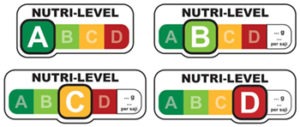
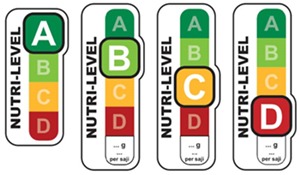
  • The Nutri-Level label must list all four letters (as shown in the examples below) unless the package meets the criteria for display of a simplified format label.
  • The Nutri-Level of the processed food must be indicated by enlarging the relevant letter, as shown in the examples below.
  • Processed foods at levels C and D must include a Nutri-Level label, while processed foods at levels A and B may do so on a voluntary basis.
  • The inclusion of a Nutri-Level label on processed foods at levels C and D must be accompanied by the sugar, salt, and fat content per serving (per saji in Indonesian, as shown in the examples below) or per package.

Nutri-Level Label Format

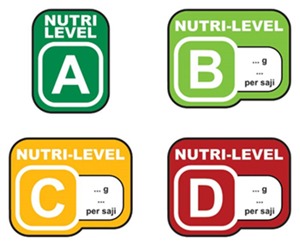
The draft regulation provides Nutri-Level label examples in both full and simplified formats. The simplified format applies to small packages of 30 square centimeters or less, while the full format must be used on other packages.

Full (horizontal)
Full (vertical)
Simplified
Timeline for Compliance

The draft regulation provides a grace period for existing product registrations:

  • Processed food that has obtained a product registration or for which a product registration application is pending before the regulation comes into effect must be amended within 30 months of the effective date of the regulation.
  • Ready-to-drink beverages, liquid concentrates, and powdered beverages must be amended within 18 months of the effective date of the regulation.

It is anticipated that the draft regulation will be finalized by the end of 2024.

For more details on this draft regulation, or on any aspect of food labeling requirements in Indonesia, please contact Tilleke & Gibbins at [email protected].

RELATED INSIGHTS​ 

November 25, 2025
Food safety incidents can emerge without warning, requiring businesses to act swiftly to protect consumers and comply with regulatory obligations. Across Southeast Asia, Thailand, Vietnam, and Indonesia have each developed comprehensive food recall frameworks designed to ensure rapid removal of unsafe products from the market while holding businesses accountable for compliance failures. While these three jurisdictions share common objectives—protecting public health and ensuring food safety—each has crafted distinct regulatory approaches reflecting their unique administrative structures, enforcement priorities, and legal traditions. Understanding these differences is essential for food businesses operating in the region, as recall procedures, timelines, reporting requirements, and penalties vary significantly across borders. This guide, available through the button below, examines the food recall regulations in Indonesia, Thailand, and Vietnam, providing practical guidance on legal requirements, procedural steps, and compliance obligations in each market.
October 15, 2025
The Indonesian Food and Drug Administration (BPOM) has introduced more stringent oversight of health supplements containing probiotics with new guidelines that require clinical trials for certain products and expanded documentation standards. BPOM Regulation No. 17 of 2025 replaces the previous 2021 regulation and establishes a comprehensive framework for evaluating probiotic strains used in health supplements. Assessment Requirements The new regulation expands the scope of assessment to include not only categorization and documentation but also technical procedures, strain classification, and clinical trial requirements. Unlike the previous regulation, which provided general guidance, the updated framework creates a comprehensive system for evaluating both registered probiotic strains and new or combined strains. Manufacturers must now submit supporting documentation covering strain identification and functional characterization, safety, efficacy, and product quality. The previous regulation required documentation only on safety, efficacy, and quality. Clinical Trials One of the most significant changes is the requirement for clinical trials conducted in Indonesia for applications that include benefit claims other than maintaining digestive health, or where there are modifications to benefit claims. The regulation specifies that phase 1 trials must demonstrate safety, while phase 2 trials must validate efficacy using statistically valid methods such as double-blind, randomized, placebo-controlled studies). In addition, phase 3 and phase 4 trials may be required, and postmarket surveillance data must be submitted. Technical Assessment Framework Annex 4, a newly introduced section, establishes technical procedures for assessing health supplements containing probiotics in Indonesia. This comprehensive framework outlines criteria for evaluating new probiotic strains, including strain identification, functional characterization, safety, efficacy, and product quality. The annex introduces a clear classification of claims for health supplement products containing probiotics: General claims(e.g., maintaining digestive health). Functional claims(e.g., normal biological function or activity in the body). Risk reduction claims(e.g., lowering disease risk). The regulation restricts use of the term
October 3, 2025
On September 26, 2025, the Contract Committee under Thailand’s Consumer Protection Board issued a regulation that aims to standardize contracts and enhance consumer protection within the beauty and wellness industry. The Notification on Prescribing the Beauty Service Business as a Contract-Controlled Business B.E. 2568 (2025), which takes effect on January 24, 2026, requires business operators to use a prescribed standard contract in Thai and adhere to strict mandatory provisions and prohibitions. These regulations apply to operators across all in-person and online service channels, including via digital platforms. “Beauty services business” is defined as the provision of services under an agreement allowing consumers to receive a series of treatments, either over a set number of sessions or within a set period. This includes massage, spa, other methods for cleanliness, beauty, or care of facial or body skin, and weight control and body shaping—including services offered electronically. The law excludes surgery, liposuction, and medical treatments performed by licensed practitioners. The notification establishes the following key requirements: Mandatory contract and formatting. All contracts with consumers must use the standard contract form, in Thai, with clear, readable text (minimum font size of 2 millimeters, no more than 11 characters per inch), and include all essential terms from the annexed form. Contract execution. Contracts must be made in duplicate, with one copy given to the consumer at signing. For agreements concluded through electronic channels, the process must comply with the Electronic Transactions Act and use the same required terms. Digital platforms. Business operators who provide services facilitated through a digital platform as an intermediary are ultimately responsible for ensuring the consumer receives a compliant contract. Prohibited clauses. The law prohibits clauses that limit or exclude liability for damages to life, body, health, mind, or property resulting from breach of contract or a wrongful act;