
You are using an outdated browser and your browsing experience will not be optimal. Please update to the latest version of Microsoft Edge, Google Chrome or Mozilla Firefox. Install Microsoft Edge

October 1, 2024

Indonesia Prepares to Require Nutritional Labeling for Sugar, Salt, and Fat Content

The Indonesian food and drug authority, also known as “BPOM,” issued a draft regulation on September 9, 2024, proposing standard labeling disclosing the sugar, salt, and fat content of packaged food products sold in the country.

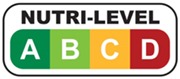
The draft Regulation on Nutritional Value Information on Food Labels to implement Government Regulation No. 28 of 2024 on the Implementation of the Health Law seeks to mandate “Nutri-Level” front-of-pack nutrition labeling to indicate the amount of sugar, salt, and fat at four possible levels, with a modified stoplight-color system:

  • Level “A” (lowest amount) has a dark green background
  • Level “B” has a light green background
  • Level “C” has a yellow background
  • Level “D” (highest amount) has a red background

These levels are shown in the following sample image:
The requirements for sugar, salt, and fat content for each level are based on amounts per 100 milliliters of ready-to-eat processed food as follows:

Further requirements relating to nutrients reflected in the Nutri-Level labeling include:

  • Foods labeled as level A are not allowed to contain natural or artificial sweetening food additives, either through direct addition or carried over from other ingredients.
  • Foods labeled as level B may only contain natural sweetening food additives.
  • Foods labeled as level C or D may use natural and artificial sweetening food additives.
  • “Sugar” includes all monosaccharides and disaccharides, excluding lactose.
  • Processed plain liquid milk and plain milk powder are exempt from the requirement to declare total fat content on the Nutri-Level label.

Labeling Implementation

The implementation of Nutri-Level labeling must comply with the following requirements:

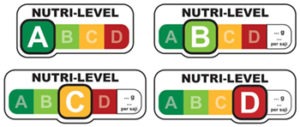
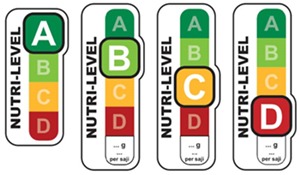
  • The Nutri-Level label must list all four letters (as shown in the examples below) unless the package meets the criteria for display of a simplified format label.
  • The Nutri-Level of the processed food must be indicated by enlarging the relevant letter, as shown in the examples below.
  • Processed foods at levels C and D must include a Nutri-Level label, while processed foods at levels A and B may do so on a voluntary basis.
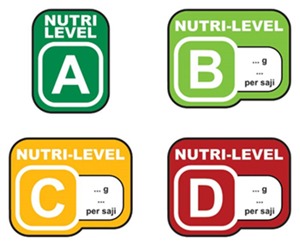
  • The inclusion of a Nutri-Level label on processed foods at levels C and D must be accompanied by the sugar, salt, and fat content per serving (per saji in Indonesian, as shown in the examples below) or per package.

Nutri-Level Label Format

The draft regulation provides Nutri-Level label examples in both full and simplified formats. The simplified format applies to small packages of 30 square centimeters or less, while the full format must be used on other packages.

Full (horizontal)
Full (vertical)
Simplified
Timeline for Compliance

The draft regulation provides a grace period for existing product registrations:

  • Processed food that has obtained a product registration or for which a product registration application is pending before the regulation comes into effect must be amended within 30 months of the effective date of the regulation.
  • Ready-to-drink beverages, liquid concentrates, and powdered beverages must be amended within 18 months of the effective date of the regulation.

It is anticipated that the draft regulation will be finalized by the end of 2024.

For more details on this draft regulation, or on any aspect of food labeling requirements in Indonesia, please contact Tilleke & Gibbins at [email protected].

RELATED INSIGHTS​ 

October 25, 2021
Michael Ramirez, a counsel in Tilleke & Gibbins’ dispute resolution group in Bangkok, has updated the firm’s contribution to the Global Attorney-Client Privilege Guide, published by Lex Mundi. The newly expanded guide provides information on what constitutes attorney-client privilege in over 70 countries around the world. The Thailand section of the guide contains in-depth information on the function and applications of attorney-client privilege in Thailand (or, as explained in the guide, an equivalent concept enshrined in Thai law), including coverage of the following topics: Privilege in corporations Common interest doctrine Litigation funding Crime-fraud exception Work product doctrine/litigation privilege Other privileges including mediation, accountant-client and settlement negotiation The interactive guide features expert contributions by Lex Mundi member firms from jurisdictions worldwide. Readers can browse the contributions, generate country-specific reports, and compare attorney-client privilege in multiple jurisdictions. For more information, please visit the Lex Mundi website.
October 14, 2021
As part of its membership in Lex Mundi, Tilleke & Gibbins has published an updated edition of its Guide to Doing Business in Thailand for 2021. This guide outlines all of the key factors for starting and operating a business in the Thai market. Issues covered include: Investment incentives Financial facilities Exchange controls Import and export regulations Structures for doing business Requirements for the Establishment of a Business Operation of the Business Cessation or Termination of the Business Labor legislation, relations, and supply Tax Immigration requirements This publication is part of Lex Mundi’s Guides to Doing Business series prepared by member firms in more than 100 jurisdictions worldwide. The guides serve as a useful resource when planning an international business strategy or researching a new market.
October 11, 2021
A registration process for plant variety protection (PVP) has been in effect in Myanmar since enactment of the New Plant Variety Protection Law 2016, which was later replaced by the New Plant Variety Protection Law 2019 (“PVP Law 2019”). In accordance with its implementation of this law, the government is encouraging private companies, associations, organizations, and individual plant breeders to apply for the protection of new plant varieties in order to increase crop production in the country. Despite the challenges of the COVID-19 pandemic in Myanmar, Tilleke & Gibbins successfully secured a plant breeder’s rights certificate for a client in June 2020, making the client the first certificate holder in Myanmar. This article summarizes the PVP application and registration process, and offers some practical insights into the authorities’ activities and approach. PVP Registration The Central Committee for National New Plant Variety Protection (PVP Committee) oversees PVP registration, which is administered by the PVP Section of the Department of Agricultural Research (DAR) in the Ministry of Agriculture, Livestock, and Irrigation. To apply for plant breeder’s rights in Myanmar, an application and a technical questionnaire on the new plant variety should be filed with the PVP Section, which reviews the technical questionnaire and determines whether the plant qualifies as a new variety. Four groups are eligible to apply for PVP registration in order to secure plant breeder’s rights under the current PVP legislation: Myanmar nationals; Foreign nationals and organizations whose permanent residence is in Myanmar; Persons or entities resident in a country that has a PVP agreement with Myanmar; and International organizations. An application can be examined in one of four ways (determined by the PVP Committee): Official field trial involving planting the new variety in Myanmar; On-site field inspection of the breeder’s field by the PVP Section; Examination of test
August 27, 2021
The process of registering pesticide products in Myanmar has been slowed significantly by regulatory challenges since the enactment of the Pesticide Law in 2016. In some cases, the whole process can take almost three years. Nonetheless, this stringent and time-consuming process has been functioning smoothly, and Tilleke & Gibbins has successfully received approvals from the Pesticide Registration Board (PRB) despite the ongoing COVID-19 pandemic and state of emergency in the country. Overview Since its enactment, the Pesticide Law of 2016 has governed the regulation of local and imported pesticides under the oversight of the Plant Protection Division (PPD) and the joint secretary of the PRB. All foreign and domestic companies (including subsidiaries and joint ventures) looking to have their agricultural or household pest control products imported into Myanmar must first provide the products’ complete formulas and lists of active ingredients to the PPD, and apply for a pesticide registration certificate. Applications should be supported by a letter of consent from the manufacturer and various other technical documents and requirements. Experts at the PRB will review the technical dossier and inform the applicant if any re-submissions are required. Key Considerations One common cause of delay in the registration process is the requirement to submit both English and Myanmar translations of proposed labels to the PRB. Because the PRB takes a restrictive view of these labels and their translations, having the labels initially reviewed by a local regulatory expert familiar with the requirements will streamline the process by flagging potential issues for correction before submission to the PRB. After document submission is complete, the next stage of the process is further lab testing according to requirements set out by the Myanmar Pesticide Law. Applicants will need to supply the formulated product in an amount sufficient for carrying out supervised trials and