
You are using an outdated browser and your browsing experience will not be optimal. Please update to the latest version of Microsoft Edge, Google Chrome or Mozilla Firefox. Install Microsoft Edge

October 1, 2024

Indonesia Prepares to Require Nutritional Labeling for Sugar, Salt, and Fat Content

The Indonesian food and drug authority, also known as “BPOM,” issued a draft regulation on September 9, 2024, proposing standard labeling disclosing the sugar, salt, and fat content of packaged food products sold in the country.

The draft Regulation on Nutritional Value Information on Food Labels to implement Government Regulation No. 28 of 2024 on the Implementation of the Health Law seeks to mandate “Nutri-Level” front-of-pack nutrition labeling to indicate the amount of sugar, salt, and fat at four possible levels, with a modified stoplight-color system:

  • Level “A” (lowest amount) has a dark green background
  • Level “B” has a light green background
  • Level “C” has a yellow background
  • Level “D” (highest amount) has a red background

These levels are shown in the following sample image:
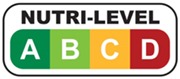
The requirements for sugar, salt, and fat content for each level are based on amounts per 100 milliliters of ready-to-eat processed food as follows:

Further requirements relating to nutrients reflected in the Nutri-Level labeling include:

  • Foods labeled as level A are not allowed to contain natural or artificial sweetening food additives, either through direct addition or carried over from other ingredients.
  • Foods labeled as level B may only contain natural sweetening food additives.
  • Foods labeled as level C or D may use natural and artificial sweetening food additives.
  • “Sugar” includes all monosaccharides and disaccharides, excluding lactose.
  • Processed plain liquid milk and plain milk powder are exempt from the requirement to declare total fat content on the Nutri-Level label.

Labeling Implementation

The implementation of Nutri-Level labeling must comply with the following requirements:

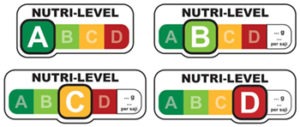
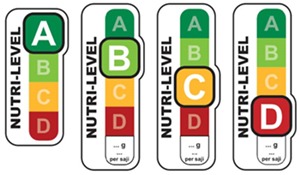
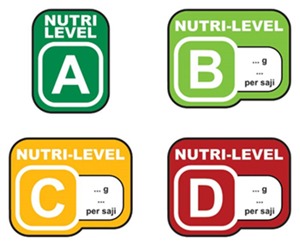
  • The Nutri-Level label must list all four letters (as shown in the examples below) unless the package meets the criteria for display of a simplified format label.
  • The Nutri-Level of the processed food must be indicated by enlarging the relevant letter, as shown in the examples below.
  • Processed foods at levels C and D must include a Nutri-Level label, while processed foods at levels A and B may do so on a voluntary basis.
  • The inclusion of a Nutri-Level label on processed foods at levels C and D must be accompanied by the sugar, salt, and fat content per serving (per saji in Indonesian, as shown in the examples below) or per package.

Nutri-Level Label Format

The draft regulation provides Nutri-Level label examples in both full and simplified formats. The simplified format applies to small packages of 30 square centimeters or less, while the full format must be used on other packages.

Full (horizontal)
Full (vertical)
Simplified
Timeline for Compliance

The draft regulation provides a grace period for existing product registrations:

  • Processed food that has obtained a product registration or for which a product registration application is pending before the regulation comes into effect must be amended within 30 months of the effective date of the regulation.
  • Ready-to-drink beverages, liquid concentrates, and powdered beverages must be amended within 18 months of the effective date of the regulation.

It is anticipated that the draft regulation will be finalized by the end of 2024.

For more details on this draft regulation, or on any aspect of food labeling requirements in Indonesia, please contact Tilleke & Gibbins at [email protected].

RELATED INSIGHTS​ 

November 24, 2021
On November 8, 2021, the Vietnamese government issued Decree No. 98/2021/ND-CP on the Management of Medical Devices (“Decree 98”). The new decree will take effect from January 1, 2022, replacing Decree No. 36/2016/ND-CP and its amendments on the same subject (“Decree 36”). Below are the main highlights of Decree 98: 1. Classification of Medical Devices Under Decree 98, responsibility for the classification of medical devices is given to the organization registering or declaring the medical device. Under Decree 36, this responsibility was reserved for Vietnamese organizations qualified for medical device classification. 2. Clinical Trials of Medical Devices Decree 98 provides stricter and more detailed requirements on clinical trials. Particularly, medical device trials will include three phases, in which phases 1 and 2 need to be finished before the product registration, while phase 3 will be conducted after the medical devices are approved for circulation, following the specific requirement from the authorities. This requirement aims to continue evaluating the safety and efficacy of medical devices after they are widely used in the community in line with their usage conditions. 3. Medical Device Registration Similar to the current regulations, Decree 98 requires that medical devices must be registered with the Vietnamese authority (i.e., must obtain registration numbers) before being imported/manufactured for circulation in the Vietnam market. However, Decree 98 further stipulates new requirements as below. Validity of registration numbers Under Decree 98, the registration numbers for all classes of medical devices, not only Class A medical devices as in the current regulations, are valid indefinitely, except for registration numbers granted under the emergency registration procedure. Registration procedure for Class A/B medical devices Instead of having to register with the central level authority with a complex registration dossier as currently required, Decree 98 allows Class B medical devices to be subject to
November 24, 2021
Attorneys from Tilleke & Gibbins have provided the latest update to the Thailand contribution to Doing Business in…, a Q&A-style guide published by Thomson Reuters Practical Law that presents an overview of the legal framework for doing business in 63 jurisdictions worldwide. The Thailand chapter of the guide outlines Thailand’s legal system and key laws applicable to foreign companies doing business in the country. The chapter specifically covers the following main topics: Legal system: Thailand’s court system and codified legal system. Foreign investment: Lists of reserved business activities, restrictions on doing business with certain jurisdictions, exchange controls and currency regulations, and grants and incentives available to investors. Business vehicles: Ordinary partnerships, registered ordinary partnerships, limited partnerships, private limited companies, and public companies. Environment: Main laws and regulations, factory operation. Employment: Laws, employment contract requirements, work permits, and termination and redundancy. Tax: Taxes on employment, tax and nontax resident employees and businesses, corporate income tax, value added tax, special business tax, municipal tax, stamp duty, dividends, interest, intellectual property royalties. Competition: Important aspects of Thailand’s regulatory regime surrounding competition, centered around the updated Trade Competition Act. Antibribery and corruption: Laws, compliance requirements, regulatory authority. Intellectual property: Patents, trademarks, registered and unregistered designs, and copyright. Marketing agreements and advertising: Regulation of marketing agreements, Thailand’s Consumer Protection Act, direct marketing, role of the Consumer Protection Board and Food and Drug Administration. E-commerce: E-commerce laws and regulations, marketing and sales via online platforms. Data protection: An outline of Thailand’s Personal Data Protection Act. Product liability: Procedures and regulations for product liability and product safety, including the Unsafe Goods Liability Act and the Consumer Case Procedure Act. Product liability: Key regulatory authorities for trade competition, environmental issues, and financial services. To browse, download, or print the Thailand chapter, please visit the Practical Law website.
November 4, 2021
A new royal decree in Thailand (Royal Decree Re: Licensee to Pay the License Renewal Fee in Lieu of a Grace Period When Submitting a License Renewal Application B.E. 2564) does away with the current red tape associated with renewing certain marketing authorization and business licenses. Under the new royal decree, there is no longer any need to submit renewal applications for eligible licenses or to wait for approval from the relevant authority. Instead, the licenses will be automatically renewed upon payment of renewal fees. There are 31 eligible licenses listed in the royal decree, with a focus on licenses for hazardous substances and cosmetics. The royal decree on license renewal was published in the Government Gazette in May 2021 and will come into force on November 22, 2021. Although the new royal decree has not yet come into force, Thailand’s Food and Drug Administration (FDA) has already begun renewing licenses for hazardous substance licenses and cosmetics notification receipts via the new procedure. These licenses and notification receipts are detailed below: (Note: Hazardous substances for household use and public health are classified into four types according to their risk. Products containing type 2 and 3 substances are a higher risk than type 1 and must be registered with the FDA. Type 4 substances are prohibited.) Procedural Guidance The licenses for hazardous substances in the table above should be renewed in the two months preceding their expiry date, while the notification receipts for cosmetics should be renewed in the six months before their expiry date. Renewed licenses are valid for another six or three years (i.e., matching the original validity period). Under the new royal decree on license renewal, eligible licenses for hazardous substances and cosmetics can be renewed by notifying the FDA via its e-submission system. The license holder
October 26, 2021
Parallel imports—branded goods imported into a domestic market and sold there without the consent of the intellectual property (IP) owner—pose a unique challenge for IP owners. In contrast to counterfeit goods, parallel imported goods are manufactured by or under the license of the IP owner and formulated or packaged for a particular jurisdiction and then imported into a different jurisdiction without the authorization of the IP owner. Intellectual property laws and perspectives on parallel import vary throughout Southeast Asia. The distinct legal landscape in each nation should be carefully navigated in consultation with legal experts to ensure brand protection to the fullest degree. This guide provides insight into the legal frameworks relating to parallel imports in Cambodia, Indonesia, Laos, Myanmar, Thailand, and Vietnam. Each section examines the relevant laws and regulations that pertain to parallel imports and explores the remedies available to IP owners in each country. Finally, the guide presents some strategies to combat parallel importation and maximize IP protection in Southeast Asia. The full guide can be downloaded through the button below.   This guide was prepared with the assistance of Tilleke & Gibbins interns Christian Pederson and Keoni Williams.