
You are using an outdated browser and your browsing experience will not be optimal. Please update to the latest version of Microsoft Edge, Google Chrome or Mozilla Firefox. Install Microsoft Edge

October 1, 2024

Indonesia Prepares to Require Nutritional Labeling for Sugar, Salt, and Fat Content

The Indonesian food and drug authority, also known as “BPOM,” issued a draft regulation on September 9, 2024, proposing standard labeling disclosing the sugar, salt, and fat content of packaged food products sold in the country.

The draft Regulation on Nutritional Value Information on Food Labels to implement Government Regulation No. 28 of 2024 on the Implementation of the Health Law seeks to mandate “Nutri-Level” front-of-pack nutrition labeling to indicate the amount of sugar, salt, and fat at four possible levels, with a modified stoplight-color system:

  • Level “A” (lowest amount) has a dark green background
  • Level “B” has a light green background
  • Level “C” has a yellow background
  • Level “D” (highest amount) has a red background

These levels are shown in the following sample image:
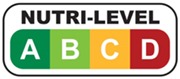
The requirements for sugar, salt, and fat content for each level are based on amounts per 100 milliliters of ready-to-eat processed food as follows:

Further requirements relating to nutrients reflected in the Nutri-Level labeling include:

  • Foods labeled as level A are not allowed to contain natural or artificial sweetening food additives, either through direct addition or carried over from other ingredients.
  • Foods labeled as level B may only contain natural sweetening food additives.
  • Foods labeled as level C or D may use natural and artificial sweetening food additives.
  • “Sugar” includes all monosaccharides and disaccharides, excluding lactose.
  • Processed plain liquid milk and plain milk powder are exempt from the requirement to declare total fat content on the Nutri-Level label.

Labeling Implementation

The implementation of Nutri-Level labeling must comply with the following requirements:

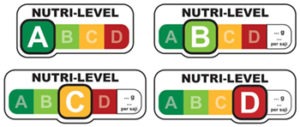
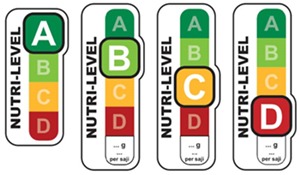
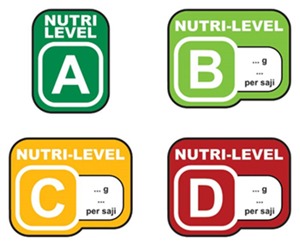
  • The Nutri-Level label must list all four letters (as shown in the examples below) unless the package meets the criteria for display of a simplified format label.
  • The Nutri-Level of the processed food must be indicated by enlarging the relevant letter, as shown in the examples below.
  • Processed foods at levels C and D must include a Nutri-Level label, while processed foods at levels A and B may do so on a voluntary basis.
  • The inclusion of a Nutri-Level label on processed foods at levels C and D must be accompanied by the sugar, salt, and fat content per serving (per saji in Indonesian, as shown in the examples below) or per package.

Nutri-Level Label Format

The draft regulation provides Nutri-Level label examples in both full and simplified formats. The simplified format applies to small packages of 30 square centimeters or less, while the full format must be used on other packages.

Full (horizontal)
Full (vertical)
Simplified
Timeline for Compliance

The draft regulation provides a grace period for existing product registrations:

  • Processed food that has obtained a product registration or for which a product registration application is pending before the regulation comes into effect must be amended within 30 months of the effective date of the regulation.
  • Ready-to-drink beverages, liquid concentrates, and powdered beverages must be amended within 18 months of the effective date of the regulation.

It is anticipated that the draft regulation will be finalized by the end of 2024.

For more details on this draft regulation, or on any aspect of food labeling requirements in Indonesia, please contact Tilleke & Gibbins at [email protected].

RELATED INSIGHTS​ 

March 8, 2022
Attorneys from Tilleke & Gibbins’ Bangkok office have authored the Thailand chapter in Pharmaceutical Advertising 2022 from Chambers & Partners. Pharmaceutical Advertising 2022—the fifth annual edition of this practice guide—provides information on pharmaceutical advertising regulations in 18 jurisdictions around the world. The guidance is especially useful for pharmaceutical manufacturers looking to share their products and innovations with the public in a responsible, transparent way that is compliant with local laws. The Thailand chapter covers the following topics: Regulatory Framework for pharmaceutical advertising Scope of advertising and general principles Advertising of unauthorized medicines or unauthorized indications Advertising pharmaceuticals to the general public Advertising to healthcare professionals Vetting requirements and internal verification compliance Advertising of medicinal products on the internet Inducement and antibribery Gifts, hospitality, congresses and related payments Transparency considerations for pharmaceutical companies Enforcement of pharmaceutical advertising rules Chambers & Partners’ Global Practice Guides provide in-house counsel with expert legal commentary focusing on practical legal issues affecting business, and enable readers to compare legislation and relevant procedures across a range of key jurisdictions. Tilleke & Gibbins also contributed the Vietnam chapter to the guide. The full Pharmaceutical Advertising 2022 guide—including the Thailand chapter—is available for free on the Chambers and Partners website. The Thailand chapter is also available as a PDF through the button below.
February 24, 2022
The enactment of Thailand’s Narcotics Code, effective December 10, 2021, marked a key milestone in promoting the commercial applications of cannabis (both marijuana and hemp) and kratom as economic plants—with subsequent regulatory developments continuing this push. For many decades, cannabis and kratom were classified as category 5 narcotics under the Narcotics Act. However, a movement for the legalization of cannabis and kratom developed over time. First, the legalization of marijuana (Cannabis indica) for medical purposes became effective on February 19, 2019, as prescribed in Amendment No. 7 of the Narcotics Act. Kratom has also been effectively decriminalized (covering consumption, production, disposal, and possession for any purpose) since August 24, 2021, as prescribed in Amendment No. 8 of the Narcotics Act. The laws governing narcotic and psychotropic substances in Thailand have now taken a significant step forward with the passage of the Narcotics Code, which is intended to be a comprehensive law covering all narcotics and psychotropic substances in Thailand. Most recently, the Ministry of Public Health announced in the Government Gazette on February 2, 2022, that only cannabis extract (both marijuana and hemp) with THC of more than 0.2% by weight will be classified as a category 5 narcotic. This means that seeds, cannabis plants, and inflorescences, if harvested in Thailand, have been removed from the list of category 5 narcotics. Although the changes to Thailand’s narcotics regulations for cannabis and kratom are intricate, both cannabis and kratom have become a topical issue for farmers and related industries. The plants are new cash crops and have attracted widespread public interest. Currently, we can see fresh kratom leaves and fresh cannabis leaves sold in the market. Unlike products with cannabis derivatives, kratom-based products are not yet available in the Thai market. Although there is an opportunity for developing kratom-based products
December 10, 2021
Indonesia’s National Agency of Drug and Food Control (BPOM) has issued a regulation to amend the country’s food labeling regulations by instituting various additional restrictions and providing additional clarity on food labeling requirements—not only for final food products but also for food additives and food products for further processing. The additions are contained in Regulation No. 20 of 2021 (an amendment to Regulation No. 31 of 2018), which took effect on August 2, 2021. The deadline to comply with the new labeling requirements for final food products is December 31, 2021, and the deadline for requirements related to food additives and food products for further processing is August 2, 2022. The new requirements introduced by the latest regulation are outlined below. Final Food Products Non-halal foods. The new regulation clarifies that food products containing non-halal ingredients are exempt from halal certification requirements. This provision is important as it explicitly confirms that non-halal food products can still be sold and distributed in Indonesia. Ingredient percentages. Percentages of ingredient content must be included in the list of ingredients on a food label, and on any ingredients that are emphasized on the label in words or pictures, or stated as part of the food name. Polyol warning. Labels for food products containing polyol must now include a warning to this effect. Allergen information. The new regulation provides an alternative for indicating allergen information on the food label. Under the 2018 regulation, allergens had to be indicated in the ingredients list in bold type, and the label had to have the disclaimer “contains allergens, see list of ingredients printed in bold.” The new regulation, however, allows allergen information to be declared on the label with the phrase “contains allergens:” followed by the allergen name(s) printed in bold. With this new alternative, it is
November 29, 2021
On November 25, 2021, the Myanmar Investment Commission (MIC) issued a list of investment sectors that will receive priority attention in order to encourage national development and state building. The investment activities that MIC will prioritize are the following: Fertilizer manufacturing Cement manufacturing Iron and steel manufacturing Agriculture and livestock farming and related industries Value-added manufacturing of foodstuffs Electric vehicle manufacturing Pharmaceutical and medical device manufacturing Public transportation services Both foreign investors and local investors may invest in these sectors, and the MIC, ministries, and relevant state and regional governments will provide necessary assistance to the investors under the Myanmar Investment Law 2016. For more details on the new requirements, please contact Tilleke & Gibbins at [email protected] or +95 9 772 440 001.