
You are using an outdated browser and your browsing experience will not be optimal. Please update to the latest version of Microsoft Edge, Google Chrome or Mozilla Firefox. Install Microsoft Edge

October 1, 2024

Indonesia Prepares to Require Nutritional Labeling for Sugar, Salt, and Fat Content

The Indonesian food and drug authority, also known as “BPOM,” issued a draft regulation on September 9, 2024, proposing standard labeling disclosing the sugar, salt, and fat content of packaged food products sold in the country.

The draft Regulation on Nutritional Value Information on Food Labels to implement Government Regulation No. 28 of 2024 on the Implementation of the Health Law seeks to mandate “Nutri-Level” front-of-pack nutrition labeling to indicate the amount of sugar, salt, and fat at four possible levels, with a modified stoplight-color system:

  • Level “A” (lowest amount) has a dark green background
  • Level “B” has a light green background
  • Level “C” has a yellow background
  • Level “D” (highest amount) has a red background

These levels are shown in the following sample image:
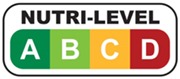
The requirements for sugar, salt, and fat content for each level are based on amounts per 100 milliliters of ready-to-eat processed food as follows:

Further requirements relating to nutrients reflected in the Nutri-Level labeling include:

  • Foods labeled as level A are not allowed to contain natural or artificial sweetening food additives, either through direct addition or carried over from other ingredients.
  • Foods labeled as level B may only contain natural sweetening food additives.
  • Foods labeled as level C or D may use natural and artificial sweetening food additives.
  • “Sugar” includes all monosaccharides and disaccharides, excluding lactose.
  • Processed plain liquid milk and plain milk powder are exempt from the requirement to declare total fat content on the Nutri-Level label.

Labeling Implementation

The implementation of Nutri-Level labeling must comply with the following requirements:

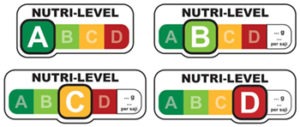
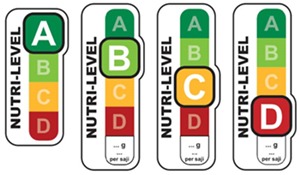
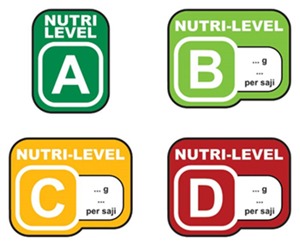
  • The Nutri-Level label must list all four letters (as shown in the examples below) unless the package meets the criteria for display of a simplified format label.
  • The Nutri-Level of the processed food must be indicated by enlarging the relevant letter, as shown in the examples below.
  • Processed foods at levels C and D must include a Nutri-Level label, while processed foods at levels A and B may do so on a voluntary basis.
  • The inclusion of a Nutri-Level label on processed foods at levels C and D must be accompanied by the sugar, salt, and fat content per serving (per saji in Indonesian, as shown in the examples below) or per package.

Nutri-Level Label Format

The draft regulation provides Nutri-Level label examples in both full and simplified formats. The simplified format applies to small packages of 30 square centimeters or less, while the full format must be used on other packages.

Full (horizontal)
Full (vertical)
Simplified
Timeline for Compliance

The draft regulation provides a grace period for existing product registrations:

  • Processed food that has obtained a product registration or for which a product registration application is pending before the regulation comes into effect must be amended within 30 months of the effective date of the regulation.
  • Ready-to-drink beverages, liquid concentrates, and powdered beverages must be amended within 18 months of the effective date of the regulation.

It is anticipated that the draft regulation will be finalized by the end of 2024.

For more details on this draft regulation, or on any aspect of food labeling requirements in Indonesia, please contact Tilleke & Gibbins at [email protected].

RELATED INSIGHTS​ 

March 7, 2023
According to the Ministry of Health of Vietnam, many healthcare facilities in the country are facing a shortage of drugs, medical devices, and materials/chemicals. To address the urgent needs of medical examination and treatment in public healthcare facilities, on March 4, 2023, the government of Vietnam promulgated Resolution No. 30/NQ-CP on continuing to implement solutions to ensure the availability of drugs, medical equipment, and healthcare supplies (“Resolution 30”). Resolution 30 amends item 4 of Resolution No. 144/NQ-CP dated November 5, 2022, allowing medical examination and treatment expenses to continue to be covered by health insurance for technical services carried out with medical devices supplied by contractors after winning tenders to supply materials and chemicals. The new mechanism brings more benefit to patients by removing the previous ending date of November 5, 2023, and will be applicable until there is further guidance from the government. Resolution 30 also allows the use of medical devices that were donated or gifted by domestic and foreign entities (including those that were provided under now-expired joint ventures or cooperation contracts) regardless of whether those entities have fulfilled the procedures for ownership establishment. Technical services that are performed by such devices will be covered by health insurance. This provision will help address the shortage of medical devices used in public hospitals. The determination of bid price is also a highlight of Resolution 30, which pilots a simpler price determination procedure for the purchase of drugs and medical devices. Instead of requiring purchasers to obtain quotations from three suppliers, Resolution 30 allows them to compare prices based on the quotations actually received, even from only one or two suppliers. Alternatively, price determination can be based on the winning bid price for a similar medical device procurement package that was awarded within the last 120 days. This
February 21, 2023
On December 28, 2022, the Ministry of Health of Laos issued Decision No. 3789/MOH on the Control of Hemp for Medication and Products (the “Decision”). The Decision approves the regulated cultivation, extraction, production, processing, storage, distribution, utilization, import-export, and transport of hemp. The Decision also authorizes the use of hemp and hemp-related products by the general population, although use of certain products is limited to those with medical prescriptions. Background In 2019, the Lao government established an ad hoc committee to consider the legalization of cannabis, as reported previously. The government permitted certain local companies to grow cannabis in specific zones under pilot programs, although it continued to strictly prohibit the use and commercialization, as well as consumption, of cannabis-related products, regardless of the level of psychoactive tetrahydrocannabinol (THC) in the products. Overview of the Decision The Decision was issued by the Ministry of Health (which led the ad hoc committee) and permits authorized companies to engage in certain activities involving the use of hemp and the consumption of hemp and hemp-related products. The Decision defines hemp (“porkeo” in Lao) as a “plant that belongs to the same family as ganja and bears the scientific name Cannabis Sativa L. (Cannabis sativa L. subsp. sativa var. sativa) which is a subspecies of ganja (Cannabis Sativa L.).” This definition aims at differentiating hemp from the general definition of ganja or marijuana, which continues to be listed as a prohibited narcotic in Laos. The Law on Narcotics (2007) and the Penal Code (2017) still prohibit the production, trade and use of all types of cannabis. These laws will need to be amended to ensure that they are aligned with changes set out in the Decision.  Authorized Hemp Activities The Decision allows approved companies to engage in the cultivation, extraction, production, processing, storage,
February 9, 2023
Vietnam’s Ministry of Finance is drafting a circular on determining the origin of imported and exported goods. This circular, a draft version of which has been released for public comment (“Draft Circular”), consolidates prevailing regulations and guidelines on determining the origin of imported and exported goods that are stipulated in the following legal documents, which the Draft Circular would replace when it comes into effect: Circular No. 38/2018/TT-BTC dated April 20, 2018, of the Ministry of Finance regulating the determination of origin of imported and exported goods, as amended by Circular No. 62/2019/TT-BTC dated September 5, 2019, of the Ministry of Finance; Circular No. 47/2020/TT-BTC dated May 27, 2020, regulating the time to submit documents proving the origin of goods and form of the documents proving the origin of imported goods applied during the Covid-19 pandemic; and Circular No. 07/2021/TT-BTC dated January 25, 2021, regulating the time to submit documents proving the origin of imported goods under the EU-Vietnam Free Trade Agreement (EVFTA). Generally speaking, the Draft Circular does not increase the administrative procedures for importers and exporters, but rather seeks to codify the recent practices implemented by the customs authorities. The Draft Circular focuses on providing comprehensive guidance for importing/exporting companies when carrying out administrative procedures to certify the origins of imported and exported goods to be in line with current trade practices and international commitments under new-generation free trade agreements. In particular, the Draft Circular supplements guidelines on declaring origins and submitting Certificates of Origin (C/Os) of imported goods under the EVFTA and the Regional Comprehensive Economic Partnership Agreement (RCEP). The Draft Circular also provides some new guidelines to facilitate exports (and imports) and overcome some obstacles and issues when implementing the prevailing regulations. For example, the submission of C/Os online, which was only applicable during the
January 27, 2023
The opening weeks of 2023 have already seen a sharp increase in enforcement against violations of product labeling and advertising rules in Cambodia, in line with a notice issued by the country’s Directorate-General for Consumer Protection, Competition, and Fraud Repression (CCF) last year. Since the Law on Consumer Protection was adopted in 2019, a major legislative push has been seen, with general rules coming out focusing on providing consumers with sufficient information on products and services, for example via product labeling or advertising rules. Then, more detailed regulations were adopted for specific product categories, for example for food products and cosmetics. Khmer language requirements have been a key feature of the recently adopted rules on advertising and labeling. Despite the Khmer language mandates in consumer protection laws and regulations, enforcement and compliance was low. Most products on the market—especially imports—did not comply with the language requirement. In line with the revamped regulatory framework, the CCF has increased its enforcement, enabled by recent substantial budget increases. They have adopted clear implementing regulations for their officers to enforce in a practical yet effective manner, and they have been issuing notices reminding companies to comply with the new rules. A September 2022 notice announced that increased CCF enforcement of product labeling rules would start on January 1, 2023. As noted above, this has already proven to be true, and enforcement is now proceeding in earnest. Companies should take heed of this notice and ensure compliance with the Khmer language requirements (detailed below), as the CCF has shown that it readily acts against violators, from small retailers to large conglomerates. Khmer Language Requirement A sub-decree issued November 4, 2022 requires all commercial advertising of products and services—by any channel—to use Khmer as the primary language. If foreign-language text is used in advertisements, it