
You are using an outdated browser and your browsing experience will not be optimal. Please update to the latest version of Microsoft Edge, Google Chrome or Mozilla Firefox. Install Microsoft Edge

October 1, 2024

Indonesia Prepares to Require Nutritional Labeling for Sugar, Salt, and Fat Content

The Indonesian food and drug authority, also known as “BPOM,” issued a draft regulation on September 9, 2024, proposing standard labeling disclosing the sugar, salt, and fat content of packaged food products sold in the country.

The draft Regulation on Nutritional Value Information on Food Labels to implement Government Regulation No. 28 of 2024 on the Implementation of the Health Law seeks to mandate “Nutri-Level” front-of-pack nutrition labeling to indicate the amount of sugar, salt, and fat at four possible levels, with a modified stoplight-color system:

  • Level “A” (lowest amount) has a dark green background
  • Level “B” has a light green background
  • Level “C” has a yellow background
  • Level “D” (highest amount) has a red background

These levels are shown in the following sample image:
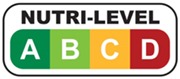
The requirements for sugar, salt, and fat content for each level are based on amounts per 100 milliliters of ready-to-eat processed food as follows:

Further requirements relating to nutrients reflected in the Nutri-Level labeling include:

  • Foods labeled as level A are not allowed to contain natural or artificial sweetening food additives, either through direct addition or carried over from other ingredients.
  • Foods labeled as level B may only contain natural sweetening food additives.
  • Foods labeled as level C or D may use natural and artificial sweetening food additives.
  • “Sugar” includes all monosaccharides and disaccharides, excluding lactose.
  • Processed plain liquid milk and plain milk powder are exempt from the requirement to declare total fat content on the Nutri-Level label.

Labeling Implementation

The implementation of Nutri-Level labeling must comply with the following requirements:

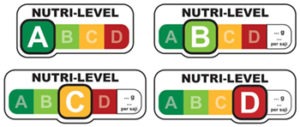
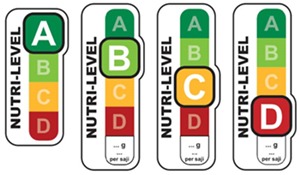
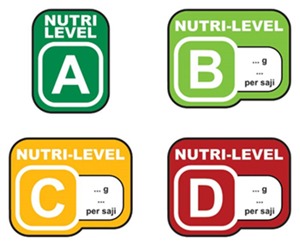
  • The Nutri-Level label must list all four letters (as shown in the examples below) unless the package meets the criteria for display of a simplified format label.
  • The Nutri-Level of the processed food must be indicated by enlarging the relevant letter, as shown in the examples below.
  • Processed foods at levels C and D must include a Nutri-Level label, while processed foods at levels A and B may do so on a voluntary basis.
  • The inclusion of a Nutri-Level label on processed foods at levels C and D must be accompanied by the sugar, salt, and fat content per serving (per saji in Indonesian, as shown in the examples below) or per package.

Nutri-Level Label Format

The draft regulation provides Nutri-Level label examples in both full and simplified formats. The simplified format applies to small packages of 30 square centimeters or less, while the full format must be used on other packages.

Full (horizontal)
Full (vertical)
Simplified
Timeline for Compliance

The draft regulation provides a grace period for existing product registrations:

  • Processed food that has obtained a product registration or for which a product registration application is pending before the regulation comes into effect must be amended within 30 months of the effective date of the regulation.
  • Ready-to-drink beverages, liquid concentrates, and powdered beverages must be amended within 18 months of the effective date of the regulation.

It is anticipated that the draft regulation will be finalized by the end of 2024.

For more details on this draft regulation, or on any aspect of food labeling requirements in Indonesia, please contact Tilleke & Gibbins at [email protected].

RELATED INSIGHTS​ 

June 24, 2026
Patent enablement requirements are provided under Article 102 of Vietnam’s Law on Intellectual Property (IP Law). In particular, a patent specification must “fully and clearly disclose the nature of the invention to such an extent that, based on the specification, a person having ordinary skill in the relevant art can implement the invention.” In pharmaceutical and biotechnology patents, this requirement is more complicated and subject to more rigorous assessment. The Patent Examination Guidelines (Guidelines) of the Intellectual Property Office of Vietnam (IP Office) were amended in March 2026 to introduce Annexes III and IV for the pharmaceutical and biotechnology sectors, in which Annex III provides detailed guidelines on the assessment of specification requirements. These amendments were made under a project for strengthening capacity in industrial property examination between the Japan International Cooperation Agency (JICA) and the IP Office. Annex III provides detailed instructions on how examiners assess enablement in a pharmaceutical or biotechnology application, and offers examples of acceptable and unacceptable descriptions with regard to the enablement aspect. Enablement Requirements in Pharma and Biotech Patents Article 12.7 of Circular 10/2026/TT-BKHCN (Circular 10) adds to the requirements of Article 102 of the IP Law that the description must demonstrate the novelty, inventive step, and industrial applicability of the technical solution. For pharmaceutical composition subject matters, Article 12.9 of Circular 10 sets out that the description must present the results of clinical trials and/or the pharmacological effects of the claimed pharmaceutical composition, and must include at least the following information: Substance/mixture used. Testing method (system) employed. Information on the test results. Correlation between the pharmacological effects obtained from the tests and the application of the pharmaceutical product in the prevention, diagnosis, and treatment of diseases. The Guidelines note that pharmacological study results should be presented in a quantified manner, and pharmacological
June 19, 2026
For the first time, Thailand’s Food and Drug Administration (FDA) has published a consolidated list identifying all substances that have successfully passed its novel food safety evaluation process. The list is a step forward in regulatory transparency, but it also highlights a feature of the Thai regime that food companies often overlook: each approval is tied exclusively to the company that applied for it. A substance’s appearance on the list does not give other companies the green light to use it. This article examines the structure of Thailand’s novel food approval framework, the implications of applicant exclusivity, and the strategic choices it requires of food companies looking to bring novel ingredients to the Thai market. Thai FDA Food Safety Evaluation Framework Notification No. 376 of the Ministry of Public Health requires novel food substances to undergo a food safety assessment, with an exemption only for novel foods manufactured exclusively for export. The framework also encompasses “foods that do not qualify as novel foods” but which present characteristics warranting a safety evaluation, such as differing quality standards, increased serving sizes, or applications in specific food categories, where such changes affect consumption levels, nutritional value, or consumer safety. The recently published list of foods that passed the safety evaluation by the Thai FDA is structured by substance category and identifies the approved company (domestic manufacturer or importer), country of origin, substance name and trade name, approved purpose of use, and date of the Thai FDA’s approval notification certificate. A notable feature of Thailand’s novel food regime is that the approval result is tied exclusively to the company that submitted the application. Publication of the consolidated list does not constitute a general authorization to use the approved substances. The Thai FDA’s approval certificate specifies the approved conditions of use and the requirements
June 17, 2026
Thailand’s new labeling requirements for medical devices, which include for the first time a unique device identification (UDI) requirement for software as a medical device (SaMD), take effect on June 20, 2026. The Notification of the Ministry of Public Health regarding Criteria, Methods, and Conditions on Labeling and Instructions for Use for Medical Devices 2025, which replaces a similar notification from 2020, was published in the Government Gazette on December 22, 2025. To ensure clarity, modernity, and patient safety, the regulation requires domestic manufacturers and importers to provide labels and instructions for use (IFU) that are clearly legible, complete, and free of false or misleading claims. It also permits IFU to be provided in electronic format, such as via QR codes, websites, or other digital channels—directly relevant to SaMD, where physical labels are impractical and electronic presentation is the natural medium. The notification distinguishes two categories for labeling language. Home-use medical devices (for lay users outside healthcare facilities) must have labels and IFU in Thai. Professional-use medical devices may display labels and documentation in either Thai or English. This distinction is significant for SaMD developers: software intended for clinical professionals may use English-language interfaces and IFU, while consumer-facing health applications must provide Thai-language content. Labeling and UDI Requirements Labels and IFU must include, at a minimum: Product name and intended purpose Quantity or volume Name and address of domestic manufacturer or importer Thai FDA approval number Lot, version, or serial number Manufacturing date and expiry date For SaMD, the version number requirement is particularly relevant. The regulation also mandates display of a UDI code for SaMD in risk category 2 (moderate-risk), category 3 (moderate- to high-risk), and category 4 (high-risk), according to Thailand’s medical device risk classification system (which complies with the ASEAN Medical Device Directive and the EU
June 5, 2026
On May 25, 2026, Vietnam’s Ministry of Health issued Circular No. 16/2026/TT-BYT governing free-of-charge medicine support programs for medical establishments (Circular 16). Circular 16 will take effect on July 10, 2026, replacing Circular No. 31/2018/TT-BYT, which currently regulates the same subject matter. Circular 16 introduces several significant changes compared to the existing legal framework. Removal of Prior Approval Requirement Under the current regulations, free-of-charge medicine support programs are divided into two categories: (1) entirely free-of-charge provision of medicines for all types of drugs and (2) partially free-of-charge provision applicable only to brand-name drugs under patent protection or drugs whose generic products with identical active ingredients and dosage forms are available in Vietnam. Under the current regulations, partially free-of-charge programs are subject to mandatory registration with the competent authority, while entirely free-of-charge programs could be implemented without prior approval. A key reform under Circular 16 is that it stipulates only entirely free-of-charge medicine support programs applicable to all types of medicines, thereby eliminating the partially free-of-charge category. In addition, free-of-charge medicine support programs may be carried out solely based on a written agreement between the pharmaceutical company and the medical establishment, without any requirement for prior approval from competent authorities prior to implementation. Written Agreement Requirements Circular 16 requires the pharmaceutical company and medical establishment to enter into a written agreement in accordance with a prescribed template. This agreement must include the following compulsory information: Information on the supported medicines Form of support (entirely free-of-charge provision to patients) Quantity of medicines provided Target patient groups and applicable indications Duration of the program Rights and obligations of each party Transitional provisions on the protection of patients’ rights upon completion of the program The agreement may contain other contents as agreed by the parties, provided that these do not contradict applicable laws.