
You are using an outdated browser and your browsing experience will not be optimal. Please update to the latest version of Microsoft Edge, Google Chrome or Mozilla Firefox. Install Microsoft Edge

October 1, 2024

Indonesia Prepares to Require Nutritional Labeling for Sugar, Salt, and Fat Content

The Indonesian food and drug authority, also known as “BPOM,” issued a draft regulation on September 9, 2024, proposing standard labeling disclosing the sugar, salt, and fat content of packaged food products sold in the country.

The draft Regulation on Nutritional Value Information on Food Labels to implement Government Regulation No. 28 of 2024 on the Implementation of the Health Law seeks to mandate “Nutri-Level” front-of-pack nutrition labeling to indicate the amount of sugar, salt, and fat at four possible levels, with a modified stoplight-color system:

  • Level “A” (lowest amount) has a dark green background
  • Level “B” has a light green background
  • Level “C” has a yellow background
  • Level “D” (highest amount) has a red background

These levels are shown in the following sample image:
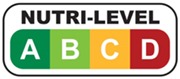
The requirements for sugar, salt, and fat content for each level are based on amounts per 100 milliliters of ready-to-eat processed food as follows:

Further requirements relating to nutrients reflected in the Nutri-Level labeling include:

  • Foods labeled as level A are not allowed to contain natural or artificial sweetening food additives, either through direct addition or carried over from other ingredients.
  • Foods labeled as level B may only contain natural sweetening food additives.
  • Foods labeled as level C or D may use natural and artificial sweetening food additives.
  • “Sugar” includes all monosaccharides and disaccharides, excluding lactose.
  • Processed plain liquid milk and plain milk powder are exempt from the requirement to declare total fat content on the Nutri-Level label.

Labeling Implementation

The implementation of Nutri-Level labeling must comply with the following requirements:

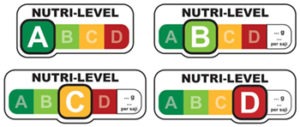
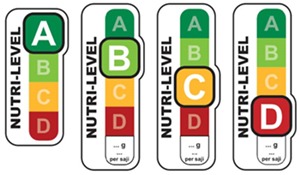
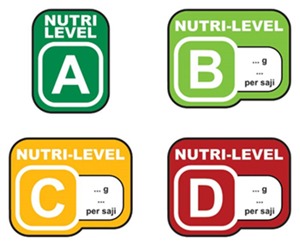
  • The Nutri-Level label must list all four letters (as shown in the examples below) unless the package meets the criteria for display of a simplified format label.
  • The Nutri-Level of the processed food must be indicated by enlarging the relevant letter, as shown in the examples below.
  • Processed foods at levels C and D must include a Nutri-Level label, while processed foods at levels A and B may do so on a voluntary basis.
  • The inclusion of a Nutri-Level label on processed foods at levels C and D must be accompanied by the sugar, salt, and fat content per serving (per saji in Indonesian, as shown in the examples below) or per package.

Nutri-Level Label Format

The draft regulation provides Nutri-Level label examples in both full and simplified formats. The simplified format applies to small packages of 30 square centimeters or less, while the full format must be used on other packages.

Full (horizontal)
Full (vertical)
Simplified
Timeline for Compliance

The draft regulation provides a grace period for existing product registrations:

  • Processed food that has obtained a product registration or for which a product registration application is pending before the regulation comes into effect must be amended within 30 months of the effective date of the regulation.
  • Ready-to-drink beverages, liquid concentrates, and powdered beverages must be amended within 18 months of the effective date of the regulation.

It is anticipated that the draft regulation will be finalized by the end of 2024.

For more details on this draft regulation, or on any aspect of food labeling requirements in Indonesia, please contact Tilleke & Gibbins at [email protected].

RELATED INSIGHTS​ 

December 15, 2023
As part of its membership in Lex Mundi, Tilleke & Gibbins has published an updated edition of its Guide to Doing Business in Thailand for 2023. This guide outlines the key factors for starting and operating a business in the Thai market. Issues covered include: Investment incentives Financial facilities Exchange controls Import and export regulations Structures for doing business Requirements for the Establishment of a Business Operation of the Business Cessation or Termination of the Business Labor legislation, relations, and supply Tax Immigration requirements This publication is part of Lex Mundi’s Country Guides series prepared by member firms in more than 100 jurisdictions worldwide. The guides serve as a useful resource for planning international business strategy and researching new markets. The full Guide to Doing Business in Thailand is available through the button below.
December 6, 2023
New regulatory requirements for medical device registration and notification in Laos are set to enter into force in the coming weeks under the plan found in Notification No. 9606 to implement Decision No. 1470/MOH on Registration and Notification of Medical Devices (Decision 1470). The notification, issued on October 25, 2023, by the Food and Drug Department (FDD) under the Ministry of Health (MOH), outlines the FDD’s strategic plan for phased-in registration and notification requirements for medical devices. In the first phase, starting January 1, 2024, the FDD will initiate the registration process for class C (moderate-high risk) and D (high risk) medical devices. Meanwhile, operators dealing with class A (low risk) and B (low-moderate risk) devices can continue applying for import permits without having to register the devices or notify the FDD. In the subsequent phase, starting January 1, 2025, operators will have to notify the FDD about class A devices and complete the registration process for class B devices. To prepare for these requirements, import-export companies in the pharmaceutical and medical products sector must submit a list of medical devices, including their classification based on the country of manufacture, to the FDD by December 15, 2023. This measure is aimed at enabling the FDD to streamline the collection, guidance, and preparation processes to ensure efficient registration within the set time frame. While import-export companies can still submit their lists after either December 15, 2023, or January 1, 2024 (the registration commencement date), registration may be delayed since the FDD will prioritize those who submit their lists by the December 15 deadline. The list of medical devices should encompass medical devices imported in the past as well as those intended for future import permission applications. During the initial registration stage (i.e., from January 1, 2024), import-export companies that are
October 25, 2023
Cambodia’s Ministry of Health (MOH) continues to increase awareness among the public and private sector of the need for strict healthcare regulations and strict enforcement to advance the quality of the country’s healthcare sector. In April 2023, the MOH issued a notification letter reminding advertisers of health products that they need to obtain a permit before advertising their products in Cambodia. On October 12, 2023, the MOH issued two press releases on continued noncompliance in the healthcare sector. The two press releases address the illegal advertising of both healthcare products and private healthcare services. The releases also address unlicensed healthcare professionals and general noncompliance by private healthcare services. These releases indicate that the MOH, in cooperation with local authorities, will substantially increase its enforcement efforts across Cambodia. Since October 12, several private healthcare clinics have had their operations closed and licenses suspended or revoked, signaling the ministry’s intent to enforce the legal framework. Noncompliant Advertising of Health Products The first press release focuses on the continued illegal advertising of health products and the advertising of unregistered health products. Health products include modern medicines, traditional medicines, health supplements, medical devices, cosmetics, and other products that prevent or treat diseases. The release highlights that the MOH has noticed ongoing unauthorized and illegal advertising, commenting that these are often found online and on social media. The noncompliant advertising referenced in the release includes advertising of health products without the required advertising permit, advertising products that are not properly registered with the MOH, and advertising by unlicensed companies and individuals. The MOH also states in the release that some advertisements are using inappropriate and noncompliant content that is not based on medical science and exaggerates the qualities of the health products—specifically mentioning skin-whitening cosmetics. The ministry’s press release also informs the public of
October 25, 2023
One significant development in the health sector in Indonesia is the use of information technology and communication in the implementation of health efforts—particularly digital health services such as telehealth and telemedicine integrated into the country’s National Health Information System. This development was addressed in a major new piece of legislation for the healthcare sector in Indonesia. Enacted in August 2023, Law No. 17 of 2023 concerning Health (the “Health Law”) provides the updates needed to support the development of healthcare services in Indonesia. Under the Health Law, health information system (HIS) providers must: Carry out processing of data and health information in the territory of Indonesia, except for certain limited and specific processing activities that may be conducted outside Indonesia when permitted by the relevant authorities and in compliance with relevant regulations. Ensure the reliability of its HIS, including availability, security, maintenance, and integration with Indonesia’s National Health Information System. Provide quality health data and information. Process data and health information, which includes planning, collection, storage, inspection, transfer, utilization, and destruction. Record its data- and information-processing history. Protect every person’s data and health information. Obtain approval from the relevant personal data subject or comply with relevant regulations if the processing of data and health information involves an individual’s health data. Inform the data owner if there is a failure to protect data and individual health information. The Health Law’s personal data protection requirements listed above appear to be aligned with the provisions in Law No. 27 of 2022 concerning Personal Data Protection (the “PDP Law”). Under this law, data and information relating to health are identified as “specific personal data,” the processing of which carries a high potential risk of impacting the relevant personal data subject. In the implementation of digital health services, patients’ personal data or medical records