
You are using an outdated browser and your browsing experience will not be optimal. Please update to the latest version of Microsoft Edge, Google Chrome or Mozilla Firefox. Install Microsoft Edge

May 12, 2022

Indonesia Introduces Shopping Center and Mall Certification Program to Fight Sale of Counterfeits

The presence of counterfeit goods in the Indonesian market is a stubbornly persistent challenge that has plagued the country for many years. The United States Trade Representative’s Special 301 Report, which is issued each year to assess intellectual property (IP) protection regimes around the world, has listed Indonesia on its “Priority Watch List” 23 times and on the “Watch List” 10 times. The 2021 report included the recommendation that Indonesia develop a specialized IP unit under the Indonesian National Police to focus on investigating domestic criminal syndicates behind counterfeiting and piracy. The police’s Special Crime Unit already handles IP matters and has been operating since long before 2021, but that year Indonesia also established its new IP Enforcement Task Force, which aims to improve intragovernmental coordination on enforcement. However, IP enforcement remains challenging in Indonesia.

The police and the Directorate General of Intellectual Property (DGIP) handled 346 total IP enforcement cases from 2020 through early 2022. While it is positive to see some enforcement activity, this is a rather low number, considering that the Indonesian market and its population are very large—and that counterfeiting is a widespread and persistent problem.

Shopping for a Solution

One way Indonesia’s Trademark Office is trying to address the country’s repeated problems with counterfeiting and piracy is by introducing a certification system for shopping centers and malls based on their support for intellectual property rights and standards. The certificates are intended to guarantee that the establishment hosts sellers of genuine products.

Both physical markets—such as Pasar Tanah Abang and Mangga Dua, two known markets for counterfeit goods—and online shopping venues are eligible to obtain a certificate. Specifically, this includes department stores, shopping streets, supermarkets, social media, online marketplaces, and crowdsourcing websites that digitally collects information, ideas, opinions, or work from a group of people. However, the certification procedure for online marketplaces has not yet been developed, as these present unique challenges to the certifying authorities.

For physical shopping centers and malls, applicants seeking certification must show evidence that at least 70% of their tenants are selling genuine products and goods—that is, those corresponding with the respective trademark registered with the DGIP.

The steps in obtaining a certificate for a shopping center or mall are outlined below.
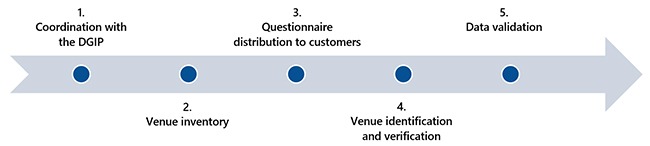
Once the landlord of a shopping center or mall contacts the DGIP to seek a certificate, the DGIP will begin an inventory of the shopping venue’s tenants. The data inventory covers tenants’ details and their business—including their relationship with the trademark owner, and the trademark registration related to the goods and services being sold. Next, the DGIP will distribute questionnaires to customers on whether the tenants are selling genuine products. However, no clear details on the form of the questionnaire or the required number of respondents has yet been provided. Depending on the results of the questionnaire, the DGIP will conduct identification and verification of sellers’ operations. This includes checking the relationship of the tenants and trademark owners and the validity of the trademark certificates. If the data validation meets with approval, the DGIP will issue a certificate to the shopping center. In case of rejection, the landlord should educate the tenants so they understand the risk of possible action against IP infringement.

These identification and verification steps are the main factor in why there is not yet a certification process for online marketplaces, as the much higher number of users makes these important steps impractical to carry out.

The certification program for shopping centers and malls also aligns with provisions in the Trademark Law and Copyright Law that specify landlord liability, with building management required to play a role in IP enforcement. The Indonesian Shopping Center Association, however, has pointed out that the situation is complex, as there are two types of shopping center ownership and this affects the involvement of the landlord. First, “strata title” mall ownership arrangements allow the tenants to own exclusive rights over their space or “lot,” as well as the right to use common space. In contrast to this, leased malls are those in which ownership of the lots remains with the landlord, who just grants temporary rights to use the space. For leased malls, the agreements between tenants and landlord include an obligation for tenants to obey the law. In regard to the sale of counterfeit goods, the landlord would be able to take action—such as an order to close the shop until the problem is resolved, or other measures requested by the complainant or authorities—against a tenant who is allegedly selling counterfeits. For strata-title malls, however, the building owner’s options are more limited, but possible measures might include periodically educating owners about IP infringement or posting notices in the premises not to buy infringing products.

On the online side, the Indonesian E-Commerce Association has noted that their members have been proactive in addressing complaints related to IP infringement. Actions they pursue include takedowns, blacklisting, and providing user data to the authorities when appropriate. For now, these efforts will continue apart from the Trademark Office’s certification program, which will remain on hold for sales venues on the internet until the DGIP can implement an efficient procedure for data verification of e-commerce users.

The certification program for malls and shopping centers has recently been launched, and the DGIP has started an informational outreach campaign for various malls in Indonesia. At this point, trademark owners should discuss with the landlord of their local stores in Indonesia to initiate coordination with the DGIP to obtain a certificate.

Conclusion

The shopping center and mall certification program may be of some assistance in helping Indonesia to make progress toward finally leaving the Priority Watch List—particularly if the DGIP focuses on the physical markets that are most notorious for selling counterfeit goods. Educating these markets (along with online marketplaces) about the certification program should be a priority in any publicity campaigns. The certification program has just launched and is not yet compulsory, but such a requirement for certification before sellers can begin physical or online operations could potentially increase the program’s effectiveness.

RELATED INSIGHTS​ 

April 20, 2026
Myanmar’s industrial design registration regime has been steadily gaining momentum since the country officially began accepting applications under the Industrial Design Law of 2019. The Industrial Design Division of Myanmar’s Intellectual Property Department (IPD) has actively advanced examination and registration procedures, and as of March 2026, approximately 300 industrial design applications have been published in the IPD’s publicly accessible database—a meaningful milestone in the development of Myanmar’s emerging intellectual property framework. This figure reflects only published applications; additional filings remain pending and will be published after the conclusion of ongoing examination. Filing Requirements in Practice Compliance with a defined set of mandatory requirements is the foundation for filing a valid design application. These mandatory particulars must be provided at the time of filing in order to establish a filing date. These include the applicant’s and creator’s identifying details, a notarized appointment of representative form, the Locarno Classification of the associated product, and a set of graphic representations of the design across multiple standard views. Applicants must also provide a written description of the design and, where applicable, information relating to any priority claim or request for deferred publication. Filing fees are payable at the time of submission. Beyond these core requirements, applicants typically need to provide supplementary documentation, either at the time of filing or in response to a formality examination. This may include evidence of the applicant’s legal entitlement to the design—particularly where the applicant and creator are different parties—as well as supporting corporate and authorization documents. Where priority rights are claimed, the relevant documents must generally be submitted within three months of the Myanmar filing date, with certified English translations required for any non-English priority applications. The supplementary requirements may vary depending on the nature of the application and the examiner’s requests during the formality examination process.
April 3, 2026
On March 16, 2026, Vietnam’s Ministry of Public Security released a draft version of a new Decree on the Prevention and Combating of Cybercrime and High-Tech Crime to replace the currently effective Decree 25/2014/ND-CP. In the draft, the ministry has proposed a comprehensive regulatory framework aimed at addressing violations occurring within the cybersecurity domain, including measures related to intellectual property. Acts of Online IP Infringement Article 9 of the draft decree notably introduces specific provisions addressing online intellectual property infringement, with detailed lists of acts considered to constitute infringement in the online environment. Copyright and related rights infringement includes: Uploading or sharing works, performances, sound recordings, video recordings, broadcasts, computer programs, software, research, documents, theses, or other intellectual creations on digital platforms without the consent of the rights holder. Unauthorized livestreaming of copyrighted television programs, sporting events, or artistic performances. Uploading, sharing, storing, transmitting, or providing links to infringing works or digital content via websites, social networks, applications, or digital platforms. Providing or using software, tools, devices, or access codes to circumvent technological protection measures or evade lawful control mechanisms implemented by rights holders. Using artificial intelligence (AI) tools to replicate the ideas or structure of another person’s work without significant new creativity or without proper attribution, thereby causing damage to the original author. Industrial property infringement includes: Manufacturing, trading, advertising, or distributing counterfeit goods bearing counterfeit trademarks, geographical indications, or industrial designs, as well as goods infringing industrial property rights through online platforms. Unauthorized registration, appropriation, or use of domain names, account names, or digital identifiers that create confusion regarding the rights holder or the origin of goods or services. Producing, using, or offering for sale products containing all or part of a patented invention via online platforms. Advertising or introducing products with technical features or characteristics identical
March 31, 2026
Vietnam’s most recent amendment of the Law on Intellectual Property (amended IP Law), passed by the National Assembly on December 10, 2025, and effective from April 1, 2026, represents one of the most significant updates to the IP Law in recent years. This amendment modernizes the IP framework, moving a step closer to international standards, while addressing the realities of Vietnam’s booming digital economy, e-commerce growth, and increasing foreign investment, which is crucial for Vietnam’s objective of complete economic transformation. For trademark practitioners, brand owners, and businesses, the changes are largely positive, as they promise faster processes, stronger enforcement tools—especially for online actions—and better commercialization options. However, they also introduce stricter requirements and a need for proactive preparation. Below are some of the most noteworthy changes in the amended IP Law related to trademarks. Significantly Shortened Timelines and Introduction of Fast-Track Examination The statutory timelines under the amended IP Law have been notably reduced: Substantive examination for trademarks is shortened from 9 months to 5 months (from the publication date). The publication period is shortened from 2 months to 1 month. A new fast-track mechanism allows substantive examination in as little as 3 months for qualifying applications (e.g., marks in actual use, facing infringement threats, or meeting government-specified criteria; details to be clarified in implementing regulations). The opposition period is shortened from 5 months to 3 months from publication. This is arguably the most welcome change. Vietnam’s IP Office has long faced criticism for lengthy backlogs, often stretching the trademark registration process to 18–24 months or more. The new timelines bring Vietnam closer to efficient systems. The fast-track option is particularly smart for high-value or urgent cases such as counterfeit threats on e-commerce platforms. However, careful preparation is mandatory for flawless applications from the start to maximize fast-track eligibility.
March 16, 2026
Indonesia’s Ministry of Law has introduced a new framework for patent applications that tightens filing requirements and introduces formal mechanisms for accelerated examination. Minister of Law Regulation No. 6 of 2026 on Patent Applications, which was issued on January 13, 2026, and took effect on February 23, 2026, serves as the implementing regulation for Law No. 65 of 2024 on Patents. It replaces the previous patent application framework (under Minister of Law and Human Rights Regulation No. 38 of 2018, as amended by Regulation No. 13 of 2021), which was considered no longer aligned with current legal, institutional, and technological developments. The regulation also reflects the institutional restructuring of the Ministry of Law and Human Rights into the Ministry of Law. Patent applications filed on or after February 23, 2026, must fully comply with the new regulation. Applications that were filed before this date will continue to be examined and processed under the previous regulation, pursuant to transitional provisions. Substantive Changes Definition of Invention The definition of “Invention” now explicitly includes systems, methods, and uses, in addition to products and processes. This expansion creates broader protection opportunities, particularly for software-enabled, digital, and method-based technologies, although it may also result in closer scrutiny during substantive examination. Excess Claims Fee Excess claims fees must now be paid at the time of filing. Failure to pay excess claims fees at filing results in the application being deemed withdrawn. There is no longer an option to defer payment to the substantive examination stage. This amendment forces applicants to face higher upfront costs. Patent claim strategy must be finalized prior to filing, reducing flexibility at later stages. Procedural and System Changes Fully Electronic Filing Patent applications must be filed electronically via the Directorate General of Intellectual Property (DGIP) online filing system. Assisted filings to