
You are using an outdated browser and your browsing experience will not be optimal. Please update to the latest version of Microsoft Edge, Google Chrome or Mozilla Firefox. Install Microsoft Edge

May 12, 2022

Indonesia Introduces Shopping Center and Mall Certification Program to Fight Sale of Counterfeits

The presence of counterfeit goods in the Indonesian market is a stubbornly persistent challenge that has plagued the country for many years. The United States Trade Representative’s Special 301 Report, which is issued each year to assess intellectual property (IP) protection regimes around the world, has listed Indonesia on its “Priority Watch List” 23 times and on the “Watch List” 10 times. The 2021 report included the recommendation that Indonesia develop a specialized IP unit under the Indonesian National Police to focus on investigating domestic criminal syndicates behind counterfeiting and piracy. The police’s Special Crime Unit already handles IP matters and has been operating since long before 2021, but that year Indonesia also established its new IP Enforcement Task Force, which aims to improve intragovernmental coordination on enforcement. However, IP enforcement remains challenging in Indonesia.

The police and the Directorate General of Intellectual Property (DGIP) handled 346 total IP enforcement cases from 2020 through early 2022. While it is positive to see some enforcement activity, this is a rather low number, considering that the Indonesian market and its population are very large—and that counterfeiting is a widespread and persistent problem.

Shopping for a Solution

One way Indonesia’s Trademark Office is trying to address the country’s repeated problems with counterfeiting and piracy is by introducing a certification system for shopping centers and malls based on their support for intellectual property rights and standards. The certificates are intended to guarantee that the establishment hosts sellers of genuine products.

Both physical markets—such as Pasar Tanah Abang and Mangga Dua, two known markets for counterfeit goods—and online shopping venues are eligible to obtain a certificate. Specifically, this includes department stores, shopping streets, supermarkets, social media, online marketplaces, and crowdsourcing websites that digitally collects information, ideas, opinions, or work from a group of people. However, the certification procedure for online marketplaces has not yet been developed, as these present unique challenges to the certifying authorities.

For physical shopping centers and malls, applicants seeking certification must show evidence that at least 70% of their tenants are selling genuine products and goods—that is, those corresponding with the respective trademark registered with the DGIP.

The steps in obtaining a certificate for a shopping center or mall are outlined below.
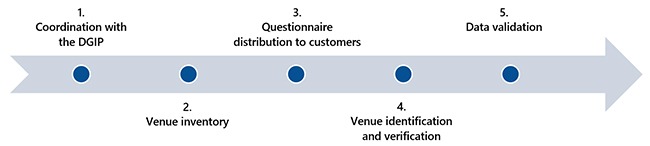
Once the landlord of a shopping center or mall contacts the DGIP to seek a certificate, the DGIP will begin an inventory of the shopping venue’s tenants. The data inventory covers tenants’ details and their business—including their relationship with the trademark owner, and the trademark registration related to the goods and services being sold. Next, the DGIP will distribute questionnaires to customers on whether the tenants are selling genuine products. However, no clear details on the form of the questionnaire or the required number of respondents has yet been provided. Depending on the results of the questionnaire, the DGIP will conduct identification and verification of sellers’ operations. This includes checking the relationship of the tenants and trademark owners and the validity of the trademark certificates. If the data validation meets with approval, the DGIP will issue a certificate to the shopping center. In case of rejection, the landlord should educate the tenants so they understand the risk of possible action against IP infringement.

These identification and verification steps are the main factor in why there is not yet a certification process for online marketplaces, as the much higher number of users makes these important steps impractical to carry out.

The certification program for shopping centers and malls also aligns with provisions in the Trademark Law and Copyright Law that specify landlord liability, with building management required to play a role in IP enforcement. The Indonesian Shopping Center Association, however, has pointed out that the situation is complex, as there are two types of shopping center ownership and this affects the involvement of the landlord. First, “strata title” mall ownership arrangements allow the tenants to own exclusive rights over their space or “lot,” as well as the right to use common space. In contrast to this, leased malls are those in which ownership of the lots remains with the landlord, who just grants temporary rights to use the space. For leased malls, the agreements between tenants and landlord include an obligation for tenants to obey the law. In regard to the sale of counterfeit goods, the landlord would be able to take action—such as an order to close the shop until the problem is resolved, or other measures requested by the complainant or authorities—against a tenant who is allegedly selling counterfeits. For strata-title malls, however, the building owner’s options are more limited, but possible measures might include periodically educating owners about IP infringement or posting notices in the premises not to buy infringing products.

On the online side, the Indonesian E-Commerce Association has noted that their members have been proactive in addressing complaints related to IP infringement. Actions they pursue include takedowns, blacklisting, and providing user data to the authorities when appropriate. For now, these efforts will continue apart from the Trademark Office’s certification program, which will remain on hold for sales venues on the internet until the DGIP can implement an efficient procedure for data verification of e-commerce users.

The certification program for malls and shopping centers has recently been launched, and the DGIP has started an informational outreach campaign for various malls in Indonesia. At this point, trademark owners should discuss with the landlord of their local stores in Indonesia to initiate coordination with the DGIP to obtain a certificate.

Conclusion

The shopping center and mall certification program may be of some assistance in helping Indonesia to make progress toward finally leaving the Priority Watch List—particularly if the DGIP focuses on the physical markets that are most notorious for selling counterfeit goods. Educating these markets (along with online marketplaces) about the certification program should be a priority in any publicity campaigns. The certification program has just launched and is not yet compulsory, but such a requirement for certification before sellers can begin physical or online operations could potentially increase the program’s effectiveness.

RELATED INSIGHTS​ 

January 30, 2026
On December 26, 2025, the government of Vietnam promulgated Decree No. 341/2025/ND-CP on administrative sanctions for violations of copyright and related rights (Decree 341), with an effective date of February 15, 2026. The new decree replaces Decree No. 131/2013/ND-CP, as amended, and represents the first comprehensive revision of the administrative enforcement framework in this area in eight years. Legislative Context and Objectives Decree 341 reflects Vietnam’s evolving copyright and related-rights framework, particularly in light of the country’s commitments under bilateral, regional, and multilateral treaties governing the digital environment. While the decree retains a number of provisions from the previous regime, it also introduces significant amendments to infringing acts, penalty thresholds, remedial measures, and enforcement procedures. The primary objectives of the new decree are to (i) enhance the deterrent effect of administrative sanctions; (ii) harmonize sanctions with the 2025 amendments to the Law on Intellectual Property and criminal law principles; and (iii) address enforcement challenges arising from online and cross-border exploitation of copyrighted works. Expanded Scope of Sanctionable Subjects Under Decree 341, administrative sanctions apply not only to Vietnamese entities committing infringing acts within Vietnam, but also to Vietnamese and foreign entities that commit acts of infringement on the internet where the protected content is accessed, consumed, or exploited by users in Vietnam. This expansion reflects the realities of cross-border digital exploitation. However, the decree does not yet provide precise definitions of key terms such as “users” or “consumers” of digital content in Vietnam, which may require further regulatory clarification. Monetary Penalties and Penalty Structure The statutory maximum fines remain unchanged, at VND 250 million for individuals and VND 500 million for organizations, but the penalty framework is substantially restructured. Fines are now calibrated based on three core criteria: (i) the amount of illegal profit obtained; (ii) the level of
January 30, 2026
Vietnam’s Intellectual Property (IP) Law, despite being amended in 2022, underwent another significant revision at the end of 2025. The latest amendment aimed to address five major policy objectives set by the Vietnamese government, including promoting innovation, digital transformation, and international integration. Among the most notable changes in the 2025 IP Law, which takes effect on 1 April 2026, is the expansion of industrial design protection under Article 4.13. The revised definition now includes partial designs and intangible designs, marking a transformative shift in Vietnam’s industrial design regime. This change has particularly significant implications on designs classified under Class 32 of the Locarno Classification—which covers graphic designs, logos, ornamentation, surface patterns, arrangements, and other intangible products. These designs, previously excluded from protection in Vietnam, are now recognized under the new legal framework. Background: Status of Class 32 Designs Before 2026 Th Intellectual Property Office of Vietnam currently applies the 13th edition of the Locarno Classification for industrial design filings. However, not all classes in this system have historically been eligible for protection. Under the 2022 IP Law, Class 32 designs were explicitly excluded based on the following legal grounds: Definition under Article 4.13 (2022 IP Law): “An industrial design is the external appearance of a product or a component for assembly into a complex product, expressed in shapes, lines, colors, or a combination thereof, and visible during the exploitation of the product’s utility or the complex product.” Product requirements under Article 21.2 of Circular 23/2023/TT-BKHCN: A product is defined as an object, a tool, a device, or means, manufactured by industrial or handicraft methods, with clear structure and function. A component for assembly into a complex product must be capable of independent circulation and detachable from the complex product. Based on these definitions, Class 32 designs, such as graphical
December 30, 2025
The Intellectual Property Office of Vietnam (IP Office), with support from the Japan International Cooperation Agency (JICA), is drafting additional annexes to its Guidelines for Patent Examination, focusing on the examination of patent applications in the pharmaceutical and biotechnology sectors. The new annexes are expected to be officially issued in early 2026 as Annexes III and IV, following the successful issuance in 2023 of Annexes I and II addressing computer program-related inventions. The IP Office recently organized a seminar to gather feedback on the draft annexes from intellectual property representatives, academic institutions, research institutes, and other interested parties, emphasizing its intention to receive further constructive opinions to refine the guidelines for pharmaceuticals and biotechnology. Why These Guidelines Matter Patent examination in Vietnam has traditionally relied on the Guidelines for Patent Examination issued under Decision No. 487/QD-SHTT (2010), recently supplemented by Annexes I and II. While these documents provide a solid foundation, they do not fully address practical challenges in examining pharmaceutical and biotech inventions, particularly issues related to clarity, sufficiency of disclosure, enablement, features of function and utility, combination therapies, and inventions involving artificial intelligence (AI) applications in these fields. Annexes III and IV aim to close these gaps by introducing structured principles and illustrative examples. Guidance on Patent Specification Requirements Annex III provides detailed guidance on the requirements for patent specifications in pharmaceuticals and biotechnology, covering two main parts: Part A addresses sufficiency of disclosure, clarity of specifications, and consistency between claims and descriptions. Part B covers inventions related to Markush-type compounds, claims containing exclusion statements (disclaimers), and additional experimental data submitted during examination. The Guidelines outline specific disclosure requirements for subject matters such as compounds, formulations, pharmaceutical compositions, genes, polypeptides, proteins, vectors, transgenic organisms, modified organisms, and hybrid cells. Annex III emphasizes that disclaimers are not accepted
December 17, 2025
Vietnam’s National Assembly approved wide-ranging amendments to the Intellectual Property (IP) Law on December 10, 2025, marking one of the most significant overhauls of the country’s IP regime in recent years. The changes, which supplement and refine existing provisions, are designed to align Vietnam’s framework more closely with international standards while addressing practical challenges faced by rights holders and practitioners. The amendments will come into force on April 1, 2026. The most notable changes are detailed below. Recognition of partial and nonphysical industrial designs: Industrial design protection has been broadened to cover partial designs and nonphysical forms (class 32), explicitly extending rights to parts of products that are not independently circulated as well as digital and intangible product appearances. The law clarifies that the external appearances of nonphysical products are protected industrial designs, and circulation of digital copies of any part of that appearance will be treated as an act of using the industrial design. The provision on the industrial applicability of industrial designs has also been amended accordingly to include the uniform reproduction of nonphysical products in cyberspace. Resolving conflicts between overlapping rights: The IP Law provides a safeguard against conflicts when a single subject matter is protected by multiple IP rights. Where overlapping rights exist, the later-arising right will be terminated if its exercise interferes with the normal exploitation of an earlier right. The decision to terminate such a later right rests with the court. Use of published data for AI training: Organizations and individuals may use lawfully published and publicly accessible documents and data for scientific research, testing, and AI system training. Such use must not unreasonably prejudice the rights or legitimate interests of authors or IP rights holders. Where the documents and data fall under copyright or related rights protection, their use must also comply