
You are using an outdated browser and your browsing experience will not be optimal. Please update to the latest version of Microsoft Edge, Google Chrome or Mozilla Firefox. Install Microsoft Edge

May 12, 2022

Indonesia Introduces Shopping Center and Mall Certification Program to Fight Sale of Counterfeits

The presence of counterfeit goods in the Indonesian market is a stubbornly persistent challenge that has plagued the country for many years. The United States Trade Representative’s Special 301 Report, which is issued each year to assess intellectual property (IP) protection regimes around the world, has listed Indonesia on its “Priority Watch List” 23 times and on the “Watch List” 10 times. The 2021 report included the recommendation that Indonesia develop a specialized IP unit under the Indonesian National Police to focus on investigating domestic criminal syndicates behind counterfeiting and piracy. The police’s Special Crime Unit already handles IP matters and has been operating since long before 2021, but that year Indonesia also established its new IP Enforcement Task Force, which aims to improve intragovernmental coordination on enforcement. However, IP enforcement remains challenging in Indonesia.

The police and the Directorate General of Intellectual Property (DGIP) handled 346 total IP enforcement cases from 2020 through early 2022. While it is positive to see some enforcement activity, this is a rather low number, considering that the Indonesian market and its population are very large—and that counterfeiting is a widespread and persistent problem.

Shopping for a Solution

One way Indonesia’s Trademark Office is trying to address the country’s repeated problems with counterfeiting and piracy is by introducing a certification system for shopping centers and malls based on their support for intellectual property rights and standards. The certificates are intended to guarantee that the establishment hosts sellers of genuine products.

Both physical markets—such as Pasar Tanah Abang and Mangga Dua, two known markets for counterfeit goods—and online shopping venues are eligible to obtain a certificate. Specifically, this includes department stores, shopping streets, supermarkets, social media, online marketplaces, and crowdsourcing websites that digitally collects information, ideas, opinions, or work from a group of people. However, the certification procedure for online marketplaces has not yet been developed, as these present unique challenges to the certifying authorities.

For physical shopping centers and malls, applicants seeking certification must show evidence that at least 70% of their tenants are selling genuine products and goods—that is, those corresponding with the respective trademark registered with the DGIP.

The steps in obtaining a certificate for a shopping center or mall are outlined below.
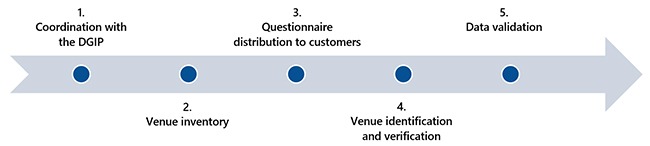
Once the landlord of a shopping center or mall contacts the DGIP to seek a certificate, the DGIP will begin an inventory of the shopping venue’s tenants. The data inventory covers tenants’ details and their business—including their relationship with the trademark owner, and the trademark registration related to the goods and services being sold. Next, the DGIP will distribute questionnaires to customers on whether the tenants are selling genuine products. However, no clear details on the form of the questionnaire or the required number of respondents has yet been provided. Depending on the results of the questionnaire, the DGIP will conduct identification and verification of sellers’ operations. This includes checking the relationship of the tenants and trademark owners and the validity of the trademark certificates. If the data validation meets with approval, the DGIP will issue a certificate to the shopping center. In case of rejection, the landlord should educate the tenants so they understand the risk of possible action against IP infringement.

These identification and verification steps are the main factor in why there is not yet a certification process for online marketplaces, as the much higher number of users makes these important steps impractical to carry out.

The certification program for shopping centers and malls also aligns with provisions in the Trademark Law and Copyright Law that specify landlord liability, with building management required to play a role in IP enforcement. The Indonesian Shopping Center Association, however, has pointed out that the situation is complex, as there are two types of shopping center ownership and this affects the involvement of the landlord. First, “strata title” mall ownership arrangements allow the tenants to own exclusive rights over their space or “lot,” as well as the right to use common space. In contrast to this, leased malls are those in which ownership of the lots remains with the landlord, who just grants temporary rights to use the space. For leased malls, the agreements between tenants and landlord include an obligation for tenants to obey the law. In regard to the sale of counterfeit goods, the landlord would be able to take action—such as an order to close the shop until the problem is resolved, or other measures requested by the complainant or authorities—against a tenant who is allegedly selling counterfeits. For strata-title malls, however, the building owner’s options are more limited, but possible measures might include periodically educating owners about IP infringement or posting notices in the premises not to buy infringing products.

On the online side, the Indonesian E-Commerce Association has noted that their members have been proactive in addressing complaints related to IP infringement. Actions they pursue include takedowns, blacklisting, and providing user data to the authorities when appropriate. For now, these efforts will continue apart from the Trademark Office’s certification program, which will remain on hold for sales venues on the internet until the DGIP can implement an efficient procedure for data verification of e-commerce users.

The certification program for malls and shopping centers has recently been launched, and the DGIP has started an informational outreach campaign for various malls in Indonesia. At this point, trademark owners should discuss with the landlord of their local stores in Indonesia to initiate coordination with the DGIP to obtain a certificate.

Conclusion

The shopping center and mall certification program may be of some assistance in helping Indonesia to make progress toward finally leaving the Priority Watch List—particularly if the DGIP focuses on the physical markets that are most notorious for selling counterfeit goods. Educating these markets (along with online marketplaces) about the certification program should be a priority in any publicity campaigns. The certification program has just launched and is not yet compulsory, but such a requirement for certification before sellers can begin physical or online operations could potentially increase the program’s effectiveness.

RELATED INSIGHTS​ 

December 5, 2025
One morning, a California-based company mapping its Southeast Asia rollout opened an unexpected cease-and-desist letter from a Vietnamese IP firm. To the company’s surprise, the letter asserted that a local client already owned the company’s brand in Vietnam and threatened legal action. This is not an isolated incident. In another recent matter in the sports industry, a squatter demanded at least USD 48,000 from our client to “resolve” a similar conflict. For brands entering Vietnam or expanding distribution there, these tactics can create acute risk at precisely the point at which market momentum is building. Vietnam’s rapid economic growth and deepening integration into global trade have made it an increasingly attractive destination for multinational brands. Those same dynamics have intensified a longstanding issue: trademark squatting. Vietnam has modernized its IP framework over the past decade, but its strict first-to-file trademark system continues to incentivize opportunistic filings by parties with no legitimate interest in a mark. As more foreign brands build their reputation abroad before turning to Vietnam, squatters remain alert to timing gaps and enforcement frictions. The First-to-File System: Advantages and Vulnerabilities Vietnam adheres closely to the first-to-file principle under its Law on Intellectual Property. In practice, exclusive trademark rights belong to whoever submits the earliest valid application to the Vietnam Intellectual Property Office, regardless of prior use in Vietnam. This approach offers administrative clarity and reduces evidentiary burdens compared to use-based jurisdictions. Yet it also creates fertile conditions for squatting. Bad-faith actors regularly monitor foreign markets, identify brands gaining traction, and move quickly to register those marks domestically, often long before the genuine owner enters the market or prioritizes local filings. By the time the true brand seeks protection, the squatter’s application (or registration) stands as a legal obstacle, pushing businesses toward costly oppositions, cancellations, or uncomfortable negotiations
November 26, 2025
On November 21, 2025, Myanmar’s Ministry of Commerce (MOC) issued Notification No. 103/2025 promulgating the Geographical Indication Rules (GI Rules), establishing a comprehensive framework for the registration and administration of geographical indications (GI), which are primarily governed by the Trademark Law of 2019. On the same day, the MOC released Notification No. 104/2025 specifying the required forms for GI-related matters. The GI Rules establish a comprehensive set of procedures for the entire GI application process, including filing applications, oppositions, cancellations, and invalidations, and appointing a local representative for GI-related matters. Under the Trademark Law and the GI Rules, domestic and foreign legal entities (organizations) that formally represent a defined group of stakeholders (such as producers or manufacturers of natural products or resources, agricultural products, handicrafts, or industrial products) and other competent authorities from government departments are eligible to apply for GI registration with the Intellectual Property Department (IPD) in Myanmar. Application A GI application can be submitted in either English or Myanmar language electronically, in person, or via post. Foreign applicants seeking to register a GI in Myanmar are required to submit a copy of the registration certificate from their country of origin with the GI application. This certificate must explicitly state the GI name of the protected product. Notably, foreign applicants are mandated to appoint a local representative in Myanmar to act on their behalf for GI-related matters with the IPD and appeal-related matters with the IP Agency. The form for appointing the local representative must be duly notarized in the applicant’s home country to ensure its legal validity and acceptance in accordance with the GI Rules. Application for Use of GI Logo Pursuant to the GI Rules, any interested individual, local or foreign, may submit an application to the IPD for authorization to use the GI logo,
November 21, 2025
Tilleke & Gibbins has contributed the Thailand chapter to Asia IP’s ASEAN Guide to IP Protection 2025, an annual reference covering key developments and practical considerations for intellectual property systems across Southeast Asia. The chapter offers an overview of Thailand’s current legal framework for the protection of trademarks, patents, industrial designs, and copyrights. It summarizes registration requirements, recent regulatory updates, and procedural considerations relevant to rights holders and practitioners. The chapter offers actionable insights for rights holders at every stage of the IP lifecycle and addresses practical strategies for managing portfolios, anticipating enforcement challenges, and maximizing the value of IP assets. The authors also highlight recent trends and developments in Thai IP law, ensuring that readers are equipped with the latest knowledge to inform their decisions. The complete Thailand chapter can be downloaded through the button below, and the chapter is also available on the Asia IP website.
November 13, 2025
Tilleke & Gibbins has contributed the Thailand chapter to Franchise 2026, part of the International Comparative Legal Guides (ICLG) series published by Global Legal Group. This annual guide offers comparative analysis of franchise laws and regulations across jurisdictions worldwide, providing practical insights for businesses and legal practitioners operating in the global franchise sector. Each country chapter in the 12th edition follows a Q&A format covering key aspects of franchise law and operations, including: Relevant legislation and rules governing franchise transactions Business organization options for franchised operations Competition law considerations Protection of intellectual property and brands Liability issues and risk mitigation Governing law and dispute resolution Real estate matters Online trading regulations Termination requirements Joint employer risks and vicarious liability Currency controls and taxation Commercial agency considerations Good faith obligations and fair dealing requirements Ongoing relationship management Franchise renewal processes Franchise migration procedures Sustainability commitments Electronic signatures and document retention Current developments in the franchise sector The Thailand chapter, authored by Alan Adcock and Kasama Sriwatanakul, provides an in-depth overview of the legal landscape for franchising and franchising-related activities in Thailand. The complete Thailand chapter is available as a PDF below. The Thailand chapter—and the full Franchise 2026 guide—are also freely available on the ICLG website.