
You are using an outdated browser and your browsing experience will not be optimal. Please update to the latest version of Microsoft Edge, Google Chrome or Mozilla Firefox. Install Microsoft Edge

August 6, 2026

Green Packaging, Gray Areas: The Challenges of Protecting Minimalist Packaging Under Thai IP Law

Introduction: A Trademark Paradox in Sustainable Packaging

Walk into any Thai supermarket, and the label-free water bottle is no longer a novelty. Thailand’s packaging market, valued at approximately USD 15.68 billion in 2025, is shifting toward minimalist, plastic-light designs as ESG pressures reshape how brands present their products. The country generated roughly 5.68 million tons of plastic waste in 2021, with a recycling rate of only 19 percent, and regulators are now considering rules that would allow label-free bottled water relying on embossing, laser printing, or QR codes instead of wrap-around labels. As packaging itself becomes the brand identifier, a paradox emerges: designs built to say the least often struggle hardest for protection under Thai intellectual property law.

The Trademark Barrier: When Shape Is Not Enough

Section 7, paragraph 2(10) of the Thai Trademark Act deems a shape distinctive only if it is not the natural form of the goods, is not necessary to achieve a technical result, and does not add value to the goods. The Department of Intellectual Property’s 2022 examination guidelines apply this test conservatively, as the following examples illustrate.
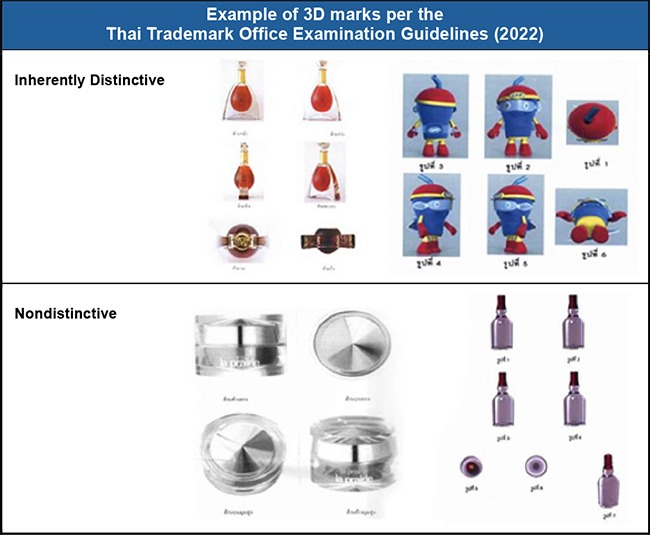
A plain water bottle relying on subtle contours to signal its brand is typically read as just another bottle, not a source identifier. Acquired distinctiveness offers a theoretical escape route, but it demands extensive evidence of sales, advertising, and consumer recognition—an especially heavy burden for new entrants whose minimalist packaging has not yet achieved market prominence. The result is a structural bias against precisely the design innovation that sustainability goals are meant to encourage.

Design Patents: A Partial, Imperfect Substitute

Design patent protection, covering a product’s shape, configuration, or ornamentation, appears to offer an alternative route. In practice, it is constrained by the same forces driving the minimalist trend. Because many brands converge on similar solutions—clear PET bottles, label-free surfaces, simple paperboard—new designs often “so nearly resemble” existing ones that they fail the novelty requirement under the Thai Patent Act. Even where novelty is established, protection lasts only ten years from filing, ill-suited to the indefinite life cycle of a brand identity that trademarks can offer. Narrow claim scope compounds the problem: because minimalist designs differ from competitors only in subtle details, rivals can make cosmetic tweaks and avoid infringement altogether.

A Layered Strategy for Now

Given these gaps, Thai practitioners should treat trademark and design patent filings as complementary layers rather than mutually exclusive options. Registration attempts can be supplemented with unfair competition claims for passing off, which remain available under Section 46 of the Trademark Act and Section 420 of the Civil and Commercial Code even where registration is refused. Contemporaneous evidence of consumer recognition—social media engagement, packaging redesign campaigns, and sales data tied to the new design—should be compiled from launch rather than assembled only once a dispute arises. Combining registered rights with common law remedies and a documented evidentiary record offers the most realistic protection available under the current framework.

Conclusion

The tension between Thailand’s IP framework and its sustainable packaging boom is unlikely to be resolved through litigation alone. The DIP’s examination guidelines predate the scale of today’s minimalist packaging trend and warrant revisiting, particularly in how consumer-perception evidence is weighed against abstract notions of “natural form” and “functionality.” Until that recalibration occurs, brands investing in green packaging should treat IP protection as a portfolio exercise: pursuing registration where possible, building an evidentiary record for acquired distinctiveness, and relying on passing-off remedies to fill the gaps. Minimalist packaging is not disappearing from Thai shelves; the law protecting it needs to catch up.


This article was prepare with the assistance of Tilleke & Gibbins intern Phuripat Kaewklom. It was originally published by the International Association for the Protection of Intellectual Property (AIPPI).

RELATED INSIGHTS​ 

November 1, 2024
Tilleke & Gibbins has contributed the Thailand chapter to Franchise 2025 from the International Comparative Legal Guides (ICLG) series published by Global Legal Group. This comprehensive guide provides detailed analysis of franchise laws and regulations across multiple jurisdictions worldwide. Each chapter of the guide follows a Q&A format, organized into key sections covering critical aspects of franchise law and operations, including: Relevant legislation and rules governing franchise transactions Business organization options for franchised operations Competition law considerations Protection of intellectual property and brands Liability issues and risk mitigation Governing law and dispute resolution Real estate matters Online trading regulations Termination requirements Joint employer risks and vicarious liability Currency controls and taxation Commercial agency considerations Good faith obligations and fair dealing requirements Ongoing relationship management Franchise renewal processes Franchise migration procedures Electronic signatures and document retention The Thailand chapter, authored by Alan Adcock and Kasama Sriwatanakul, examines these topics in detail, with particular attention to recent developments like the Trade Competition Commission’s Franchising Guidelines which introduced new disclosure requirements and protections for franchisees. The complete Thailand chapter is available as a PDF below. The Thailand chapter—and the full Franchise 2025 guide—are also freely available on the ICLG website.
October 21, 2024
Thailand’s Central Intellectual Property and International Trade (IP&IT) Court has delivered a favorable ruling for Sumitomo Rubber Industries, Ltd., a major player in the tire manufacturing industry, regarding the registration of its motorcycle tire design patent. In this case, Tilleke & Gibbins represented Sumitomo in successfully advocating for recognition of the unique design elements in the company’s motorcycle tire products. Case Overview The case revolved around Sumitomo’s two design patent applications for motorcycle tire designs, which were initially rejected by the Department of Intellectual Property (DIP) on the grounds that they were similar to prior art. Based on an examination of the design elements, primarily focusing on the tire tread patterns, the DIP’s Patent Board had concluded that Sumitomo’s designs were not sufficiently unique to warrant patent protection, as the tread patterns of the new designs were deemed too similar to one found in prior art for tire products. In response, Tilleke & Gibbins filed a complaint with the IP&IT Court on behalf of Sumitomo, seeking a revocation of the Patent Board’s decision and requesting that the court compel the DIP, as the defendant, to proceed with the registration of Sumitomo’s design patents. The complaint emphasized that the designs were novel and distinct, warranting patent protection under Thai law. Legal Strategy The firm’s legal argument focused on the interpretation of Thai patent law, particularly regarding the protection of a product’s external appearance, and emphasized that the determination of a design’s novelty must consider the product’s overall appearance rather than isolating individual features. This approach is consistent with international guidelines on design patents, which require the evaluation of novelty and distinctiveness based on how an informed user would perceive the design as a whole. While Sumitomo’s tire tread patterns may share some superficial similarities to existing designs, the overall impression
October 20, 2024
The annual statistics issued by the Intellectual Property Office of Vietnam (“IP Office”) in recent years show an increase in the number of IP transactions and applications to establish IP rights, including requests for the recordal of assignment of IP rights. Nevertheless, the numbers of trademark assignment recordals approved by the IP Office has not followed this trend, falling from 1,281 requests approved in 2022 to 1,120 requests approved in 2023. This decrease may be due to the IP Office’s overly strict viewpoint in approving trademark assignments, including its rejection of assignment recordal on the ground of conflict with the assignor’s trade name. IP Office’s practice on assignment recordal Vietnam’s IP Law restricts the assignment of trademarks in several cases, as set out in Article 139.4 that “the assignment of the rights to marks must not cause confusion as to properties or origins of goods or services bearing such marks.” Thus, when an assigned mark is identical to the dominant element of the assignor’s company name, the IP Office will view that the assignee’s use of the mark will result in confusion with the assignor’s trade name, and then instantly reject the assignment request. In this case, the IP Office will only accept the assignment if the IP holder can submit documents issued by relevant authorities proving at least one of the following conditions: The assignor has assigned all business premises and operations under its name to the assignee; The assignor has removed business lines relating to the goods/services bearing the trademarks and such removal is recorded in the Enterprise Registration Certificate; The assignor has been dissolved or does not exist after signing the agreement; The assignor has changed its name after signing the agreement so that it does not contain any element identical or similar to the assigned
October 7, 2024
Starting October 15, 2024, Cambodia will implement a new penalty for late patent annuity payments and restorations, according to an unofficial announcement from the country’s Department of Industrial Property under the Ministry of Industry, Science, Technology, and Innovation. This new penalty will apply to patents, utility model certificates, and plant variety protection registrations. To avoid additional charges and prevent the abandonment of any pending applications or the lapse of registrations, applicants and registration owners must pay each annuity within the six months before the annuity period starts, or by its due date. If the annuity is not paid by the due date, a grace period of six months is allowed for late payment, with a daily charge of KHR 500 (approximately USD 0.125) per day. If payment is not made within this grace period, the patent will be deemed withdrawn or will lapse. However, the Patent Office can initiate the restoration process within the last six months of the annuity period. This requires a USD 25 restoration fee plus an additional daily charge of USD 0.125 from the start of the grace period until payment is completed. To avoid additional charges and prevent the potential abandonment of applications or registrations, companies and their appointees need to keep track of all annuity due dates for patents, utility model certificates, and plant variety protection registrations and pay all annuities well in advance of the due date. For more details on this penalty, or on any aspect of intellectual property protection in Cambodia, please contact Tilleke & Gibbins at [email protected].