
You are using an outdated browser and your browsing experience will not be optimal. Please update to the latest version of Microsoft Edge, Google Chrome or Mozilla Firefox. Install Microsoft Edge

August 6, 2026

Green Packaging, Gray Areas: The Challenges of Protecting Minimalist Packaging Under Thai IP Law

Introduction: A Trademark Paradox in Sustainable Packaging

Walk into any Thai supermarket, and the label-free water bottle is no longer a novelty. Thailand’s packaging market, valued at approximately USD 15.68 billion in 2025, is shifting toward minimalist, plastic-light designs as ESG pressures reshape how brands present their products. The country generated roughly 5.68 million tons of plastic waste in 2021, with a recycling rate of only 19 percent, and regulators are now considering rules that would allow label-free bottled water relying on embossing, laser printing, or QR codes instead of wrap-around labels. As packaging itself becomes the brand identifier, a paradox emerges: designs built to say the least often struggle hardest for protection under Thai intellectual property law.

The Trademark Barrier: When Shape Is Not Enough

Section 7, paragraph 2(10) of the Thai Trademark Act deems a shape distinctive only if it is not the natural form of the goods, is not necessary to achieve a technical result, and does not add value to the goods. The Department of Intellectual Property’s 2022 examination guidelines apply this test conservatively, as the following examples illustrate.
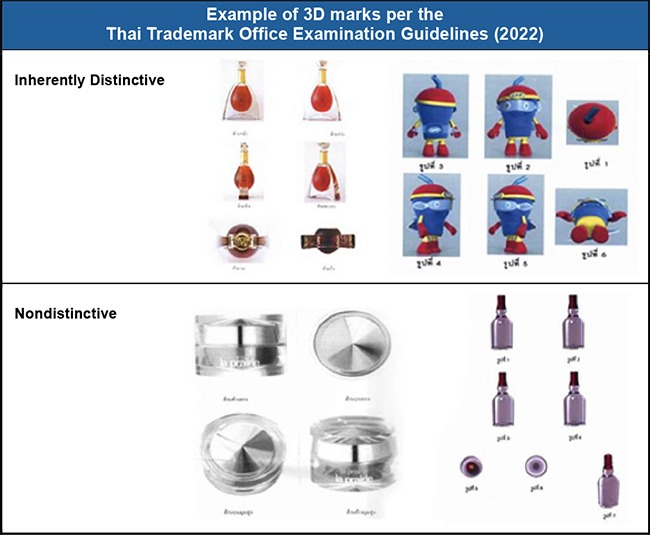
A plain water bottle relying on subtle contours to signal its brand is typically read as just another bottle, not a source identifier. Acquired distinctiveness offers a theoretical escape route, but it demands extensive evidence of sales, advertising, and consumer recognition—an especially heavy burden for new entrants whose minimalist packaging has not yet achieved market prominence. The result is a structural bias against precisely the design innovation that sustainability goals are meant to encourage.

Design Patents: A Partial, Imperfect Substitute

Design patent protection, covering a product’s shape, configuration, or ornamentation, appears to offer an alternative route. In practice, it is constrained by the same forces driving the minimalist trend. Because many brands converge on similar solutions—clear PET bottles, label-free surfaces, simple paperboard—new designs often “so nearly resemble” existing ones that they fail the novelty requirement under the Thai Patent Act. Even where novelty is established, protection lasts only ten years from filing, ill-suited to the indefinite life cycle of a brand identity that trademarks can offer. Narrow claim scope compounds the problem: because minimalist designs differ from competitors only in subtle details, rivals can make cosmetic tweaks and avoid infringement altogether.

A Layered Strategy for Now

Given these gaps, Thai practitioners should treat trademark and design patent filings as complementary layers rather than mutually exclusive options. Registration attempts can be supplemented with unfair competition claims for passing off, which remain available under Section 46 of the Trademark Act and Section 420 of the Civil and Commercial Code even where registration is refused. Contemporaneous evidence of consumer recognition—social media engagement, packaging redesign campaigns, and sales data tied to the new design—should be compiled from launch rather than assembled only once a dispute arises. Combining registered rights with common law remedies and a documented evidentiary record offers the most realistic protection available under the current framework.

Conclusion

The tension between Thailand’s IP framework and its sustainable packaging boom is unlikely to be resolved through litigation alone. The DIP’s examination guidelines predate the scale of today’s minimalist packaging trend and warrant revisiting, particularly in how consumer-perception evidence is weighed against abstract notions of “natural form” and “functionality.” Until that recalibration occurs, brands investing in green packaging should treat IP protection as a portfolio exercise: pursuing registration where possible, building an evidentiary record for acquired distinctiveness, and relying on passing-off remedies to fill the gaps. Minimalist packaging is not disappearing from Thai shelves; the law protecting it needs to catch up.


This article was prepare with the assistance of Tilleke & Gibbins intern Phuripat Kaewklom. It was originally published by the International Association for the Protection of Intellectual Property (AIPPI).

RELATED INSIGHTS​ 

August 21, 2025
Although the “passing off” principle has sometimes faced criticism for potentially broadening trademark protection—particularly in cases involving unregistered or unconventional marks like shapes, scents, or sounds—it serves an essential purpose. It safeguards the rights of business owners and shields consumers from deception, ensuring fair competition and reflecting the realities of modern commerce. What is passing off, and why is registrability not required? The passing-off principle is a legal concept rooted in English law, aimed at preventing a person from falsely representing or using a mark similar to another’s in a way that causes consumers to mistakenly believe the goods or services come from the same source. Under Thai law, the passing-off principle is provided under Section 46 of the Thai Trademark Act, which states: No person shall be entitled to bring legal proceedings to prevent or to recover damages for the infringement of an unregistered trademark. The provisions of this Section shall not affect the right of the owner of an unregistered trademark to bring legal proceedings against any person for passing off goods as those of the owner of the trademark. The passing-off principle can be interpreted as a practical legal concept. It does not require proof that the mark is registrable or meets the registrability criteria under trademark law. It is sufficient to show that the mark has established goodwill and that the other party’s use of a similar mark is likely to confuse consumers, making it a straightforward and effective tool for protecting brand assets. Requiring a claimant to prove that an unregistered mark could have been registered would undermine the very function of passing off. The doctrine was conceived precisely to fill the gaps left by the registration system. Imposing registrability criteria would nullify its function and leave many commercially valuable identifiers unprotected. If the
August 15, 2025
Indonesia’s Directorate General of Intellectual Property (DGIP) has introduced a temporary feature in its online filing system to accommodate the submission of annual patent working statements. The requirement to submit these annual working statements was introduced under the amended Patent Law enacted on October 28, 2024, but the implementing regulation has still not been issued. Annual Working Statements Article 20A of the amended Patent Law requires all patentees to submit an annual statement regarding the implementation of their patents in Indonesia. This obligation applies to all active patents, regardless of when they were granted. The annual working statement declares the status of implementation of the patented invention within Indonesia. Acceptable forms of implementation include: Manufacturing the patented product (whether commercialized or not) Utilizing the patented process (whether commercialized or not) Importation Licensing If the patent has not yet been implemented in Indonesia, the DGIP provides an option to indicate: “The mentioned registered patent has not been implemented in Indonesia.” The statement must be made using the official template provided by the DGIP through the online filing system. Submission The working statement must be submitted annually no later than December 31 of each calendar year. No supporting documents are needed for the submission apart from the signed form itself. A color scanned copy will suffice; the original document is not required. There is currently no official fee for submitting the working statement. While the submission process may eventually align with annuity fee payments, the current process remains separate due to the pending implementing regulation. The submission process may be subject to change upon issuance of the implementing regulation, which is under discussion and expected in the coming months. In the interim, the DGIP accepts submissions of overdue working statements, allowing patentees to fulfill their obligations retroactively. This flexibility is expected
July 31, 2025
The Madrid System for international trademark registration provides the opportunity for a simplified and cost-effective way to register trademarks in multiple countries through a single application. Indonesia joined the Madrid System in 2018, and in 2024 alone, it received over 8,600 applications through this system. Despite the system’s effectiveness, it is important for trademark owners to be aware of the potential risks of refusal that can arise during the process of registration. Trademark applicants must pay close attention to these critical points when designating Indonesia. Appointing a Local Representative to Respond An applicant or representative of an international registration (IR) application that has been provisionally refused must appoint a local Indonesian representative in order to submit a response to the provisional refusal. This appointment is solely for the purpose of responding to the refusal in Indonesia; it is not necessary if the IR has not received any rejection. Furthermore, the local representative should not be registered with WIPO, as doing so would affect representation across all designated countries. Timing When it comes to calculating the deadline for responding to a provisional refusal, there is a discrepancy between the methods used by the DGIP and WIPO. Under the Indonesian Trademark Law, trademark owners can file a response within 30 working days, excluding weekends and national holidays. However, the WIPO cover letter accompanying the DGIP’s provisional refusal notice specifies both the start date and the deadline for responding to the notification, which is calculated as 30 calendar days, including weekends and national holidays. Therefore, a response to the provisional refusal of IR should be submitted in accordance with the WIPO cover letter to prevent any formality issue. Grounds for Refusal After an IR application is published in Indonesia’s Trademark Gazette, it undergoes substantive examination by the Directorate General of Intellectual Property (DGIP) examiners. The
July 30, 2025
Artificial intelligence (AI) model training and data scraping are essential processes in the development of modern AI systems. AI model training involves using large datasets to teach machine learning algorithms to recognize patterns, make predictions, or generate new content. Data scraping refers to the automated extraction of information from websites or digital sources, often to assemble the vast datasets required for effective AI training. As these practices become more widespread, questions about the legality of using third-party content—especially copyrighted works—have become increasingly important. In Thailand, the legal landscape for AI developers is shaped primarily by the Copyright Act, which presents unique challenges due to the absence of a fair-use exception. This article examines the copyright-related risks and legal uncertainties facing AI developers under Thailand’s current copyright law and practices, offering strategic guidance for navigating this complex environment. Copyright Risks in AI Scraping and Training Thailand’s Copyright Act does not provide a broad fair use or fair dealing exception, unlike some other jurisdictions, such as the United States. This absence has significant consequences for AI developers: No general defense for AI training: Any use of copyrighted material for AI model training is presumed to be infringing unless a specific, narrow statutory exception applies or explicit permission is obtained from the rights holder. There is no general legal basis for using copyrighted works in AI training without authorization. Increased rights clearance burden: Developers must identify and secure licenses for every copyrighted work included in their training datasets. Given the scale and diversity of data required for effective AI models, this process can be both impractical and costly. Legal ambiguity and litigation risk: The lack of clear statutory guidance or case law leaves developers in a legal gray area. There is no established precedent clarifying whether certain uses of copyrighted material for