
You are using an outdated browser and your browsing experience will not be optimal. Please update to the latest version of Microsoft Edge, Google Chrome or Mozilla Firefox. Install Microsoft Edge

August 6, 2026

Green Packaging, Gray Areas: The Challenges of Protecting Minimalist Packaging Under Thai IP Law

Introduction: A Trademark Paradox in Sustainable Packaging

Walk into any Thai supermarket, and the label-free water bottle is no longer a novelty. Thailand’s packaging market, valued at approximately USD 15.68 billion in 2025, is shifting toward minimalist, plastic-light designs as ESG pressures reshape how brands present their products. The country generated roughly 5.68 million tons of plastic waste in 2021, with a recycling rate of only 19 percent, and regulators are now considering rules that would allow label-free bottled water relying on embossing, laser printing, or QR codes instead of wrap-around labels. As packaging itself becomes the brand identifier, a paradox emerges: designs built to say the least often struggle hardest for protection under Thai intellectual property law.

The Trademark Barrier: When Shape Is Not Enough

Section 7, paragraph 2(10) of the Thai Trademark Act deems a shape distinctive only if it is not the natural form of the goods, is not necessary to achieve a technical result, and does not add value to the goods. The Department of Intellectual Property’s 2022 examination guidelines apply this test conservatively, as the following examples illustrate.
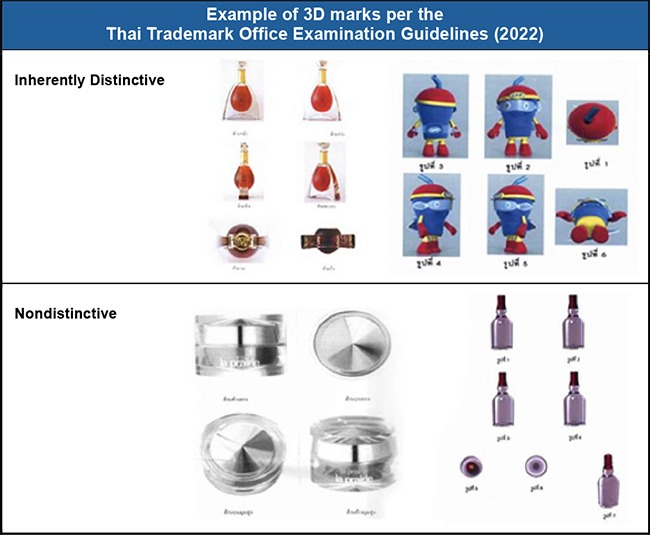
A plain water bottle relying on subtle contours to signal its brand is typically read as just another bottle, not a source identifier. Acquired distinctiveness offers a theoretical escape route, but it demands extensive evidence of sales, advertising, and consumer recognition—an especially heavy burden for new entrants whose minimalist packaging has not yet achieved market prominence. The result is a structural bias against precisely the design innovation that sustainability goals are meant to encourage.

Design Patents: A Partial, Imperfect Substitute

Design patent protection, covering a product’s shape, configuration, or ornamentation, appears to offer an alternative route. In practice, it is constrained by the same forces driving the minimalist trend. Because many brands converge on similar solutions—clear PET bottles, label-free surfaces, simple paperboard—new designs often “so nearly resemble” existing ones that they fail the novelty requirement under the Thai Patent Act. Even where novelty is established, protection lasts only ten years from filing, ill-suited to the indefinite life cycle of a brand identity that trademarks can offer. Narrow claim scope compounds the problem: because minimalist designs differ from competitors only in subtle details, rivals can make cosmetic tweaks and avoid infringement altogether.

A Layered Strategy for Now

Given these gaps, Thai practitioners should treat trademark and design patent filings as complementary layers rather than mutually exclusive options. Registration attempts can be supplemented with unfair competition claims for passing off, which remain available under Section 46 of the Trademark Act and Section 420 of the Civil and Commercial Code even where registration is refused. Contemporaneous evidence of consumer recognition—social media engagement, packaging redesign campaigns, and sales data tied to the new design—should be compiled from launch rather than assembled only once a dispute arises. Combining registered rights with common law remedies and a documented evidentiary record offers the most realistic protection available under the current framework.

Conclusion

The tension between Thailand’s IP framework and its sustainable packaging boom is unlikely to be resolved through litigation alone. The DIP’s examination guidelines predate the scale of today’s minimalist packaging trend and warrant revisiting, particularly in how consumer-perception evidence is weighed against abstract notions of “natural form” and “functionality.” Until that recalibration occurs, brands investing in green packaging should treat IP protection as a portfolio exercise: pursuing registration where possible, building an evidentiary record for acquired distinctiveness, and relying on passing-off remedies to fill the gaps. Minimalist packaging is not disappearing from Thai shelves; the law protecting it needs to catch up.


This article was prepare with the assistance of Tilleke & Gibbins intern Phuripat Kaewklom. It was originally published by the International Association for the Protection of Intellectual Property (AIPPI).

RELATED INSIGHTS​ 

December 17, 2025
Vietnam’s National Assembly approved wide-ranging amendments to the Intellectual Property (IP) Law on December 10, 2025, marking one of the most significant overhauls of the country’s IP regime in recent years. The changes, which supplement and refine existing provisions, are designed to align Vietnam’s framework more closely with international standards while addressing practical challenges faced by rights holders and practitioners. The amendments will come into force on April 1, 2026. The most notable changes are detailed below. Recognition of partial and nonphysical industrial designs: Industrial design protection has been broadened to cover partial designs and nonphysical forms (class 32), explicitly extending rights to parts of products that are not independently circulated as well as digital and intangible product appearances. The law clarifies that the external appearances of nonphysical products are protected industrial designs, and circulation of digital copies of any part of that appearance will be treated as an act of using the industrial design. The provision on the industrial applicability of industrial designs has also been amended accordingly to include the uniform reproduction of nonphysical products in cyberspace. Resolving conflicts between overlapping rights: The IP Law provides a safeguard against conflicts when a single subject matter is protected by multiple IP rights. Where overlapping rights exist, the later-arising right will be terminated if its exercise interferes with the normal exploitation of an earlier right. The decision to terminate such a later right rests with the court. Use of published data for AI training: Organizations and individuals may use lawfully published and publicly accessible documents and data for scientific research, testing, and AI system training. Such use must not unreasonably prejudice the rights or legitimate interests of authors or IP rights holders. Where the documents and data fall under copyright or related rights protection, their use must also comply
December 5, 2025
One morning, a California-based company mapping its Southeast Asia rollout opened an unexpected cease-and-desist letter from a Vietnamese IP firm. To the company’s surprise, the letter asserted that a local client already owned the company’s brand in Vietnam and threatened legal action. This is not an isolated incident. In another recent matter in the sports industry, a squatter demanded at least USD 48,000 from our client to “resolve” a similar conflict. For brands entering Vietnam or expanding distribution there, these tactics can create acute risk at precisely the point at which market momentum is building. Vietnam’s rapid economic growth and deepening integration into global trade have made it an increasingly attractive destination for multinational brands. Those same dynamics have intensified a longstanding issue: trademark squatting. Vietnam has modernized its IP framework over the past decade, but its strict first-to-file trademark system continues to incentivize opportunistic filings by parties with no legitimate interest in a mark. As more foreign brands build their reputation abroad before turning to Vietnam, squatters remain alert to timing gaps and enforcement frictions. The First-to-File System: Advantages and Vulnerabilities Vietnam adheres closely to the first-to-file principle under its Law on Intellectual Property. In practice, exclusive trademark rights belong to whoever submits the earliest valid application to the Vietnam Intellectual Property Office, regardless of prior use in Vietnam. This approach offers administrative clarity and reduces evidentiary burdens compared to use-based jurisdictions. Yet it also creates fertile conditions for squatting. Bad-faith actors regularly monitor foreign markets, identify brands gaining traction, and move quickly to register those marks domestically, often long before the genuine owner enters the market or prioritizes local filings. By the time the true brand seeks protection, the squatter’s application (or registration) stands as a legal obstacle, pushing businesses toward costly oppositions, cancellations, or uncomfortable negotiations
November 26, 2025
On November 21, 2025, Myanmar’s Ministry of Commerce (MOC) issued Notification No. 103/2025 promulgating the Geographical Indication Rules (GI Rules), establishing a comprehensive framework for the registration and administration of geographical indications (GI), which are primarily governed by the Trademark Law of 2019. On the same day, the MOC released Notification No. 104/2025 specifying the required forms for GI-related matters. The GI Rules establish a comprehensive set of procedures for the entire GI application process, including filing applications, oppositions, cancellations, and invalidations, and appointing a local representative for GI-related matters. Under the Trademark Law and the GI Rules, domestic and foreign legal entities (organizations) that formally represent a defined group of stakeholders (such as producers or manufacturers of natural products or resources, agricultural products, handicrafts, or industrial products) and other competent authorities from government departments are eligible to apply for GI registration with the Intellectual Property Department (IPD) in Myanmar. Application A GI application can be submitted in either English or Myanmar language electronically, in person, or via post. Foreign applicants seeking to register a GI in Myanmar are required to submit a copy of the registration certificate from their country of origin with the GI application. This certificate must explicitly state the GI name of the protected product. Notably, foreign applicants are mandated to appoint a local representative in Myanmar to act on their behalf for GI-related matters with the IPD and appeal-related matters with the IP Agency. The form for appointing the local representative must be duly notarized in the applicant’s home country to ensure its legal validity and acceptance in accordance with the GI Rules. Application for Use of GI Logo Pursuant to the GI Rules, any interested individual, local or foreign, may submit an application to the IPD for authorization to use the GI logo,
November 21, 2025
Tilleke & Gibbins has contributed the Thailand chapter to Asia IP’s ASEAN Guide to IP Protection 2025, an annual reference covering key developments and practical considerations for intellectual property systems across Southeast Asia. The chapter offers an overview of Thailand’s current legal framework for the protection of trademarks, patents, industrial designs, and copyrights. It summarizes registration requirements, recent regulatory updates, and procedural considerations relevant to rights holders and practitioners. The chapter offers actionable insights for rights holders at every stage of the IP lifecycle and addresses practical strategies for managing portfolios, anticipating enforcement challenges, and maximizing the value of IP assets. The authors also highlight recent trends and developments in Thai IP law, ensuring that readers are equipped with the latest knowledge to inform their decisions. The complete Thailand chapter can be downloaded through the button below, and the chapter is also available on the Asia IP website.