You are using an outdated browser and your browsing experience will not be optimal. Please update to the latest version of Microsoft Edge, Google Chrome or Mozilla Firefox. Install Microsoft Edge

December 22, 2020

Further Extension for E-Tax Filing and Payment in Thailand

On December 15, 2020, Thailand’s Revenue Department (RD) announced a further extension for e-tax filing and payment until January 31, 2024.

The RD’s announcement is meant to support the government’s Thailand 4.0 policy by encouraging use of the online system for filing and paying taxes. The RD has been promoting the use of e-tax filing and payment since 2012 by granting eight-day extensions to anyone who submits online, rather than using traditional paper filing. Initially, this eight-day extension program was due to expire on January 31, 2021, but the RD has now further extended it for another three years, until January 31, 2024.

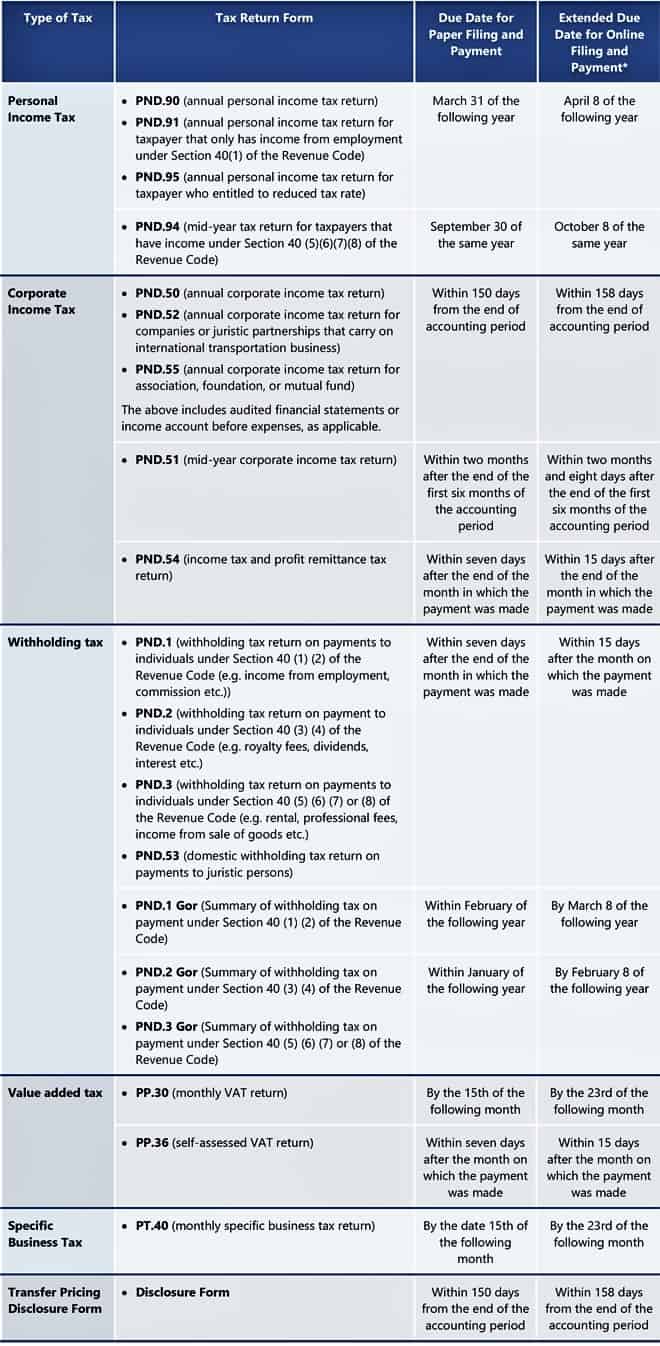
Tax Filing and Payment Schedule for Eligible Tax Returns

* Notification of the Ministry of Finance Re: Extension of Period for Tax Return Filing and Tax Payment via Internet System (No.3) dated December 15, 2020.

It should be noted that tax returns and supplemental tax returns must be submitted via the e-filing system to qualify for the eight-day extension. If a taxpayer has submitted their tax return in paper form, they will not be entitled to the extension even if they resubmit via e-filing system. The reverse is also true—a tax payer who submits via the e-filing system, and resubmits in paper form, will not be eligible for the eight-day extension.

For personal income tax payments set up as three instalments, the first instalment can be paid together with the e-filing and that tax payment is also entitled to eight-day extension.  The second instalment can be paid within one month after the extended due date of the first instalment, and the third instalment can be paid within one month after the due date for the second instalment.

For more information about these tax filing extensions, or any aspect of tax law in Thailand, please contact Varapa Aurat at [email protected].

RELATED INSIGHTS​ 

April 30, 2011
This open letter from David Lyman to the clients of Tilleke & Gibbins addresses the events that unfolded in April 2009, when political demonstrations—sometimes violent—took place in Bangkok and Pattaya. Although the protests by the so-called Red Shirts attracted a great deal of media attention, life continued without serious disruption in Thailand’s capital.
April 30, 2011
The current global economic crisis has had a considerable effect on Thailand’s real estate market, and house purchasing demand has decreased accordingly. The stagnant housing market will have an impact on many businesses, the main ones being real estate developers, financial institutions, construction companies, and construction material suppliers. To address this issue, on January 20, 2009, the Cabinet passed a resolution which provides tax measures intended to stimulate the Thai economy.
April 30, 2011
This 34-page guide provides a comprehensive summary of Thailand’s tax laws. The authors provide a full overview of income taxes as they apply to business entities and individuals in Thailand. The guide also provides a review of Value Added Tax, Specific Business Tax, Customs duties, stamp duties, property tax, and other issues.
April 30, 2011
Within the past two years, Thailand has experienced a number of events that have called into question the country’s political stability. In this article, David Lyman puts these events into historical perspective by looking back on the path that has led to the current situation. This article provides a thorough overview of Thailand’s recent history and explains many of the driving factors underlying the political instability of 2008. The article concludes that there is reason for optimism about Thailand’s future, with progressive development likely to return to the country.