You are using an outdated browser and your browsing experience will not be optimal. Please update to the latest version of Microsoft Edge, Google Chrome or Mozilla Firefox. Install Microsoft Edge

December 22, 2020

Further Extension for E-Tax Filing and Payment in Thailand

On December 15, 2020, Thailand’s Revenue Department (RD) announced a further extension for e-tax filing and payment until January 31, 2024.

The RD’s announcement is meant to support the government’s Thailand 4.0 policy by encouraging use of the online system for filing and paying taxes. The RD has been promoting the use of e-tax filing and payment since 2012 by granting eight-day extensions to anyone who submits online, rather than using traditional paper filing. Initially, this eight-day extension program was due to expire on January 31, 2021, but the RD has now further extended it for another three years, until January 31, 2024.

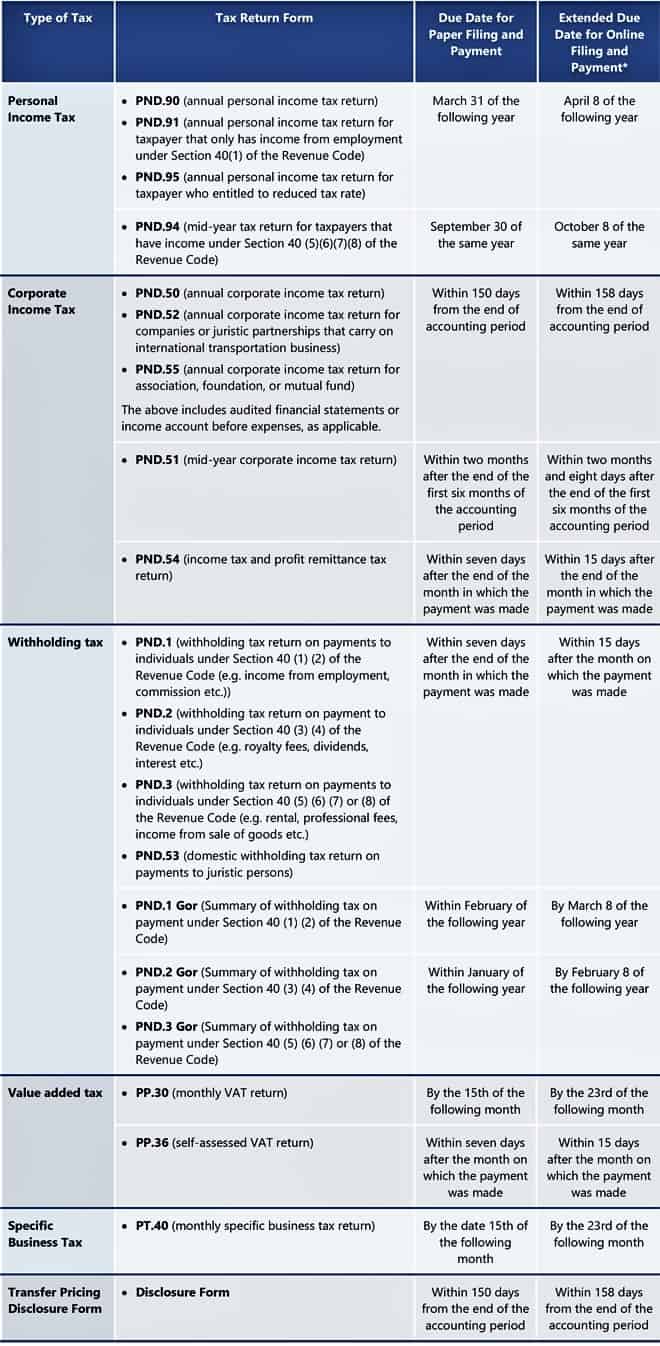
Tax Filing and Payment Schedule for Eligible Tax Returns

* Notification of the Ministry of Finance Re: Extension of Period for Tax Return Filing and Tax Payment via Internet System (No.3) dated December 15, 2020.

It should be noted that tax returns and supplemental tax returns must be submitted via the e-filing system to qualify for the eight-day extension. If a taxpayer has submitted their tax return in paper form, they will not be entitled to the extension even if they resubmit via e-filing system. The reverse is also true—a tax payer who submits via the e-filing system, and resubmits in paper form, will not be eligible for the eight-day extension.

For personal income tax payments set up as three instalments, the first instalment can be paid together with the e-filing and that tax payment is also entitled to eight-day extension.  The second instalment can be paid within one month after the extended due date of the first instalment, and the third instalment can be paid within one month after the due date for the second instalment.

For more information about these tax filing extensions, or any aspect of tax law in Thailand, please contact Varapa Aurat at [email protected].

RELATED INSIGHTS​ 

December 25, 2013
The key to developing a successful business lies not only with having good entrepreneurial spirit and skills, but also with having sound knowledge of the laws and regulations that affect you and your company. To help business owners understand and navigate the ever-shifting legal landscape, Practical Law Company, in association with Lex Mundi, has published the latest edition in its series of multi-jurisdictional question-and-answer guides to doing business worldwide.
March 20, 2013
Published by Tilleke & Gibbins in association with Lex Mundi, the Guide to Doing Business in Thailand  provides a comprehensive overview of the legal environment for investors entering the Thai market. Topics covered in the guide include the political and economic situation, import and export regulations, exchange controls, tax, requirements for establishment of a business, structures for doing business, cessation or termination of a business, labor legislation, and immigration requirements. The guide provides an invaluable primer for investors new to Thailand.
March 6, 2013
The streets of Hanoi and Ho Chi Minh City are being filled with popular brand names of international franchises like KFC, Lotteria, and Circle K. Yet a foreign tourist wishing to find the nearest McDonald’s for a quick bite or a corner 7-Eleven for forgotten travel necessities would be rather surprised to find that these brands, so common in Asia and around the world, are still absent from the Vietnamese market (at the time of this writing).
February 14, 2013
In association with Lex Mundi, Practical Law Company has now published the latest edition in its series of guides on how to do business in jurisdictions worldwide. The Thailand chapter, written by attorneys at Tilleke & Gibbins, provides an overview of the legal system and key laws for foreign companies doing business in the Kingdom. Presented in a question-and-answer format, the chapter examines the rules governing foreign investment, business vehicles, employment, tax, competition, intellectual property, marketing agreements, e-commerce, data protection, and product liability.