You are using an outdated browser and your browsing experience will not be optimal. Please update to the latest version of Microsoft Edge, Google Chrome or Mozilla Firefox. Install Microsoft Edge

December 22, 2020

Further Extension for E-Tax Filing and Payment in Thailand

On December 15, 2020, Thailand’s Revenue Department (RD) announced a further extension for e-tax filing and payment until January 31, 2024.

The RD’s announcement is meant to support the government’s Thailand 4.0 policy by encouraging use of the online system for filing and paying taxes. The RD has been promoting the use of e-tax filing and payment since 2012 by granting eight-day extensions to anyone who submits online, rather than using traditional paper filing. Initially, this eight-day extension program was due to expire on January 31, 2021, but the RD has now further extended it for another three years, until January 31, 2024.

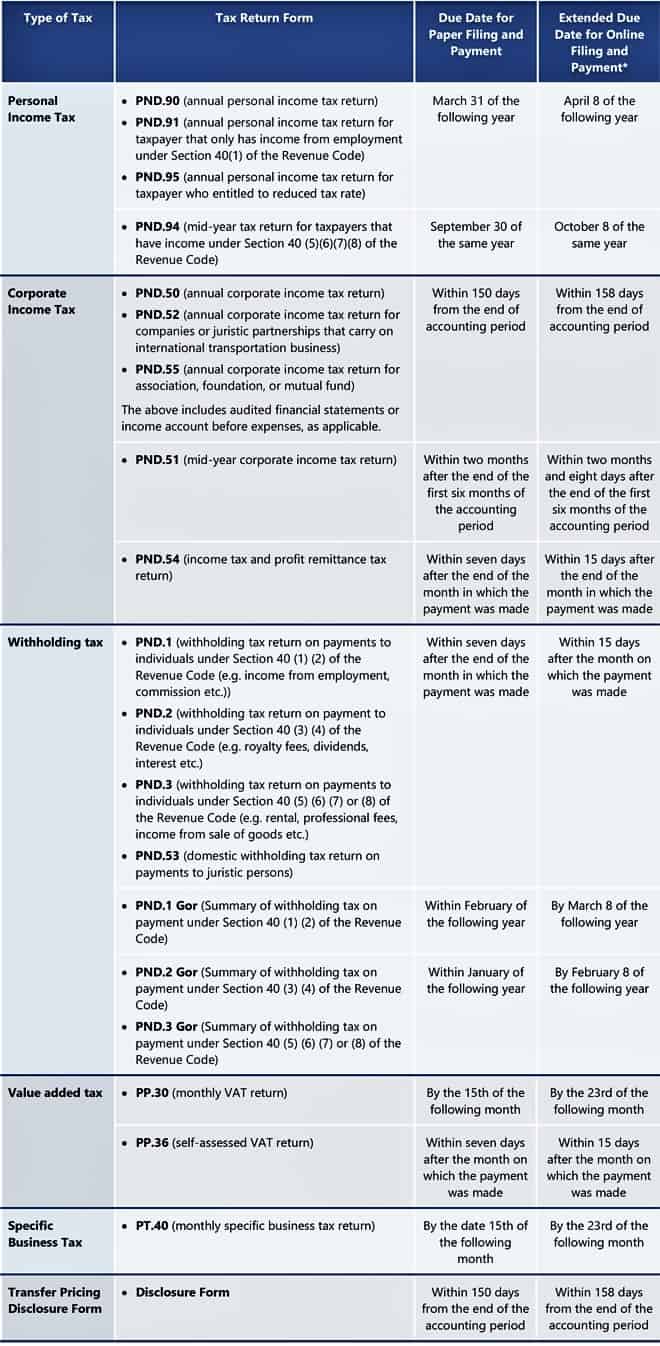
Tax Filing and Payment Schedule for Eligible Tax Returns

* Notification of the Ministry of Finance Re: Extension of Period for Tax Return Filing and Tax Payment via Internet System (No.3) dated December 15, 2020.

It should be noted that tax returns and supplemental tax returns must be submitted via the e-filing system to qualify for the eight-day extension. If a taxpayer has submitted their tax return in paper form, they will not be entitled to the extension even if they resubmit via e-filing system. The reverse is also true—a tax payer who submits via the e-filing system, and resubmits in paper form, will not be eligible for the eight-day extension.

For personal income tax payments set up as three instalments, the first instalment can be paid together with the e-filing and that tax payment is also entitled to eight-day extension.  The second instalment can be paid within one month after the extended due date of the first instalment, and the third instalment can be paid within one month after the due date for the second instalment.

For more information about these tax filing extensions, or any aspect of tax law in Thailand, please contact Varapa Aurat at [email protected].

RELATED INSIGHTS​ 

September 5, 2011
Trademarks, tax, and termination are the terms in a franchise agreement most likely to cause trouble for a franchisor in Asia. In Thailand, many of the world’s most successful franchise models have established themselves to cater to the sophisticated Thai consumer. Well-known examples include Zara and Gap (for clothing and accessories); KFC, Pizza Hut, and Krispy Kreme (food); Ikea (home accessories); and 7-Eleven and Family Mart (convenience stores).
August 11, 2011
This Japanese-language Guide to Doing Business in Thailand was prepared by Tilleke & Gibbins in collaboration with Nishimura & Asahi, the Lex Mundi member firm for Japan. Written for potential Japanese investors in Thailand, the guide provides an overview of the Thai legal system, structures for doing business, and foreign investment regulations. It introduces other aspects of Thai law relevant to investment activities, including the following:
August 4, 2011
Recognizing the importance of foreign investment for its economic growth, Thailand has through the years relaxed restrictive investment laws and regulations, thus favorably positioning itself as a prime market for cross-border M&A activity. Continuing the trend toward investment liberalization, the Bank of Thailand and the Ministry of Finance will implement the second phase of the Financial Sector Master Plan over the course of 2010-2014, which will grant waivers on income tax, specific business tax, and stamp duty for earnings on merger and acquisition activities.
August 3, 2011
One question that is frequently asked by individual shareholders concerns the utilization of tax credit on dividends granted under Section 47 bis of the Thai Revenue Code. This article will discuss the conditions for using tax credit and explain how the tax credit can benefit a shareholder.