
You are using an outdated browser and your browsing experience will not be optimal. Please update to the latest version of Microsoft Edge, Google Chrome or Mozilla Firefox. Install Microsoft Edge

April 20, 2020

Current Requirements for Persons Traveling to Cambodia During the COVID-19 Pandemic

In order to prevent imported cases of COVID-19, on March 27, 2020, Cambodia’s Ministry of Foreign Affairs and International Cooperation imposed new requirements on foreigners entering Cambodia. These requirements are applicable to all foreigners, unless there is ban in effect for foreigners from specific countries. These legal requirements are effective from 23:59 of March 30, 2020.

Therefore, any foreigner considering a trip to Cambodia during this time should note the below requirements, plan appropriately and consider how they may impact their trip.
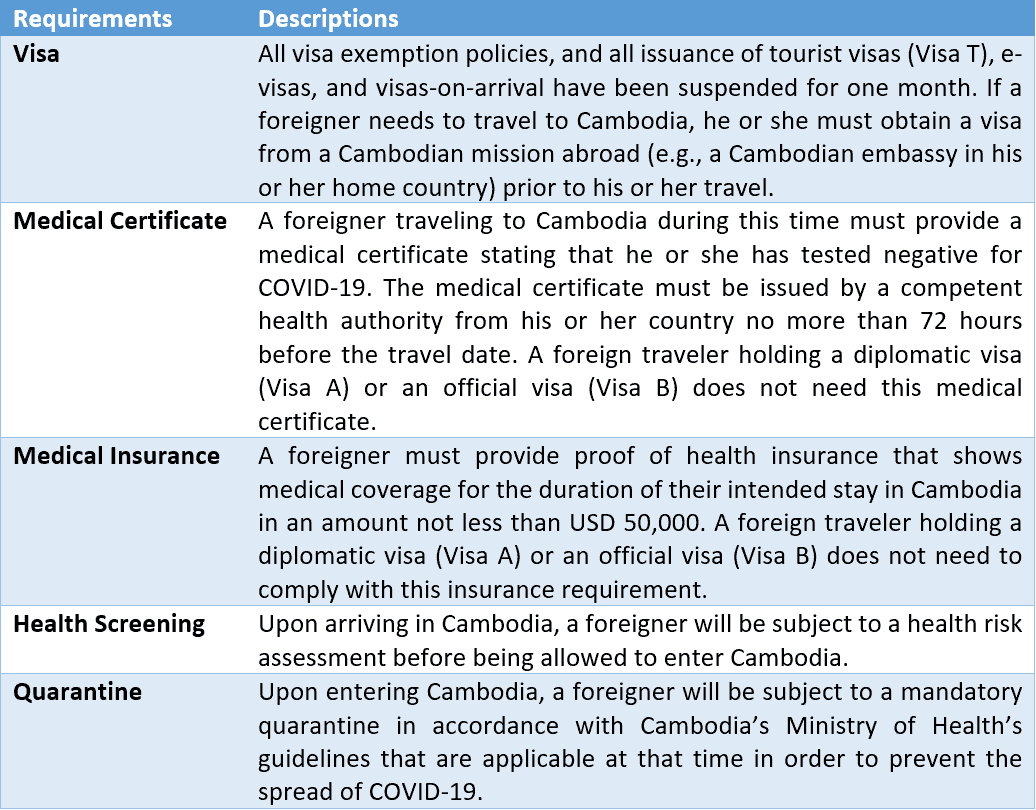
Cambodia’s Ministry of Foreign Affairs and International Cooperation notes that these requirements are temporary. The Cambodian government will review them regularly based on the current COVID-19 situation.

We would like to highlight that these travel requirements are in addition to the travel bans imposed earlier on travelers from the following six countries: France, Germany, Iran, Italy, Spain and the US as noted in our previous alert. These travel bans have been extended indefinitely until further notice, according to the Ministry of Foreign Affairs and International Cooperation’s letter on April 16, 2020.

RELATED INSIGHTS​ 

July 10, 2025
For companies and individuals doing business in Vietnam, a common question is whether electronic signatures (e-signatures) are legally recognized under Vietnamese law. This matter is governed by Law No. 20/2023/QH15 on Electronic Transactions issued on June 22, 2023 (ETL 2023) and its guiding legal documents such as Decree No. 23/2025/ND-CP dated February 21, 2025, and Circular 06/2024/TT-BTTTT dated July 1, 2024 (Circular 06). Recognition of Validity of E-signatures in Vietnam As a general principle, the ETL 2023 confirms that an e-signature cannot be denied legal validity solely due to its electronic form. The law categorizes e-signatures into three types: Type 1: Specialized e-signatures for organizations Type 2: Public digital signatures for individuals and organizations Type 3: Specialized digital signatures for government agencies Among these types, only secure specialized e-signatures (a secure e-signature of type 1) and digital signatures (type 2) are explicitly granted the same legal validity as handwritten (wet) signatures. This distinction is particularly important in legal disputes and for transactions with government agencies. (For more details, please refer to our previous article.) Domestic e-signatures A domestic organization can choose to use secure specialized e-signatures (type 1) and/or digital signatures (type 2) while a Vietnam-based individual can choose digital signatures (type 2) for their transactions—particularly for those involving government agencies and transactions of high value and complexity which require stronger legal protection. Specialized e-signatures (type 1) can be created by the organizations themselves, and additionally must be “secure” to be explicitly recognized as having the same legal validity as handwritten signatures. For clarity, “secure” specialized e-signatures are those certified (granted a safety certificate) by the Ministry of Science and Technology (MST). (This was formerly the responsibility of the Ministry of Information and Communications, which was merged with MST under Vietnam’s 2025 administrative restructuring.) Digital signatures (type 2) are
July 9, 2025
On June 16, 2025, the National Assembly of Vietnam adopted Law No. 75/2025/QH15 amending and supplementing a number of articles of the 2012 Advertising Law, with an effective date of January 1, 2026. The amended Advertising Law was enacted to further refine the legal framework for advertising activities in the modern era. Online Advertising Under the amended Advertising Law, “online advertising” is defined to encompass not only advertising on electronic newspapers and electronic information pages (as provided under the 2012 Advertising Law) but also advertising on other electronic venues, including social media, online applications, and digital platforms with internet connection. The amended Advertising Law also imposes new requirements for online advertising, including: Identification signs: Advertisements must have clear identifiable signs in numbers, letters, symbols, images, or sounds to distinguish them from non-advertising content. Control features: For advertisements not in fixed areas, there must be easily recognizable features and icons that allow recipients to turn off the advertisement, notify the service provider of violating advertising content, and refuse to view inappropriate advertising content. Linked content: Content in the links embedded in advertisements must comply with the law. Advertising service providers and publishers must have measures to check and monitor the linked content. Advertising on social media: Organizations and enterprises providing social media services must offer users features to distinguish advertising content from other content. Signage for sponsored content: When advertising, users of social media services must use signs to differentiate advertising or sponsored content from other content they provide. In response to the above requirements for online advertising, the amended Advertising Law sets out obligations of advertisers, advertising service providers, advertising publishers, and advertising conveyors in relation to online advertising. Among these, it is notably the responsibility of individuals and organizations engaging in online advertising to prevent and remove violating
July 7, 2025
On June 20, 2025, Cambodia’s Ministry of Economy and Finance issued Instruction No. 19116 to clarify when board members and company directors must receive salaries and pay payroll taxes. Board members and company directors who are not considered employees are subject to a withholding tax. This category consists of people who complete services for a nonresident individual and people who perform independent work for a company in Cambodia. Board members and company directors who are considered employees, including those appointed by a foreign head office to temporarily manage a company in Cambodia, must pay payroll taxes on any salary they receive, regardless of whether they are paid by a local or foreign branch of the company. The above obligations apply regardless of whether the person has a work permit. Board members and company directors are exempt from paying payroll tax if they: Are not present and not performing a regular management role at the company despite being registered on the company’s statutes or patent tax card; Participate only in board meetings and occasional shareholder meetings; and Do not receive a salary from a company in Cambodia. Overall, this instruction provides an important clarification regarding the tax obligations of board members and company directors. Companies should pay attention to the classification of their board members and directors and be mindful of the exemption.   This article was written with the assistance of Tilleke & Gibbins interns Amelia Gemma Erickson and Amrin Keat.
July 7, 2025
On June 27, 2025, Thailand issued the new Ministerial Regulation Prescribing the Criteria and Rates for Receiving Unemployment Benefits (No. 2) B.E. 2568 (2025), which amended a similarly named ministerial regulation by boosting the rate of social security benefits to alleviate hardships for employees who are terminated. The new ministerial regulation took effect the following day. Under this new ministerial regulation, eligible terminated employees are entitled to receive unemployment benefits under the Social Security Fund (SSF) for a maximum of 180 days per year, at the rate of 60% of the employee’s monthly wages at the time of termination, up from 50% previously. However, the maximum wage used as the basis for calculating the benefit remains capped at THB 15,000 per month. Therefore, the maximum unemployment benefit that an employee can receive from the SSF is now THB 9,000 (up from THB 7,500) per month for a period of up to six months. To qualify for the unemployment benefits from the SSF, employees must be registered with the Social Security Office and must have contributed to the SSF for at least six months within the 15 months prior to the start date of the relevant unemployment period. This new ministerial regulation was enacted to increase the amount of financial support provided to insured persons in the case of termination, as part of the government’s objective of alleviating economic hardship under current economic and social conditions in Thailand. For more details on unemployment benefits in Thailand, or on any aspect of employment law in the country, please contact Pimvimol (June) Vipamaneerut at [email protected], Dusita Khanijou at [email protected], Ketnut Pukahuta at [email protected], or Chomanut Arif at [email protected].